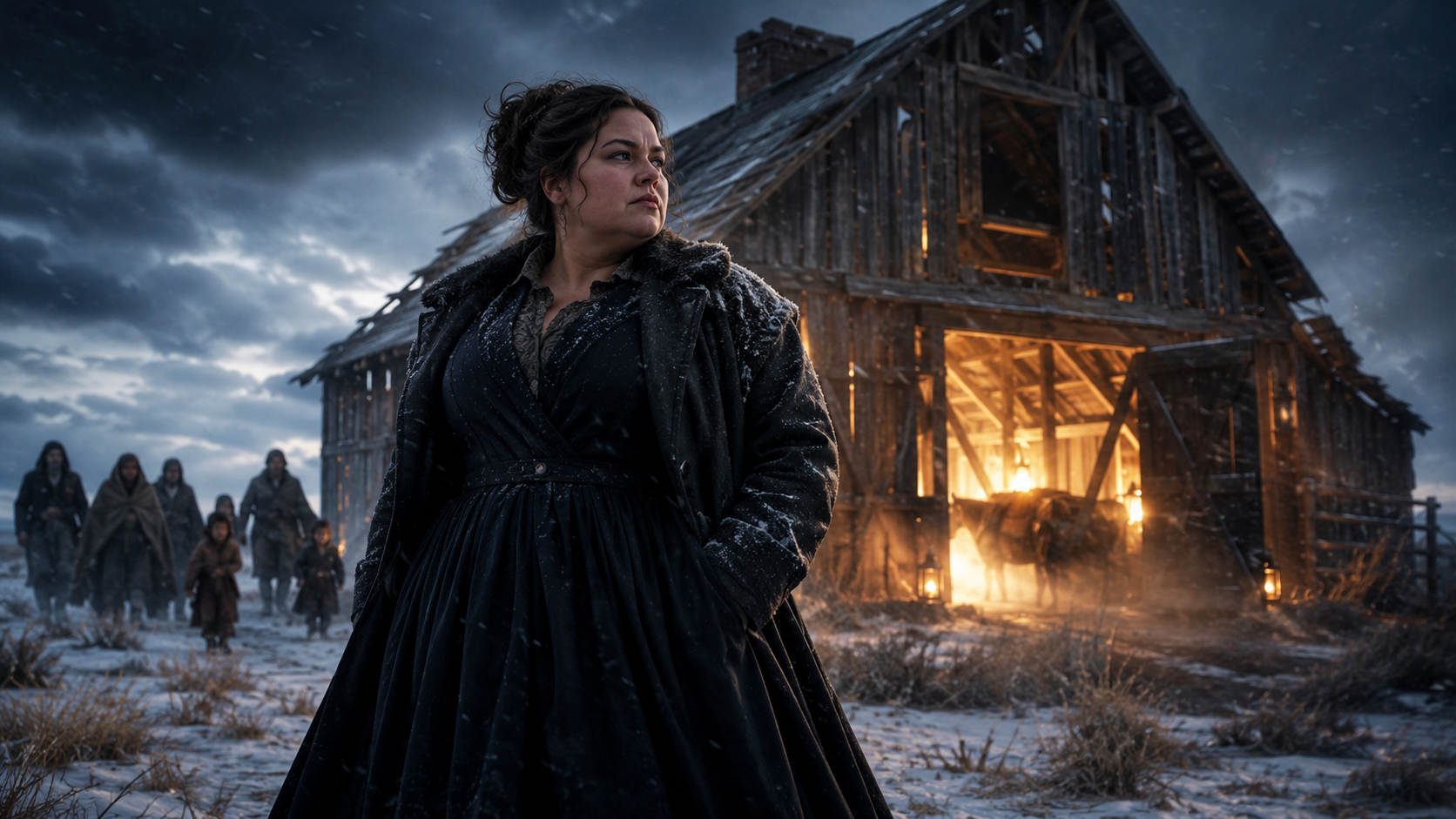
“No,” Ada said. “I find you desperate.”
Shaw stepped forward. “Ada, this spectacle only proves our concern. You have filled an unstable barn with vulnerable people. You are endangering lives.”
From behind Ada, a voice called, “She saved mine.”
A woman stepped out of the warmth. Her name was Tamsin Vale, though Ada had known her only six hours. She had come from Shaw’s charity house with a bruised wrist and a memory full of secrets.
Shaw went pale.
Tamsin looked at the gathered town and raised her voice.
“Reverend Shaw keeps a second book. Not for charity. For blackmail. He writes down who is hungry, who is afraid, who is running, and who will pay to find them.”
The barn erupted in whispers.
Shaw pointed at her. “Lies.”
Another voice answered. “No.”
An old man stepped forward, then a widow, then a stable boy, then a mother holding a sleeping baby. One by one, people spoke. Not loudly at first. But truth grows braver when it hears itself repeated.
“He took my donation and gave my sister nothing.”
“He told my husband where I was hiding.”
“Rook’s men came after I spoke to Shaw.”
“My land papers changed after the bank held them.”
Rook backed away one step.
Only one.
But Ada saw it.
Then sleigh bells sounded from the ridge.
Everyone turned.
A black carriage emerged through the snow, escorted by two federal marshals carrying lanterns. The carriage stopped beside Rook’s men. A woman stepped down in a dark traveling coat, silver hair pinned beneath a plain hat.
“I am Judge Verity Hale,” she said. “I have ridden through miserable weather and worse roads because Lillian Crowell sent me twelve years of evidence and a letter predicting that Silas Rook would attempt an unlawful seizure of this property within ten days of her death.”
No one breathed.
Judge Hale looked at Ada. “Are you Lillian’s daughter?”
Ada stepped forward. “Yes.”
“Which one?”
“The one she left the barn.”
The judge studied her for a moment.
Then she smiled faintly.
“Of course.”
Rook tried to speak. “Your Honor, this is a local estate matter—”
“It is now a federal fraud investigation,” Judge Hale said. “And if half of what I read is true, it is also conspiracy, coercion, charity fraud, unlawful confinement, witness intimidation, and attempted theft of protected water rights.”
Shaw clutched his Bible.
A marshal took it from him and shook it open.
Papers fell out.
Names.
Payments.
Locations.
The reverend sank onto the snow as if his bones had been cut.
Rook did not sink. Men like him rarely collapsed when exposed. They calculated. His eyes moved to the horses, the road, the dark beyond the lanterns.
Rowan stepped into his path.
“Going somewhere?”
Rook looked at Ada. For the first time, he did not bother smiling.
“You have no idea what you are standing in the way of.”
Ada looked past him, into the barn.
At Celestine carrying soup.
At Marnie wrapping a child’s feet.
At Tamsin standing upright.
At the townspeople warmed by her mother’s impossible mercy.
Then she looked back at Silas Rook.
“Yes,” she said. “I do.”
By morning, the storm had buried the road, but not the barn.
Smoke rose from patched vents. Warm water steamed in basins. Children woke hungry and alive. Men who had mocked Ada split wood without meeting her eyes. Women who had whispered about her size now asked where she wanted supplies stacked. The church bell hung silent. The bank doors stayed closed.
Judge Hale remained at the north parcel for three days, taking statements at the long table beneath the barn. The hidden chamber became a courtroom, a kitchen, a hospital, and a confession room. Lillian Crowell’s notebooks lay open beneath lantern light, and every page made the dead woman larger.
Not flawless.
Not gentle.
Not safe.
Larger.
Celestine apologized on the second morning.
Not with pretty words. With swollen hands, red eyes, and a full account of everything she had signed.
Marnie apologized on the third.
She cried. Ada let her.
But Ada did not rush to comfort either sister.
Some wounds deserved air before bandages.
Rowan stayed through the thaw.
He repaired the roof, then the south wall, then the broken loft ladder. He never asked to be paid. Ada paid him anyway. On the fifth week, when the snow had softened and the first mud appeared in the yard, he found her standing outside the barn at sunset.
“You could sell now,” he said.
Ada looked at him sharply.
He lifted both hands. “I am not saying you should. I am saying you could. Rook’s company is ruined. The land is worth more than anyone admitted.”
Ada watched steam drift from the cracks beneath the barn doors.
“And what would I buy with the money?” she asked.
“Comfort.”
“I have had comfort offered to me before. It usually comes with a smaller cage.”
Rowan leaned against the fence. “Then what will you do?”
Ada smiled.
It felt strange on her face. Not because she had never smiled, but because this one did not ask permission.
“I will keep the barn,” she said. “I will fix what is rotten. I will open what was hidden. I will build rooms above and keep the refuge below. I will make sure no woman, child, worker, widow, or fool with frostbitten pride has to earn warmth before receiving it.”
Rowan’s eyes softened. “Your mother would like that.”
“No,” Ada said, looking at the barn. “She would tell me the roofline is crooked and the hinges need replacing.”
He laughed then.
So did she.
By spring, people stopped calling it the rotten barn.
They called it Mercy House.
Travelers found meals there. Widows found legal help there. Children found boots there. Men who had been cruel found work there, if they were willing to take orders from Ada Crowell and keep their opinions quieter than their hammers.
The warm spring flowed beneath it all.
And sometimes, when the evening light turned the fields gold, Ada would stand in the doorway and remember the parlor, the laughter, the sentence meant to shame her.
Give the big girl the rotten barn.
They had said it like a curse.
Her mother had made it an inheritance.
And Ada, who had spent her life being told she was too much, finally understood the truth.
She had never been too much.
The world around her had simply been built too small.