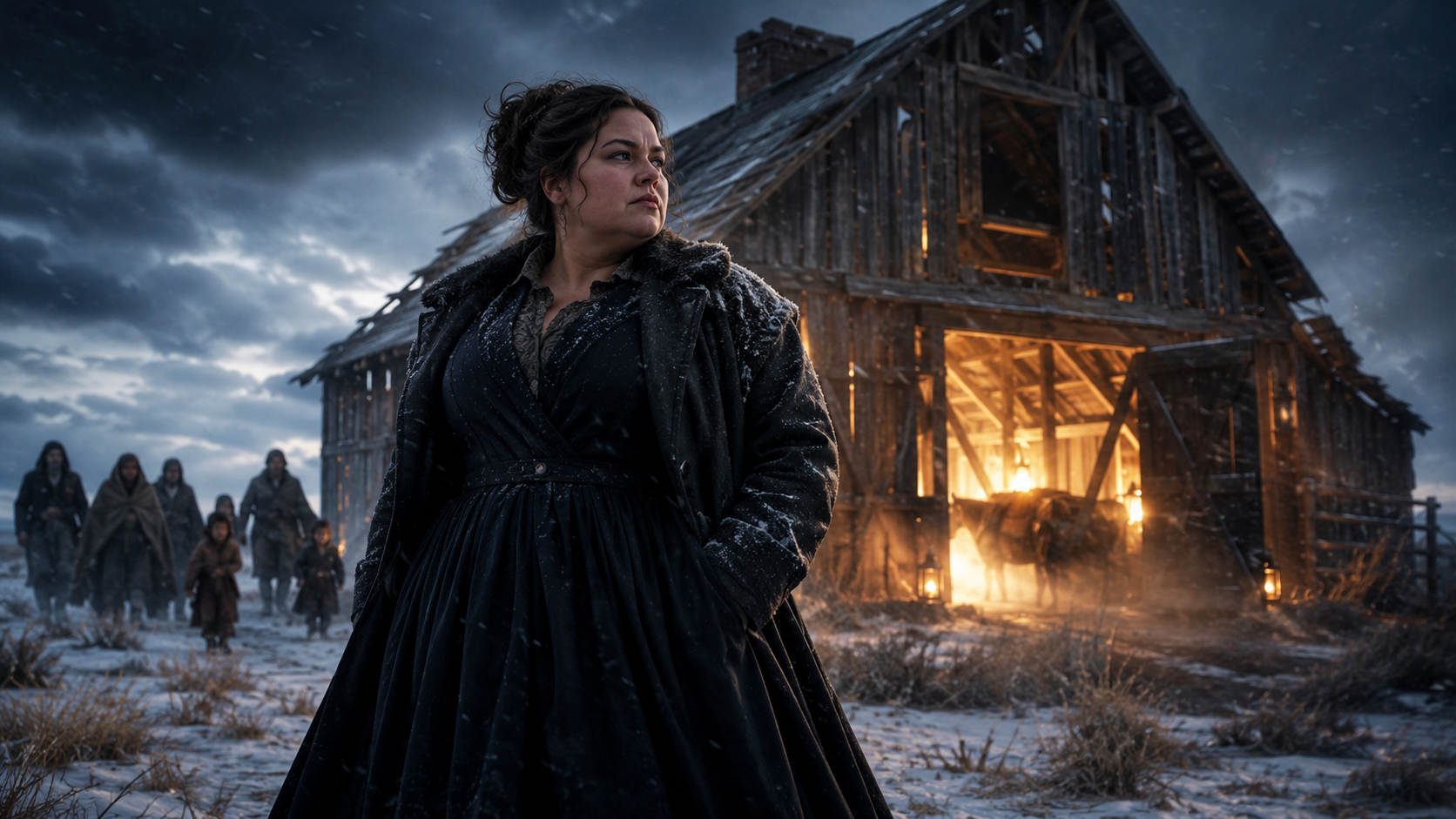
“My mother never mentioned you.”
“She would not have.”
“How convenient.”
His mouth twitched, but he did not smile. “That is fair.”
Ada lifted one of the notebooks. “You knew about this place?”
“Yes.”
“You helped her?”
“When she let me.”
“Why would she trust you?”
Rowan removed his gloves slowly. His hands were scarred, the knuckles bent from old breaks.
“When I was fifteen, I ran from a work camp north of here,” he said. “I had frost in my feet and a chain mark on my ankle. I collapsed outside this barn. Your mother brought me down here, cut the iron off me, and fed me for eighteen days. She never asked whether I deserved mercy. She only asked whether I could stand.”
Ada’s grip loosened on the pry bar.
“She never told me.”
“She kept the saved people hidden even after they were safe. That was part of the saving.”
Ada looked down at the notebooks. “There are names in here. Some coded. Some not. One name appears too often.”
Rowan’s face hardened. “Benedict Shaw.”
“The minister?”
“The minister.”
Ada turned another page. “And Silas Rook.”
“The banker.”
Outside, the wind struck the barn hard enough to make dust fall from the beams.
Rowan lowered his voice. “Rook has wanted this land for years. He knows about the warm spring, though not the chamber. He wants the water rights for a storage company tied to the new rail spur. Warm water means power in winter. Controlled water means controlled ranches. Controlled ranches mean every family in Briar Glen eventually kneeling at his desk.”
“And Shaw?”
“Shaw sells suffering twice. First from the pulpit, when he collects donations for widows and orphans. Then in private, when he gives desperate people’s names to anyone willing to pay.”
Ada felt cold in spite of the warm room.
“My mother knew.”
“Your mother had proof.”
Ada looked at the notebooks again. “Where is the proof now?”
“Some of it is here,” Rowan said. “Some of it she sent to a federal judge in Westhaven ten days before she died.”
“Did it arrive?”
“I do not know.”
Ada hated that answer because it sounded honest.
Before she could speak, a horse screamed outside.
Rowan moved first. Ada followed him up the steps, through the barn, and into the storm-gray afternoon.
A riderless horse stood near the wagon, reins dragging, foam on its neck. Tied to the saddle was a woman’s scarf.
Ada knew the scarf.
Marnie’s.
She untied it with numb fingers.
Inside the knot was a scrap of paper, torn from hotel stationery.
Ada, I did something foolish. Rook knows about the will. He has papers. He says you are unfit. He says by tomorrow the barn will not be yours. Do not come to town alone.
No signature.
It did not need one.
Ada folded the paper and put it in her pocket.
Rowan watched her. “What will you do?”
For years, Ada had answered that question in the way people expected. She had lowered her voice, lowered her eyes, lowered herself. She had stepped aside in doorways. She had laughed at jokes that cut her. She had pretended not to notice when chairs were pulled away or plates were counted.
But beneath her feet was a hidden refuge her mother had built in secret.
Behind her were shelves of supplies bought with sacrifice.
Ahead of her was a town about to freeze under a storm and a lie.
Ada climbed onto the wagon.
“I am going to Briar Glen,” she said.
Rowan frowned. “That is exactly where Rook wants you.”
“No,” Ada said. “He wants me ashamed. There is a difference.”
The town was busy pretending not to watch when Ada drove in.
Men paused outside the livery. Women looked from shop windows. Children whispered and were hushed. The sky hung low and ugly over the street, promising a storm large enough to erase roads.
Ada stopped in front of Pennick’s office.
Celestine came out before Ada could climb down. Her cheeks were pale, her mouth tight.
“Ada,” she said. “We need to discuss the property.”
“Which property?”
“The north parcel. Be reasonable. You cannot maintain it. Mr. Rook is prepared to make a generous offer before the land becomes a danger to everyone.”
Ada looked past her sister.
Across the street, Silas Rook stood on the bank steps in a black coat trimmed with fur. He was smiling. Beside him stood Reverend Benedict Shaw, his silver hair shining beneath his hat, one hand resting on a Bible as if God were something he kept for balance.
Ada turned back to Celestine.
“What did you sign?”
Celestine blinked.
“What did you sign?” Ada repeated.
Her sister’s composure cracked.
“I signed a concern statement,” Celestine whispered. “Only a statement. Mr. Rook said it would protect the estate from mismanagement.”
“Mismanagement by whom?”
“Ada—”
“Say it.”
Celestine’s eyes filled, but Ada did not look away.
“By you,” Celestine said.
A hot, clean anger moved through Ada, but she held it still.