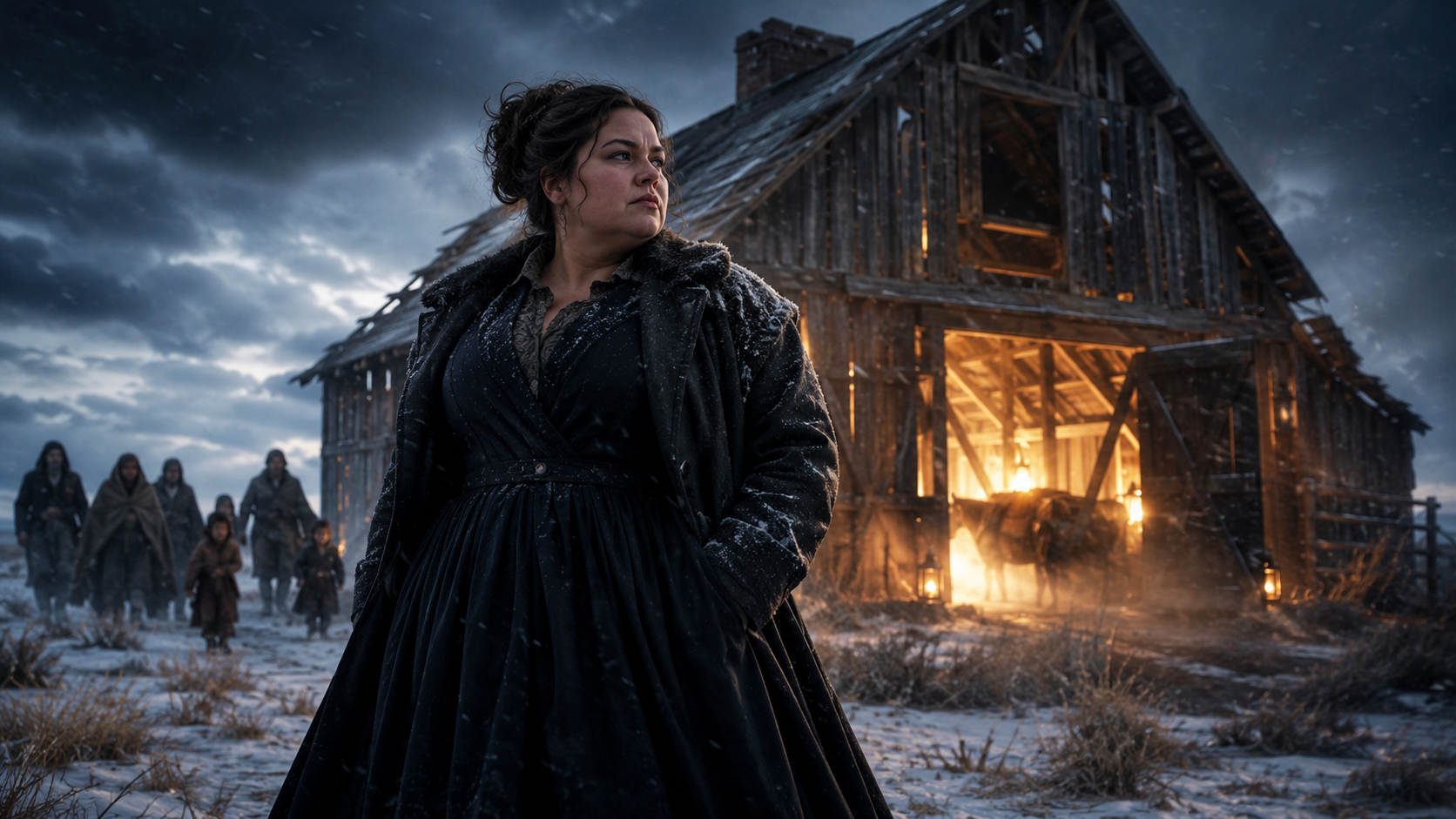
Now Lillian was in the ground.
And the barn belonged to Ada.
She climbed down from the wagon, boots sinking into snow crust. The cold bit through her coat. A loose shutter banged against the wall in the wind, slow and hollow, like a knock from someone too tired to insist.
Inside, the barn smelled of dust, old straw, pine pitch, and mice. Faint light came through cracks in the siding. The stalls were empty. The loft ladder was broken. A rusted plow leaned in one corner, half buried in hay.
“A fine inheritance,” Ada muttered.
Then she felt it.
Warmth.
Not from the stove; there was no stove. Not from sun; the sky was iron. It rose through the floorboards in the center aisle, soft but steady, like the breath of some sleeping animal beneath the earth.
Ada took off one glove and pressed her palm against the boards.
The wood itself was cold.
But between the planks, heat slipped upward.
Her heart began to pound.
She searched the walls, the stalls, the corners. On the third post from the back, half hidden behind a strip of old harness leather, hung a pry bar. It had been oiled recently. Not yesterday, perhaps, but not years ago either.
Ada stared at it.
Her mother had left her the barn.
Her mother had left her the tool.
Her mother had left her the word below.
All contents above and below the structure.
Ada took down the pry bar.
The first board resisted. The second cracked. By the fifth, she found the iron ring set into a trapdoor so cleverly fitted that straw and dust had hidden it completely. It took all her weight to lift it. The hinges groaned. Warm air rushed up and wrapped around her face.
Below, stone steps descended into darkness.
Ada lit the lantern she had brought from the wagon.
Then she went down.
The chamber beneath the barn was not a cellar.
It was a world.
The walls had been reinforced with stone and timber. Shelves stretched from one end to the other, packed with flour, beans, preserved fruit, candles, lamp oil, blankets, wool socks, boots, coats, medicines, bandages, tools, rope, seed sacks, and locked boxes marked with symbols Ada did not understand. A narrow channel of steaming water ran along the far wall and emptied into a stone basin.
Ada knelt beside it.
The water was warm.
Clear.
Alive.
In the center of the chamber stood a long table. On it lay a stack of leather-bound notebooks, a tin cup, a folded quilt, and a letter addressed in her mother’s unmistakable hand.
Ada sat down slowly.
The letter contained only nine words.
Ada, when they laugh, let them. Then look deeper.
For the first time since the funeral, Ada wept.
Not loudly. Not prettily. She bent over the table with her hand pressed to her mouth while the secret room blurred in the lantern light. Her mother had known. She had known they would mock her. She had known Ada would be humiliated, dismissed, underestimated. She had built the insult into the trap.
When Ada could breathe again, she opened the first notebook.
Three hours later, the woman who climbed out of that hidden room was not the same woman who had gone down.
Lillian Crowell had not been careless with money.
She had been saving lives.
For twelve years, her mother had used the north barn as a refuge. Women escaping violent men. Children sent away from mining camps swallowed by fever. Farmhands cheated out of wages. Widows threatened with false debts. Girls who had answered advertisements for work and found locked doors waiting. Lillian had hidden them beneath the barn, warmed them, fed them, clothed them, and sent them onward with new names, train fare, and instructions written in code.
The debt everyone mocked had bought tickets.
The missing silver had bought medicine.
The late nights had carried people through snow.
And the warm spring beneath the barn had kept them alive.
Ada read until the lantern burned low.
Then a floorboard creaked above her.
She froze.
Another step.
Slow.
Deliberate.
Ada grabbed the pry bar and stood at the foot of the stairs.
A man appeared in the opening above, his hat in one hand and snow on his shoulders. He was tall, dark-haired, and lean in the way of men who had survived on less food than pride. A pale scar crossed his brow and disappeared near his temple.
“I am armed,” Ada said.
The man looked at the pry bar. “So I see.”
“This is private property.”
“Yes, ma’am.”
“Then you are trespassing.”
“Yes, ma’am.”
His calm annoyed her almost as much as his trespass.
“Come down where I can see you properly,” Ada said. “Or leave before I decide which part of you to break first.”
The man hesitated, then descended.
When his boots touched the chamber floor, he did not look at the shelves first. He looked at the water. Then at the table. Then at the notebooks.
His face changed.
Not with greed.
With sorrow.
“My name is Rowan Hale,” he said. “Your mother asked me to come if the barn passed to you.”