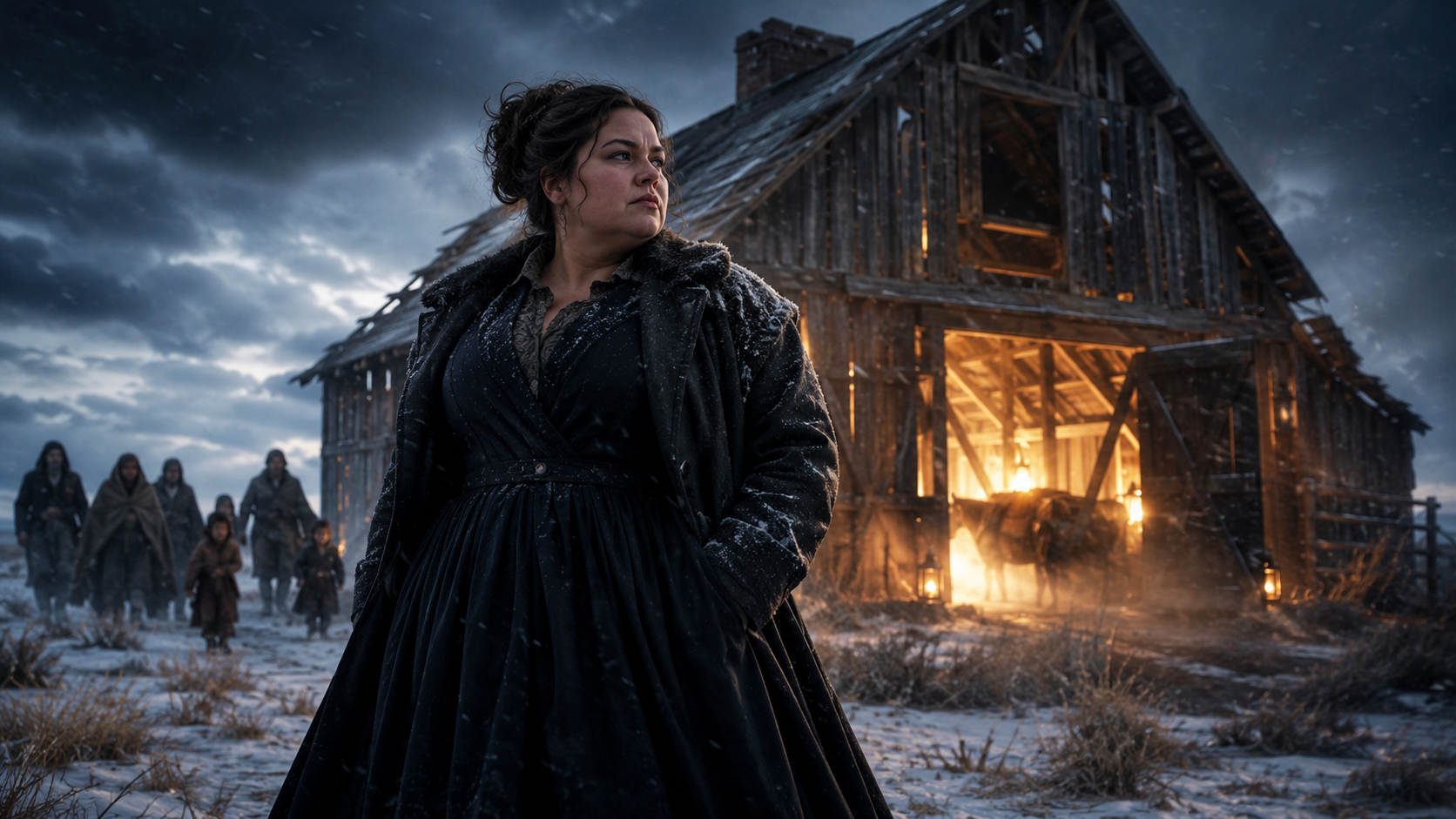
The day they read the will, the whole family learned what kind of cruelty could wear black gloves.
Ada Crowell sat at the far end of the parlor in a chair too narrow for her hips and too delicate for her grief. The wallpaper behind her was patterned with little blue flowers, the same flowers her mother had once called “too polite to survive winter.” Outside, snow pressed against the windows of the Crowell house like a crowd trying to listen.
Her sisters sat close to the fire.
Celestine, the oldest, wore a mourning dress with pearl buttons and a face arranged for sympathy. She had always known how to look wounded without losing her beauty. Beside her, Marnie dabbed her eyes with a handkerchief that had not absorbed a single tear. Their husbands stood behind them, solemn as fence posts, already measuring what could be sold, divided, mortgaged, or blamed on Ada.
Ada said nothing.
She had learned long ago that silence made people nervous. They expected her to apologize for taking up space, for breathing loudly, for eating, for sweating, for being the daughter whose body did not fold neatly into rooms designed by smaller people. When she was a girl, her sisters called her “the ox.” When she became a woman, they improved their cruelty with lace.
Big-boned, they said in public.
Unfortunate, they whispered in kitchens.
Useful, their mother had said.
That was the only word Ada kept.
Lillian Crowell had died four days earlier during the first hard freeze of December. She had gone the way she had lived: privately, stubbornly, with unfinished work on the table and a kettle singing in the next room. She left behind debts, land, three daughters, and more questions than comfort.
Mr. Pennick, the town solicitor, unfolded the will with fingers that trembled slightly. He was a thin man with a nervous mouth and a habit of clearing his throat before bad news.
“To my eldest daughter, Celestine Wray, I leave the south pasture, the main house, and the household furnishings, excluding those items specifically named elsewhere.”
Celestine bowed her head as if receiving a blessing.
“To my youngest daughter, Marnie Bell, I leave the river meadow, the two milk cows, the silver service, and the contents of the east pantry.”
Marnie let out a soft little sob. Her husband squeezed her shoulder, already smiling with one corner of his mouth.
Ada kept her hands folded.
Mr. Pennick swallowed.
“To my middle daughter, Ada Crowell, I leave the north parcel, including the old winter barn, the dry slope, the abandoned well, and all contents above and below the structure.”
For a heartbeat, no one moved.
Then Marnie laughed.
She tried to stop it, covering her mouth with her handkerchief, but the sound had already escaped. Celestine turned her face toward the fire, shoulders shaking once. One of the husbands coughed into his fist.
“The old winter barn?” Celestine said at last, her voice sweet enough to rot teeth. “Mama left Ada the dead barn?”
“It is legally described as the north parcel,” Mr. Pennick said.
Marnie leaned toward Ada. “At least it’s large enough for you, dear.”
The room went still, waiting to see whether Ada would break.
She had broken before. Quietly. In pantries, in haylofts, behind wash lines, under quilts. She had broken so often in secret that people thought she never felt anything at all. But grief had done something strange to her. It had hollowed her out until insults passed through without finding enough flesh to stick.
Ada looked at her sisters.
“If Mama left it to me,” she said, “then she had a reason.”
Celestine smiled. “Yes. She knew you were the only one sentimental enough to keep a collapsing barn.”
“No,” Ada said. “She knew I was the only one strong enough to open it.”
That ended the laughter for a moment.
But only for a moment.
By noon, half of Briar Glen knew what Lillian Crowell had done. By sundown, nearly everyone had an opinion. Ada heard the whispers as she drove her wagon through town with her mother’s old trunk tied behind the seat.
There goes the barn queen.
Give the big girl the big ruin.
Maybe she can sleep with the horses.
She kept her eyes forward.
The north parcel lay beyond the last line of houses, past the cemetery ridge and the frozen creek. It had once been the first place travelers saw when they came into Briar Glen from the mountains. Now it stood alone under a bruised winter sky, its roof sagging in the middle, its boards weather-gray, its doors hanging crooked from iron hinges.
Ada pulled the wagon to a stop.
For years she had avoided this place. Not because it frightened her, but because her mother had always told her, “Leave the north barn alone unless I send you there.”
Ada had obeyed. She had obeyed even when she became old enough to wonder why her mother spent so many nights riding out here with sacks tied to the saddle. She had obeyed when she found mud on Lillian’s boots during dry weeks. She had obeyed when strangers appeared in town and disappeared before sunrise.