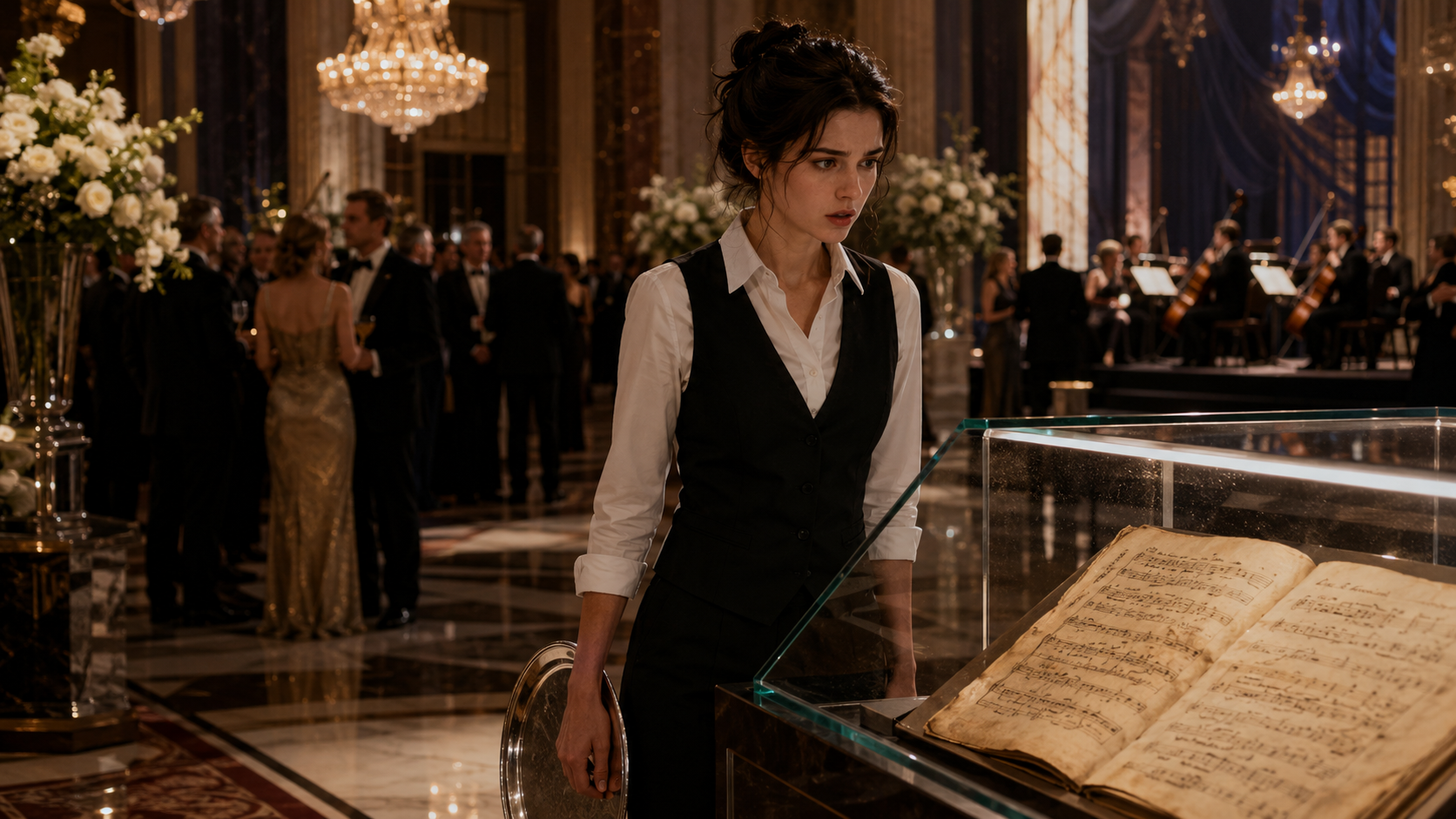
Theodore returned to his cello.
“Begin at the final variation,” she told the orchestra.
The conductor did not move.
Dr. Wynn called from the floor.
“Maestro, give her your baton.”
Reluctantly, he handed it to Lena.
It felt lighter than she expected.
Her mother had never owned a real conductor’s baton. She had used pencils, knitting needles, wooden spoons, and once a rolled-up electricity bill.
Lena lifted her arms.
“Cellos alone for the first four measures. Violas enter beneath them. The violins should sound distant, almost like something being remembered incorrectly.”
The musicians exchanged glances.
Then Theodore placed his bow against the strings.
The first note filled the ballroom.
Low.
Warm.
Uncertain.
The violas joined.
Lena’s hands moved without hesitation. The orchestra responded slowly at first, then with growing confidence. A melody unfolded through the room, fragile as a voice traveling across water.
People lowered their glasses.
Waiters stood motionless beside the walls.
Kitchen staff watched through the service doors.
Lena guided the music toward the unfinished passage.
The melody climbed.
The violins reached the final written measure.
Then the orchestra stopped.
The silence that followed felt like the edge of a cliff.
Lena lowered the baton.
“This is where the auction manuscript ends,” she said.
Damian called from the floor.
“Because the composer never finished it.”
“My mother finished it eleven years before she died.”
“Then where are the pages?”
“She never wrote them down.”
A murmur moved through the guests.
Damian smiled.
“So there is no proof.”
“The ending was a promise between us.”
Lena turned toward the orchestra.
“When I was a child, I was afraid of thunderstorms. My mother created a melody to calm me. Four notes descending, three notes rising. She hid that melody throughout the symphony.”
Theodore’s eyes filled with recognition.
“I remember,” he said. “She called it the lantern theme.”
Lena nodded.
“She told me the symphony could not end until the lantern found its way home.”
She raised the baton again.
“Follow me.”
The orchestra waited.
Lena breathed in.
Then she began to conduct the unwritten coda.
The cellos introduced the four descending notes.
The violins answered with three rising notes.
Woodwinds carried the melody upward. The harmony widened, growing brighter with each repetition. What had begun as a private lullaby became a storm of sound.
Lena heard the music exactly as her mother had imagined it.
She remembered sitting beneath the piano while Miriam played.
She remembered her mother saying that music was not a monument built for important people.
It was a door.
Anyone could walk through it.
The orchestra reached the final progression.
Lena gave the signal.
Every instrument joined the lantern theme.
The sound filled the ballroom with such force that the glass pendants of the chandeliers trembled.
Then Lena closed her fist.
The final note vanished.
No one moved.
Theodore was the first to stand.
He placed his cello beside the chair and began applauding.
The other musicians followed.
Then the hotel employees near the service doors.
Then the guests.
Within seconds, the entire ballroom was on its feet.
Lena remained on the podium, holding the baton at her side.
Damian was not applauding.
“A performance proves nothing,” he said.
Theodore turned toward him.
“It proves she knows music that was never included in your manuscript.”
“She could have invented that ending.”
“She did not.”
Theodore opened his cello case and removed a yellow envelope.
“I brought this tonight because I believed the auction catalogue contained an error. I did not realize the error was deliberate.”
He carried the envelope to Dr. Wynn.
Inside were three photographs, an old rehearsal programme, and a small cassette tape.
The first photograph showed Miriam Marlowe sitting at a piano.
On the stand before her was the first page of the symphony.
The blue stain was clearly visible.
The second showed Theodore and Miriam rehearsing the fourth movement.
The third showed a teenage Lena asleep beneath the piano while her mother wrote music above her.
The rehearsal programme listed the work under its original title:
The Lantern Sea, composed by Miriam Marlowe.
Theodore held up the cassette.
“This is a recording of our final rehearsal. Miriam speaks at the beginning. She explains the lantern theme and says the completed work belongs to Lena.”
Victor Crane sat down heavily.
Everyone looked at him.
Damian approached his father.
“Say something.”
Victor stared at the manuscript.
After a long silence, he spoke.
“Celeste bought several boxes at an estate auction many years ago. She found the score inside one of them.”
Lena stepped down from the podium.