“Why is her name on it?”
Victor closed his eyes.
“She admired the work. She planned to donate it anonymously.”
Damian interrupted.
“My mother is not here to defend herself.”
Victor looked at his son.
“Your mother never claimed she composed it.”
The words struck the room harder than a shout.
Damian’s face changed.
Victor continued.
“The attribution was added this year.”
Dr. Wynn turned toward Damian.
“By whom?”
He said nothing.
She repeated the question.
“By whom, Mr. Crane?”
Damian looked around the ballroom. Cameras were recording. Donors whispered to one another. Members of the trust board stepped away from him.
Finally, he answered.
“My office prepared the catalogue.”
Victor stared at his son.
“You knew?”
“I knew there were questions about the manuscript.”
“You placed your mother’s name on another woman’s work.”
“I was protecting the family.”
“No,” Lena said. “You were protecting a story that made your family look generous.”
Damian faced her.
“You have no idea what it takes to maintain an institution like this.”
“I know exactly what it costs when institutions decide some names matter more than others.”
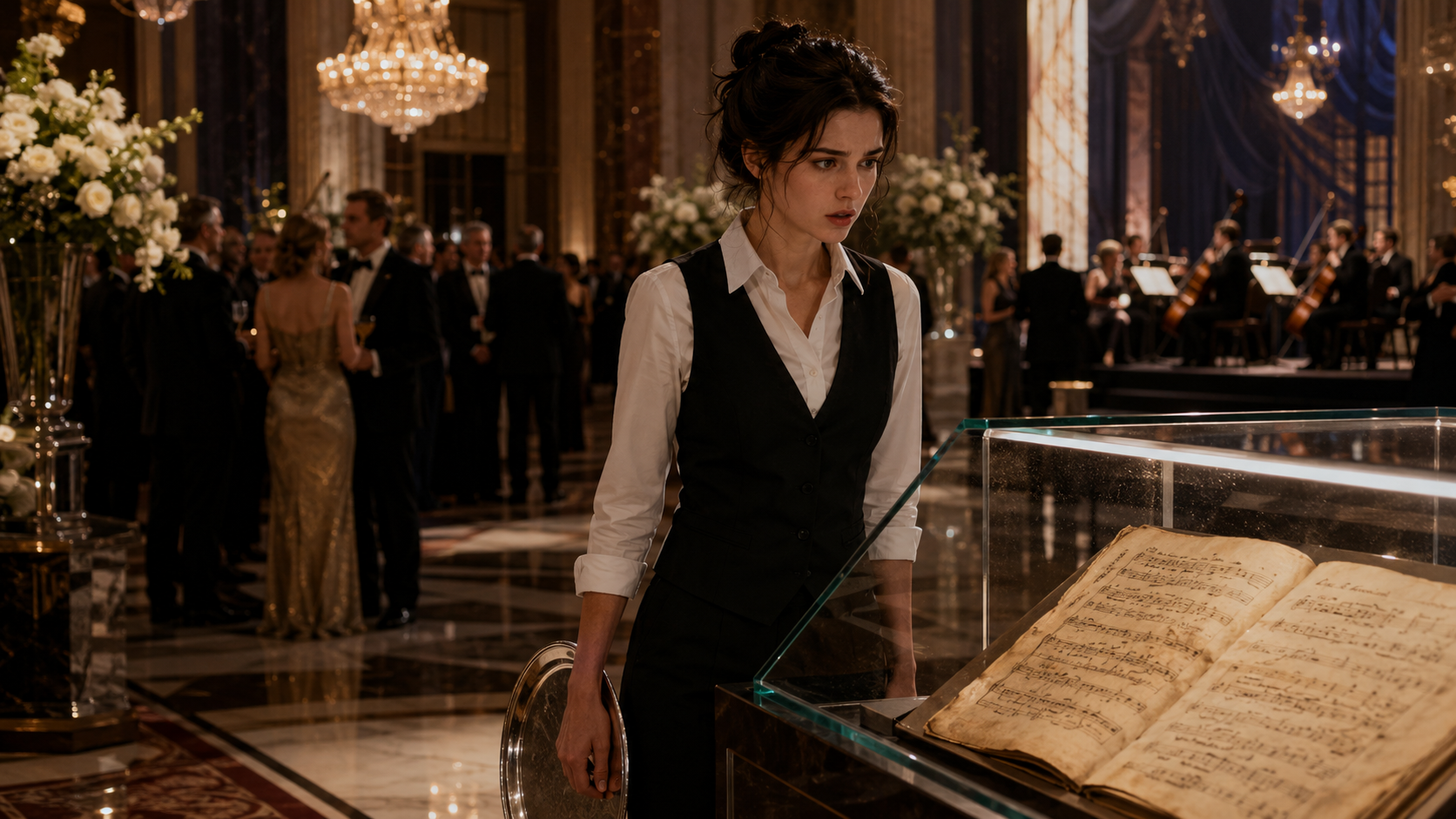
Dr. Wynn closed the auction catalogue.
“The sale is cancelled.”
Damian took a step toward her.
“You cannot do that.”
“I just did.”
She instructed security to seal the manuscript case and transfer it to independent conservators.
Then she addressed the guests.
“The Bellwether Arts Trust will conduct a formal provenance investigation. Until it is complete, the Crane family will have no authority over the collection or tonight’s funds.”
Damian looked toward his father.
Victor did not defend him.
One by one, members of the board removed the small gold Crane Foundation pins from their clothing and placed them on the nearest table.
Damian walked toward the ballroom doors.
Lena called after him.
He stopped.
“You spoke to me as though my uniform told you everything about my life,” she said. “Even if my mother had never written a note, you would still have been wrong to treat me that way.”
Damian opened his mouth.
No answer came.
He left the room.
The clock above the entrance showed eleven fifty-eight.
Dr. Wynn approached Lena.
“At midnight, we were supposed to announce the construction of the Crane Concert Hall.”
Lena looked toward the hotel workers gathered beside the service doors.
“What will you announce instead?”
“I was hoping you might tell me.”
Lena thought about her mother.
Miriam had spent her life composing between temporary jobs. She taught children whose parents could not afford lessons. She wrote music in borrowed rooms. She died believing that her greatest work would never be heard.
Lena looked at the manuscript beneath glass.
“Do not build another hall with a wealthy person’s name on it.”
The room remained quiet.
“Use the money to find artists whose work has been lost, stolen, or ignored. Restore their names. Pay for instruments. Pay for rehearsal rooms. Pay people while they create, so they do not have to choose between art and rent.”
Dr. Wynn smiled.
“That sounds less like a building.”
“It sounds more useful than one.”
The grandfather clock began to strike midnight.
Dr. Wynn walked onto the stage and took the microphone.
She announced that the auction had been cancelled. She promised an independent investigation and the immediate return of the manuscript to Miriam Marlowe’s estate.
Then she revealed the creation of the Lantern Archive, a programme dedicated to recovering misattributed work and supporting artists from families without institutional influence.
The first recovered composition would be The Lantern Sea.
The first public performance would take place in three months.
Admission would be free.
Dr. Wynn invited Lena to lead the project.
Lena accepted one condition.
Every hotel employee who had worked the gala would be invited to the premiere as an honored guest.
Not through the service entrance.
Not in the upper balcony.
Through the front doors.
The applause that followed was louder than anything the auction organizers had planned.
At two in the morning, after the donors and photographers had gone, the Bellwether Ballroom looked entirely different.
The expensive flowers remained, but the formal table arrangements had disappeared.
Cooks sat beside violinists.
Dishwashers ate cake beneath the chandeliers.
Housekeepers drank coffee from porcelain cups.
Security guards tested the acoustics by clapping at different corners of the room.
Lena sat at the grand piano with Theodore beside her.
Saira approached carrying two plates of untouched chocolate dessert.
“I suppose this means you are quitting,” she said.
Lena smiled.
“Not tonight.”
She played the four descending notes of the lantern theme.
Theodore answered by singing the three rising notes badly and without embarrassment.
The people around them laughed.
Then Lena began again.
This time, the room joined her.
Some hummed.
Some sang.
Some simply listened.
Outside, snow drifted between the buildings.
Inside, the music no longer belonged to the family with the largest donation, the most influential friends, or the most impressive name.
It belonged to the woman who had written it.
It belonged to the daughter who remembered it.
And for the first time in thirty years, the lantern found its way home.