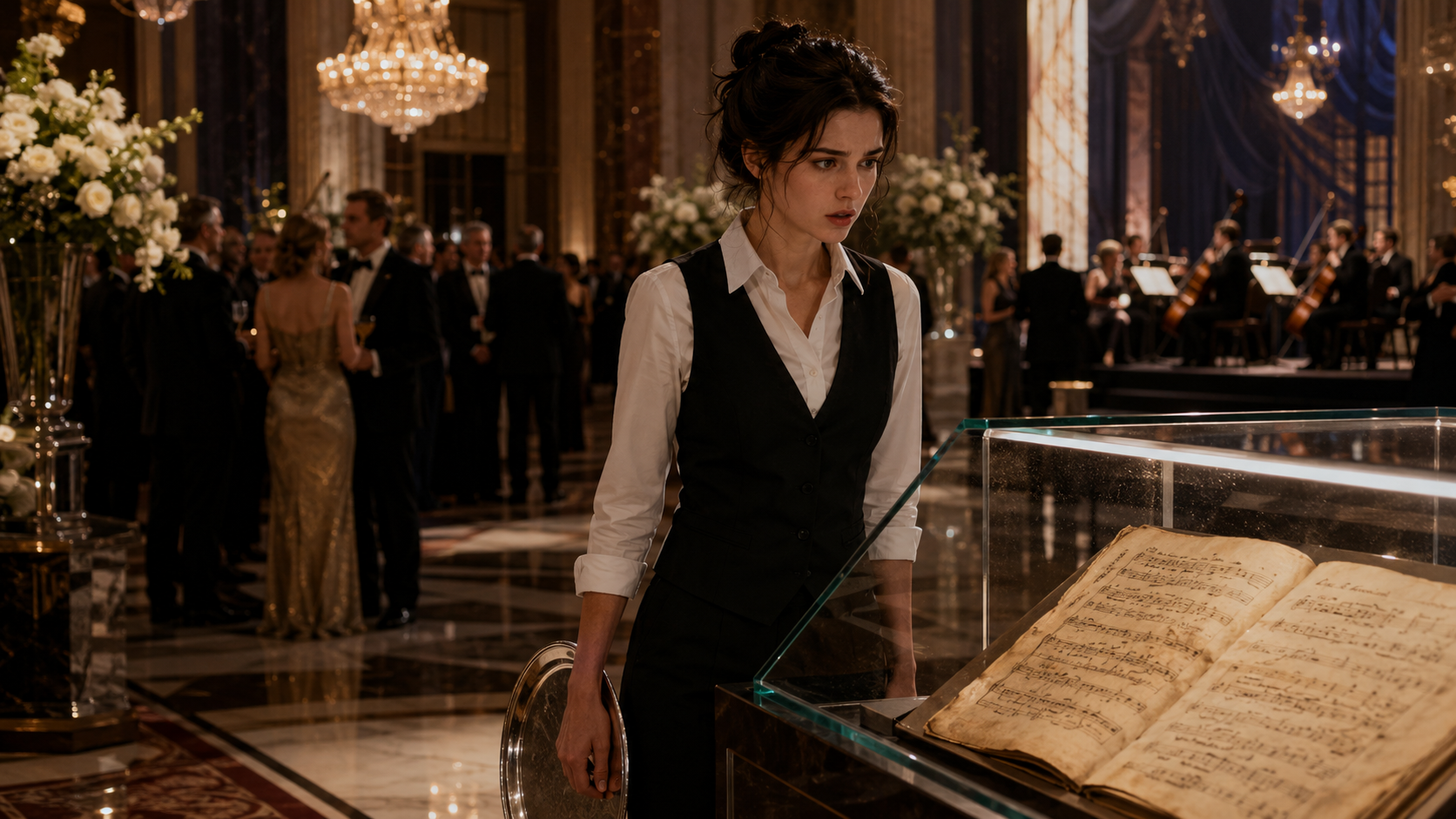
Lena looked at him.
“My mother wrote that symphony.”
For the first time, Damian had no immediate answer.
The presenter stared at Lena. The cameraman slowly raised his camera again.
Damian noticed and pointed toward the exit.
“Both of you, leave.”
Then he turned back to Lena.
“Your mother?”
“Miriam Marlowe.”
The name seemed to reach someone on the stage.
An elderly cellist stopped playing.
The music collapsed around him.
The conductor struck his music stand with the baton.
“Mr. Brand?”
The cellist rose slowly from his chair.
His name was Theodore Brand. He had performed with major orchestras for nearly five decades. Lena knew his face from old photographs stored inside a cardboard box beneath her childhood bed.
Theodore stepped off the stage.
“Who said Miriam Marlowe?”
Lena’s throat tightened.
“I did.”
He approached her, studying her face.
Then his eyes widened.
“You’re Lena.”
She nodded.
Theodore covered his mouth with one hand.
“I haven’t seen you since your mother’s funeral.”
Damian moved between them.
“Mr. Brand, this employee is making an absurd accusation.”
Theodore ignored him.
He looked through the glass case at the manuscript.
“Where did this come from?”
“My father purchased it legally,” Damian said. “It was found among my mother’s private papers after her death.”
Theodore leaned closer to the glass.
“That is Miriam’s handwriting.”
Several musicians left the stage and gathered nearby.
The guests began noticing the disturbance. Conversations faded. Heads turned. Phones appeared.
Damian’s father stood near the center table.
Victor Crane was nearly seventy, with silver hair and the tired posture of a man who had spent decades pretending that control and peace were the same thing.
He approached the display.
“What is happening?”
Damian spoke before anyone else could.
“A member of the hotel staff claims Mother stole the auction manuscript.”
Lena faced Victor.
“Did your wife ever tell you where she found it?”
Victor looked at the score.
“She said it had been given to her by a composer who wished to remain anonymous.”
“My mother never met your wife.”
“You cannot possibly know that.”
“I was there when my mother wrote every movement.”
Damian laughed.
“You would have been a child.”
“I was.”
“That is not evidence.”
“No,” Lena said. “But the music is.”
Damian turned to Saira.
“Remove her.”
Saira hesitated.
Theodore stepped beside Lena.
“Do not touch her.”
Damian’s face hardened.
“This is my family’s event.”
“No,” said a new voice. “It is the foundation’s event.”
Dr. Beatrice Wynn, chairwoman of the Bellwether Arts Trust, emerged from the crowd. She was small, silver-haired, and dressed in a dark green gown. Unlike the other guests, she wore no jewelry.
She looked at Lena.
“You believe you can prove authorship through the music?”
“Yes.”
“How?”
Lena pointed toward the stage.
“Let the orchestra play the fourth movement.”
The conductor shook his head.
“We have not rehearsed it. The final pages are incomplete.”
“They are not incomplete.”
He frowned.
“The manuscript ends in the middle of the coda.”
“That is because those are not the final pages.”
Damian folded his arms.
“And I suppose you conveniently know the missing ending.”
Lena met his eyes.
“I do.”
The ballroom became silent.
Dr. Wynn considered her for several seconds.
“Take the stage.”
Damian turned toward her.
“You cannot be serious.”
“The manuscript is being sold under the authority of this foundation. If its provenance is being challenged, we have a duty to investigate.”
“By allowing a waitress to conduct an orchestra?”
Lena removed her black service jacket.
Underneath, she wore the hotel’s plain white shirt.
“I don’t need anyone to believe me before I begin.”
She placed the jacket over a chair.
“I only need them to listen.”
Lena walked toward the stage.
Every step awakened a memory.
Her mother at the piano before sunrise.
Her mother writing music at the kitchen table because the apartment was too cold in the practice room.
Her mother conducting an imaginary orchestra with a wooden spoon while soup boiled on the stove.
Her mother coughing into a handkerchief and hiding the blood before Lena could see it.
After Miriam died, unpaid medical bills consumed everything the family owned. The piano was sold. The apartment was emptied. Boxes of manuscripts disappeared after the storage company auctioned their belongings.
Lena had been sixteen.
For years, she believed the symphony had been destroyed.
Then, six weeks earlier, she saw a photograph of the Bellwether auction catalogue.
The blue stain was visible in the corner.
She applied for a temporary position at the hotel the following morning.
Lena reached the conductor’s podium.
The musicians watched her with uncertainty.