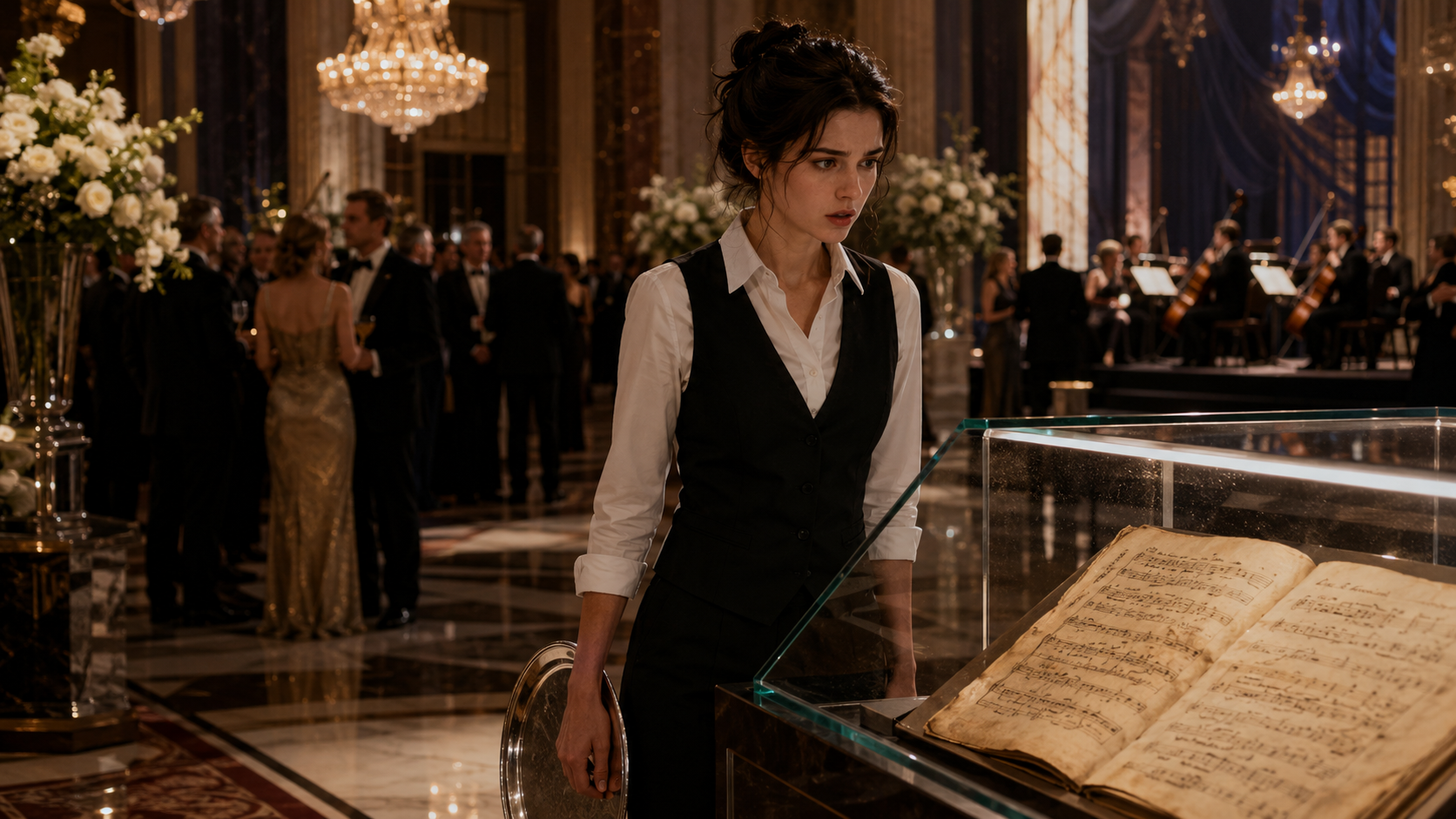
The first wrong note appeared at exactly nine seventeen.
Almost no one in the Bellwether Ballroom noticed it.
The guests were too busy admiring one another beneath the crystal chandeliers. Politicians compared invitations. Investors spoke in lowered voices about acquisitions. Women in silk gowns raised glasses beneath clouds of white winter flowers. Photographers moved between the tables, capturing diamonds, handshakes, and practiced smiles.
But Lena Marlowe heard the mistake immediately.
She stopped beside a table of empty dessert plates, balancing a silver serving tray against her shoulder.
On the stage, a twelve-piece chamber orchestra continued rehearsing the music that would open the midnight auction. The melody was elegant and melancholy, rising slowly through the violins before passing into the deeper voices of the cellos.
Then the second violin entered one beat too early.
Lena’s fingers tightened around the tray.
“Measure forty-three,” she whispered.
The orchestra continued.
The conductor frowned but did not stop them. Perhaps he had not heard it. Perhaps he had heard it and decided the error was too small to matter during a private rehearsal.
To Lena, it mattered.
Every note mattered.
She carried the tray through the ballroom, placed the plates inside the service station, and forced herself to keep moving.
She had accepted the banquet shift for one reason only.
At midnight, the Bellwether Arts Trust planned to auction the original handwritten score of a forgotten symphony called Dawn Over Ashwater. According to the gala catalogue, the work had been composed thirty years earlier by Celeste Crane, the late wife of industrialist Victor Crane.
The manuscript was expected to sell for more than two million dollars.
The proceeds would fund a new concert hall bearing the Crane family name.
There was only one problem.
Celeste Crane had not written the symphony.
Lena’s mother had.
The manuscript was displayed inside a glass case near the ballroom entrance. Lena had already passed it six times while carrying trays of champagne.
Each time, she had seen her mother’s handwriting.
The narrow musical symbols.
The long tails on the eighth notes.
The tiny circles drawn around passages that needed revision.
Even the faded blue stain in the lower corner of the first page was familiar. Lena had caused it when she was seven years old by knocking over a cup of paint beside her mother’s piano.
She remembered crying.
Her mother, Miriam, had laughed and kissed the top of her head.
“Now the music has a little piece of you in it,” she had said.
Twenty-three years later, that same stain sat beneath museum glass while wealthy strangers praised the generosity of the Crane family.
“Server.”
The sharp voice came from behind her.
Lena turned.
Damian Crane stood beside the display case.
He was Victor Crane’s only son and the public face of the family foundation. His tailored tuxedo fit perfectly. His dark hair had been arranged to appear effortless. A television presenter stood at his side, holding a microphone while a cameraman adjusted his position.
Damian looked at the empty glasses on Lena’s tray.
“Table twelve has been waiting for champagne.”
“I’ll take care of it.”
His attention shifted to the manuscript.
“You’ve been staring at this all evening.”
Lena said nothing.
Damian smiled toward the camera.
“She probably thinks sheet music is decorative handwriting.”
The presenter gave a polite laugh.
Lena looked through the glass at the first page.
“The tempo marking has been changed.”
Damian’s smile weakened.
“What?”
“The original marking was andante con memoria. Slowly, with memory. Someone crossed out the final two words.”
The presenter lowered her microphone slightly.
Damian studied Lena as though she had performed a trick at his expense.
“And how would a banquet server know that?”
“Because whoever edited the catalogue misunderstood the piece.”
He glanced toward the cameraman.
“Turn that off.”
The cameraman obeyed.
Damian stepped closer to Lena.
“You are here to carry drinks, not offer opinions about my family’s collection.”
“It isn’t your family’s collection.”
His expression became still.
The music from the stage continued behind them.
“You should be careful,” he said quietly.
“So should anyone selling something that does not belong to them.”
Damian’s eyes narrowed.
Before he could answer, Lena’s supervisor hurried across the ballroom.
Saira Patel had managed hotel events for fifteen years. She rarely appeared frightened by anyone, but the color had drained from her face.
“Mr. Crane, is there a problem?”
“Your employee seems confused about her responsibilities.”
Saira turned to Lena.
“Please return to the service corridor.”
“I need five minutes.”
“You need to do as your supervisor says,” Damian replied.