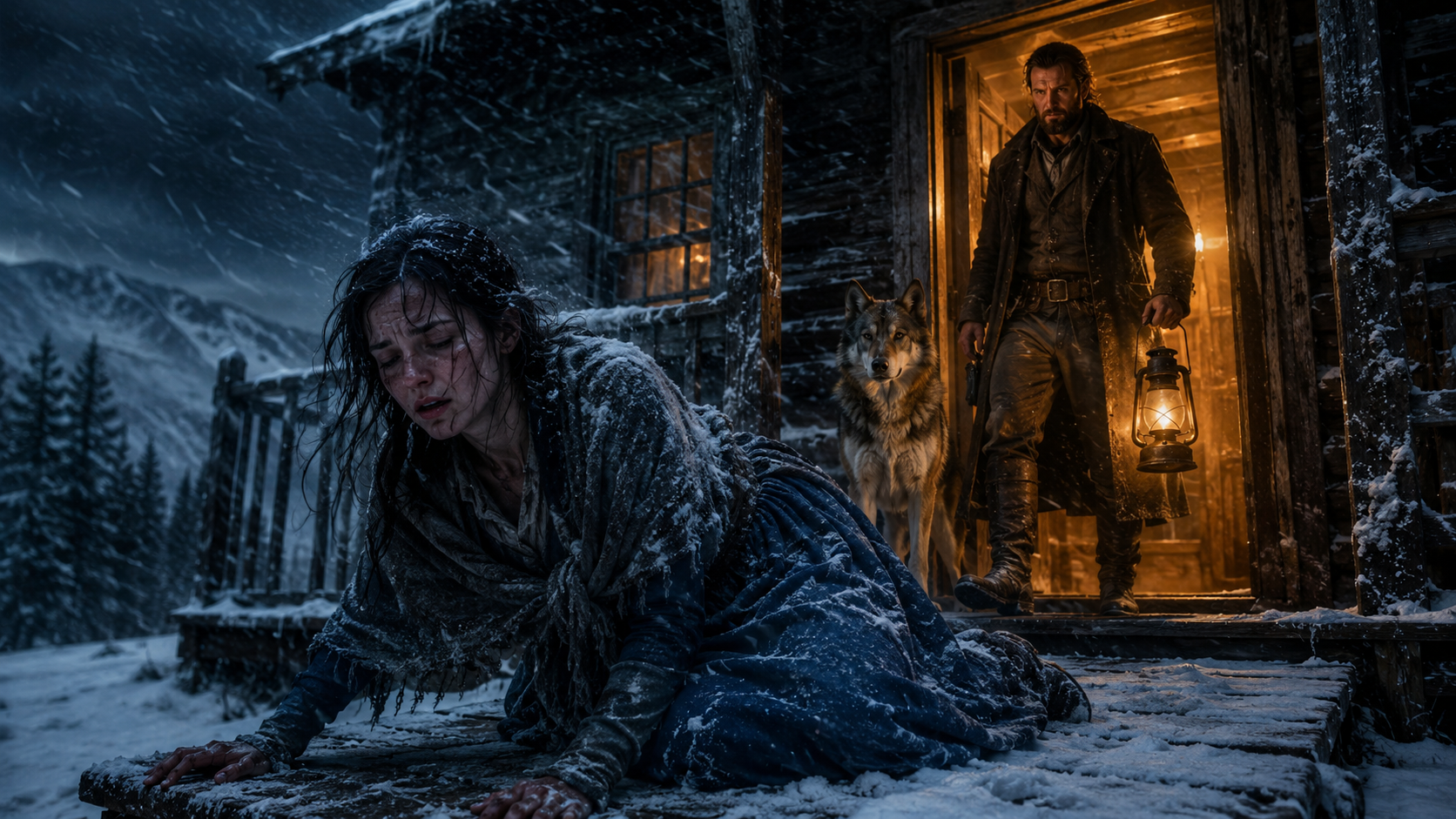
“My coat?” she asked.
“Dry.”
“My knife?”
“On the shelf by the window.”
“My mother’s box?”
Rowan nodded toward the table. “There.”
The tin box sat untouched.
Livia dragged herself upright, wincing.
“You opened it?”
“No.”
“Why?”
“It was not mine.”
She stared at him.
The answer was too simple. Too strange.
Rowan poured coffee into a tin cup, then hesitated. “You want it?”
She nodded.
He set it on the floor halfway between them and returned to the stove.
That small act nearly made her cry.
He gave space like other men took air.
Days passed.
Then weeks.
Winter sealed Blackthorn Ridge from the valley. Snow buried the lower road. Ice formed along the creek. Bram could not climb to the cabin without freezing. Silas Voss could not send a wagon. Sheriff Pike could not pretend a paper had power where horses broke legs.
Livia healed slowly.
Her body learned first.
It learned that no one struck her when she dropped a cup. It learned that footsteps outside the door did not mean punishment. It learned that Rowan’s silence was not the same as Bram’s silence.
Bram’s silence had always been the breath before violence.
Rowan’s silence was simply a place where nothing was demanded.
He taught her practical things because pity embarrassed them both.
How to bank coals before bed. How to cut kindling without wasting strength. How to read animal tracks. How to tell weather by the color of cloud bellies over the ridge. How to load a rifle, then unload it safely.
“I don’t want to shoot anyone,” she said, stepping away from the weapon.
“Good,” Rowan replied.
“Then why teach me?”
“Because not wanting cruelty does not stop cruel men.”
She looked at the rifle on the table.
“My father always said women with weapons become wicked.”
“Your father said that because wicked men prefer unarmed women.”
She did not know what to do with that sentence, so she carried it silently for several days, turning it over like a smooth stone.
Rowan never asked for her story.
That made it easier to tell him pieces of it.
One evening, while mending Bishop’s torn sleeping mat, she said, “He was not always like that.”
Rowan, carving a peg by the fire, did not look up too quickly.
“Bram?”
She nodded.
“When my mother was alive, he laughed sometimes. Not much, but enough that I remember it. After she died, he started drinking. Then cards. Then blaming. First the weather. Then the mill. Then me.”
Rowan’s knife moved slowly through the wood.
“What was her name?”
“Celia.”
“A good name.”
Livia smiled faintly. “She used to say my name meant blue flower, though I don’t know if that’s true.”
“Does it matter?”
“I suppose not.”
“If she meant love by it, then it was true enough.”
Livia looked at him then.
The fire lit one side of his face and left the scarred side in shadow. He was not handsome in the polished way Silas Voss was handsome. Rowan looked carved by weather and loss. His hands were large, his beard streaked with iron, his shoulders heavy with work.
Above the mantel hung a small portrait of a woman in a dark dress.
Livia had noticed it the first day she could sit up.
“Was that your wife?” she asked.
Rowan’s knife stopped.
“Yes.”
“What was her name?”
“Elise.”
The name entered the room gently.
Livia lowered her eyes. “I’m sorry.”
“So am I.”
He set the carving aside.
“She died in childbirth,” he said after a long while. “The child too. Road washed out. Doctor could not come. I carried them both down in spring.”
The fire snapped.
“I thought grief was the worst thing a house could hold,” Rowan said. “Then you came to my door and reminded me some houses hold worse.”
Livia swallowed.
“I didn’t mean to bring trouble here.”
“You brought yourself.”
He said it as if that were enough.
For the first time in years, Livia wondered whether being alive might be something other than a burden someone else had to tolerate.
In March, the thaw began.
And with it came danger.
Snow loosened. The creek swelled. Roads opened. Smoke appeared again from cabins down in the valley. Men began riding between farms. News climbed the ridge slowly, carried by a peddler who stopped at Rowan’s fence with coffee, salt, and gossip.
Silas Voss was angry.
Bram Hart was drinking harder than ever.
Sheriff Pike had told anyone who asked that Rowan Vale was harboring a thief.
And a judge from the territorial circuit was expected in Mercy Creek by the end of the month.
Rowan listened to the peddler, paid him, and watched him go.
That evening, Livia found him cleaning his rifle by the window.
“They’ll come again,” she said.
“Yes.”
“Can we leave?”
“We can.”
She waited.
“But?”
“But if we leave, Voss keeps the valley. Pike keeps the badge. Bram finds someone else to sell, or beat, or blame.”
Livia folded her hands tightly.
“I don’t know how to fight men like that.”