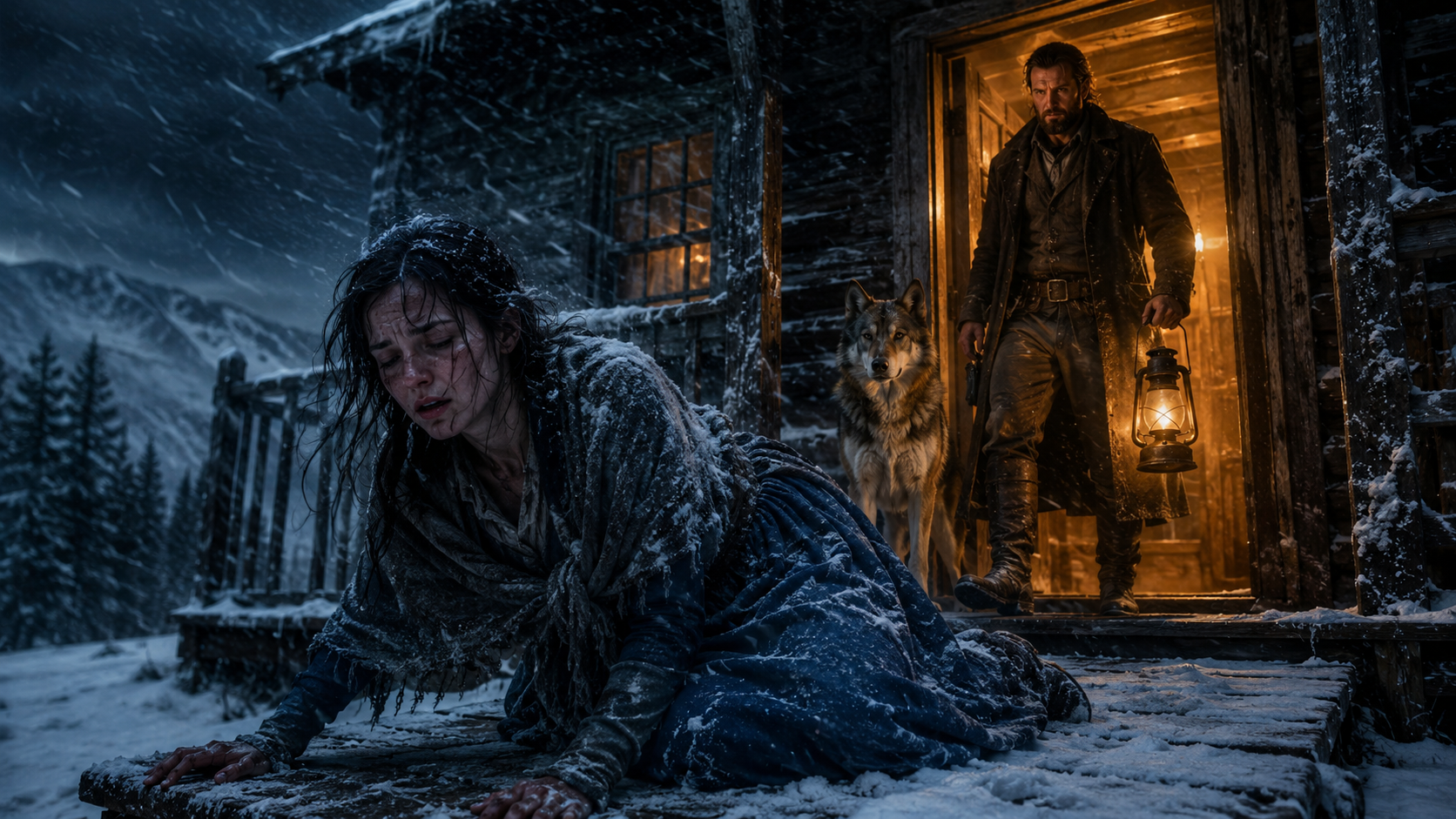
The night Livia Hart learned her father had sold her, the wind was clawing at the cabin walls like something hungry.
She had been mending a torn sleeve beside the stove, trying to make her fingers move though they were stiff from cold and old bruises, when the horses came up the road.
Three of them.
Nobody rode that high after dark unless they carried trouble with them.
Her father, Bram Hart, heard the hoofbeats too. He lifted his head from the table, where a half-empty bottle leaned beside a stack of losing cards. His face changed at once. Drink made him cruel most nights, but fear made him almost sober.
“Get behind the curtain,” he hissed.
Livia did not ask why. In Bram’s house, questions were another way to earn pain.
She rose, gathered her mending, and slipped behind the faded quilt that hung between the kitchen and the main room. Through a tear in the cloth, she saw her father wipe his mouth with the back of his hand and stagger toward the door.
The knocking came before he reached it.
Not loud. Not frantic.
Three calm strikes, as if the man outside already owned whatever waited within.
Bram opened the door only a crack.
“Mr. Voss,” he said, and his voice sounded smaller than Livia had ever heard it. “I wasn’t expecting you tonight.”
“No debtor ever expects the man he owes,” replied a smooth voice.
The door opened wider.
Silas Voss stepped inside with snow on his shoulders and silver on his gloves. He owned the card rooms down in Mercy Creek, the freight contracts along the pass, half the lawmen by rumor, and all the frightened silence in the valley by fact.
Two men followed him in. Both wore pistols. Neither removed his hat.
Bram swallowed. “I’ll have the money after the spring drive.”
“You said that after the autumn cutting.”
“The mill cheated me.”
“You gambled away the mill payment.”
The words struck the room like stones dropped into a well.
Livia held her breath.
Voss walked to the stove, warmed his hands, and glanced around the poor cabin with an expression of polished disgust.
“Three hundred and eighty dollars,” he said. “Plus interest. Plus the cost of my patience.”
Bram’s mouth twitched. “I can work it off.”
“You?” Voss smiled faintly. “Bram, you have worked at being useless for twenty years. Why start changing now?”
One of the men laughed.
Bram’s face reddened, but he did not raise his voice. Not to Silas Voss. He saved that courage for his daughter.
“I need time,” Bram said.
“No,” Voss answered. “You need value.”
The silence after that became sharp.
Livia felt it before she understood it.
Voss turned his head slowly toward the hanging quilt.
“There are other kinds of payment,” he said.
Bram stared at the floor.
Livia’s fingers tightened around the sleeve in her lap until the needle bit into her skin.
“No,” Bram muttered.
But there was no horror in the word.
Only bargaining.
Voss removed one glove finger by finger. “There is a house in Abilene that pays for quiet girls with no mother and no brothers. They do not ask many questions if the paper is signed by a father.”
The room tilted.
Livia pressed a hand over her mouth.
Bram was silent for so long that hope, foolish and wounded, lifted its head inside her. Perhaps some small piece of him still remembered carrying her on his shoulders through summer grass. Perhaps he remembered her mother’s hands, or the way Livia used to sing while washing clothes by the creek.
Then he said, “She’s stubborn.”
Voss smiled.
“They all learn.”
“She’s not pretty like the ones they usually take.”
“They are not buying a bride.”
Livia shut her eyes.
The words did not merely frighten her. They erased her. Reduced her to a debt, a sum, a thing moved from one man’s hand to another.
“She’s bruised,” Bram said.
“They fade.”
“She runs her mouth when she’s desperate.”
“Then gag her.”
A log collapsed in the stove. Sparks flared. Livia flinched.
Bram reached for the bottle, drank, and wiped his lips again.
“How much of the debt?”
“All of it.”
Another silence.
This one had a grave inside it.
“When?” Bram asked.
“Before dawn tomorrow,” Voss said. “Wash her. Put her in something clean. I’ll send a wagon.”
Livia waited for the world to stop.
It did not.
Voss placed a folded note on the table.
“Sign this.”
Bram stared at it.
“You want the debt gone?” Voss asked.
Bram took the pen.
The scratching sound of his name on paper was smaller than a scream and worse than one.
Livia stood behind the quilt and felt something inside her go cold and clear.
Not broken.
Not yet.
Clear.
After Voss left, Bram drank himself into a heavy, open-mouthed sleep by the fire. The note remained on the table, weighted beneath the bottle. Snow whispered against the windows. The horses disappeared down the road.
Livia did not move for several minutes.