Then, quietly, she stepped out from behind the quilt.
Her father’s hand hung loose from the chair. The same hand that had once braided her hair badly after her mother died. The same hand that later learned the shape of belts, sticks, and fists.
She looked at him for a long time.
“You were supposed to keep my name,” she whispered.
Bram snored.
That was answer enough.
Livia turned away.
From the bedroom, she took her mother’s shawl, a pair of wool stockings, a cracked leather belt, and a small knife with a pearl-colored handle. From beneath a loose board near the stove, she pulled out a tin box no larger than a Bible.
Inside were the only things Bram had never managed to sell: her mother’s wedding ribbon, a pressed blue flower, a brass thimble, and a folded paper sealed with wax.
Livia had never read the paper. Her mother had given it to her the winter before she died and said, “When the world tries to tell you who you are, open this.”
Livia had been eight then.
Now she was twenty.
Her hands trembled as she tucked the paper into her bodice.
She wanted to take the note Voss had left. Proof. Evidence. Something.
But Bram’s arm shifted in his sleep.
Livia froze.
He mumbled, cursed softly, then sank back into the chair.
She left the note where it was. Proof would mean nothing if she was still here when dawn came.
At the back window, she paused.
Outside waited darkness, snow, wolves, and the ridge.
Inside waited a wagon.
She opened the window.
The cold hit like a thrown bucket of river water.
Livia climbed out.
She did not run toward town. Town had watched Bram drag her by the wrist through the mercantile. Town had seen bruises along her jaw and asked whether she had fallen. Town knew Silas Voss and lowered its eyes.
So she ran toward the mountains.
Toward Blackthorn Ridge.
Toward the one place Bram had warned her never to go.
Toward the cabin of Rowan Vale.
People in Mercy Creek spoke of Rowan as if he were half-man, half-storm. A widower. A trapper. A giant with a scar down one cheek and hands that could break a rifle stock. Children dared one another to creep near his land and touch the split-rail fence before racing away.
But Livia had seen him once at the feed store.
She had dropped a sack of flour because her wrist was swollen and weak. The men near the counter laughed. Rowan Vale had not laughed. He had picked up the flour, carried it to Bram’s wagon, and said only, “That wrist needs binding.”
Bram had sneered. “Mind your ridge, Vale.”
Rowan had looked at him then. Just looked.
Bram had gone quiet.
As Livia climbed through the snow that night, that memory became a lantern in her mind.
The creek led south. Rowan’s ridge rose beyond the old cedar grove. If she could reach it before dawn, before the wagon, before Voss’s men realized she had fled—
A dog barked behind her.
Livia stopped so sharply she nearly fell.
Another bark.
Then men shouting.
Bram had woken.
She stumbled forward, one hand pressed to her ribs, the other clutching her shawl at her throat. Snow filled her boots. Branches slapped her cheeks. The moon was hidden, and the forest seemed to shift around her, every tree becoming a man, every gust a hand.
A gunshot cracked behind her.
She dropped to her knees.
The shot had gone high, into the trees. A warning.
“Livia!” Bram’s voice roared through the storm. “You come back here!”
She crawled, then forced herself up.
No.
She had come back all her life. Back from the creek when he called. Back from the neighbor’s porch when he dragged her home. Back into the kitchen after each beating. Back into silence after every insult.
Not tonight.
The ridge steepened. Her breath tore at her throat. Her legs shook. Twice she fell and slid backward, clawing at frozen roots to stop herself.
The cold began to speak.
Rest.
Just for a moment.
Close your eyes.
Snow is soft.
She bit her lip until blood warmed her mouth and kept climbing.
Then, through the trees, she saw a light.
Small.
Amber.
Real.
A cabin window glowed above the slope.
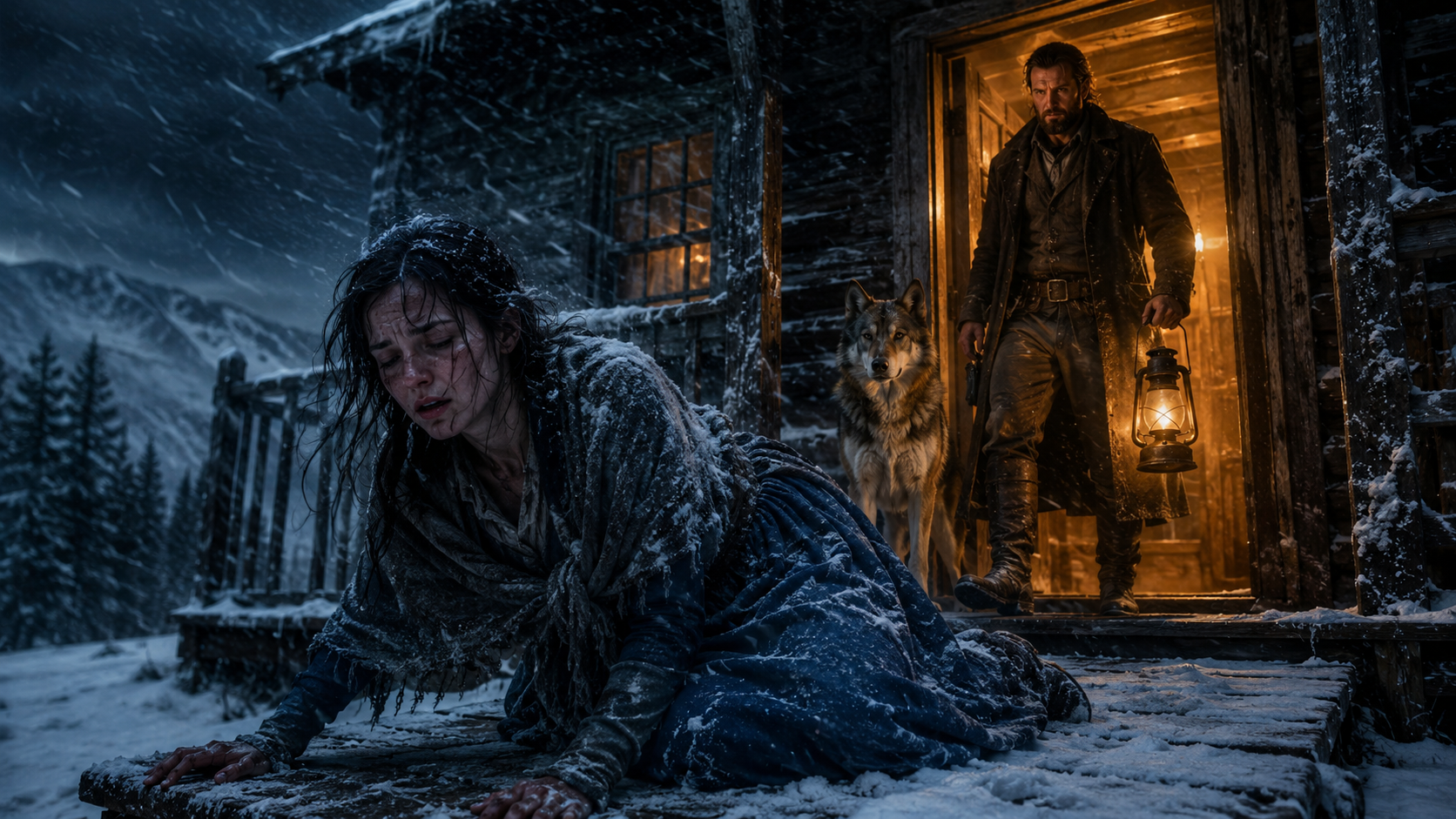
Livia tried to call out, but her voice broke. She dragged herself over the last rise, crossed a yard half-buried in drifts, and reached the porch on hands and knees.
Inside, a dog barked.
She lifted one numb hand and struck the door.
Once.
The door opened.
Warmth spilled over her.
Rowan Vale stood in the doorway, broad as an oak, a rifle in one hand, his gray eyes taking in her torn shawl, bloody mouth, frozen hair, and terror all at once.
Livia tried to stand.
Failed.
“Please,” she whispered. “Don’t let him sell me.”
Then the world went dark.
When Livia woke, men were shouting outside.
She did not know where she was at first. Smoke. Pine. Wool. Heat. A dog’s low growl. She lay on a bearskin near a hearth, buried under blankets, her boots removed, her feet burning with returning feeling.