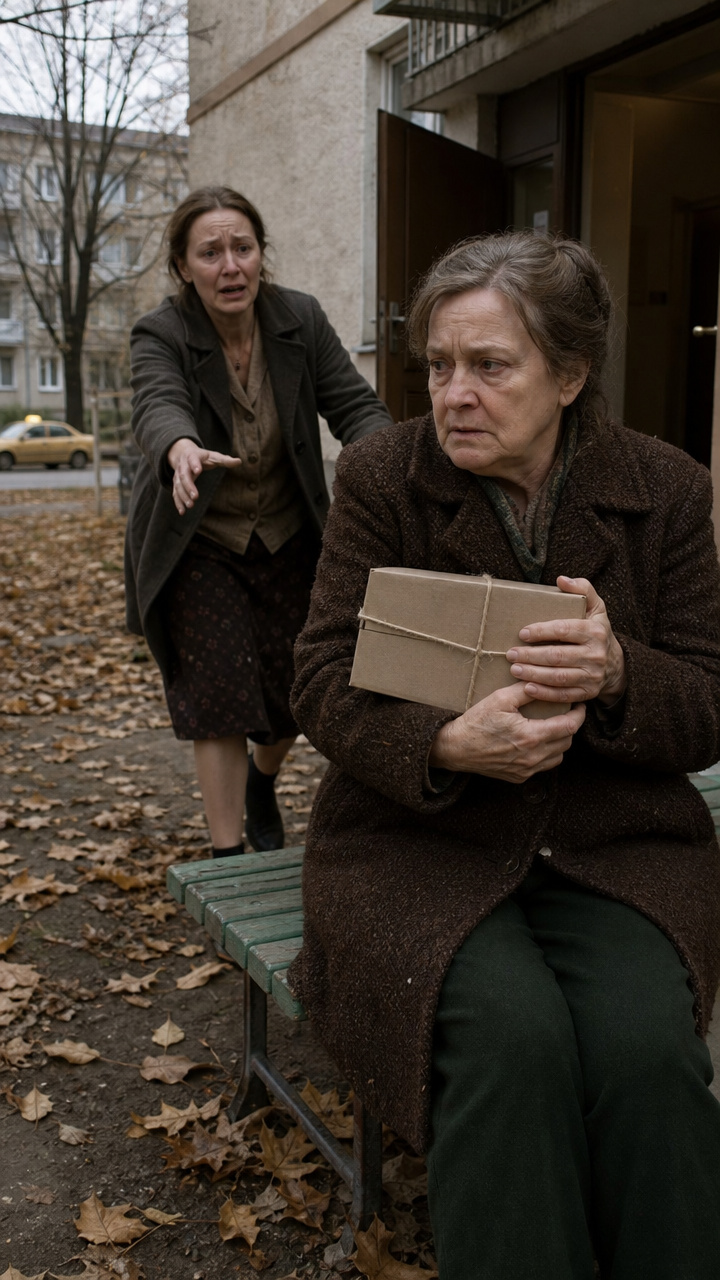
The cab was due in twelve minutes, and Margaret Foster decided that would be more than enough time to leave without a scene.
She placed three bags on the bench beside the apartment entrance. Against them she leaned a box fan—white, with a pink button and its cord wound tightly around the base.
Then she sat on the very edge of the bench, trying not to take up space, though there was no one to inconvenience. At seven in the morning, the courtyard was completely empty. Only the groundskeeper was sweeping chestnut leaves toward the curb, the bristles whispering over the pavement like someone restlessly turning in their sleep in the next room.
October had arrived early that year, bringing cold weather with it. Margaret buttoned her coat all the way to her throat and settled a shoebox tied with twine across her knees.
There was no chance she would allow that box to be placed in the trunk.
Upstairs, beneath a sunflower magnet on the refrigerator, she had left a note:
“Emily, please don’t be angry. I found a room, and everything is fine. I’ll call tonight. There’s meatloaf in the refrigerator—enough for two dinners.”
She had added the line about the meatloaf at the very end. Without it, the note seemed too bare and helpless.
Her husband, Arthur, had died in the spring, just when he had been planning to replace the roof over the detached kitchen.
The roofing sheets still lay beneath the walnut tree, covered with plastic. Every morning Margaret walked past them and thought she ought to ask someone to haul the materials away.
But she never asked.
Emily called her mother every evening at exactly nine, after feeding her family and washing the dishes.
“Mom, what do you need that big house for now that you’re alone? Carrying coal in the winter, tending the garden, that gate sticking every other day. Sell it. Come live with us, and maybe I’ll finally be able to sleep without worrying.”
“Where would I fit in your place, sweetheart? You only have two bedrooms.”
“We’ll manage. Daniel doesn’t mind. I talked to him. Mom, I mean it. What am I to you, a stranger?”
She repeated some version of that during nearly every call. By the third week, Margaret gave in.
They found a real-estate agent in the nearby town. He was a young man in narrow trousers who photographed everything with his phone and never said “area” when he could say “location.”
The buyers arrived a month later: a young couple with a little girl who immediately climbed the mulberry tree.
The woman asked whether the built-in wardrobe would stay with the house.
Margaret told her that everything would remain, except whatever could fit into her bags.
Not much fit.
The photo albums. The pear-patterned china set they had received as a wedding gift and used only a handful of times in forty-two years. A towel embroidered by Margaret’s mother. The cuckoo clock whose bird had long ago stopped appearing through its little door.
And the shoebox tied with twine.
Margaret placed that separately on the front passenger seat and held it with one hand for the entire drive.
Emily had insisted that her mother take the fan.
“We only have air conditioning in the bedroom, and the living room is unbearable in August. Take it, Mom. You’ll need it.”
The first month almost felt like a celebration.
Margaret slept on a folding sofa in the living room, hidden behind a bookcase. She rose at five, as she had always done back home, and while everyone else was still asleep, she made beef stew, scrubbed the stovetop, and ironed Daniel’s shirts.
“Mom, what are you doing?” Emily would laugh. “Relax. You’re a guest.”
At the time, the word “guest” passed right over Margaret without leaving a mark.
Daniel worked from home. His desk, with two monitors, stood in the same living room, barely three feet from the sofa.
From ten in the morning until six in the evening, he sat wearing headphones, speaking English with people no one ever saw, and occasionally asking everyone to keep their voices down.
Margaret learned to move through the apartment sideways, as if she were living in someone else’s house.
She stopped turning on the television. She boiled water only during the brief stretches when Daniel had no calls, and stood beside the kettle so she could switch it off before it began to whistle.
At the beginning of October, she noticed that Emily had stopped looking at her whenever she spoke about anything important. Her daughter’s eyes went instead to her phone, the window, or her own hands.
“Mom, did you rearrange the jars again?”
“I only moved the dry goods higher so they’d be easier for you to reach…”
“Daniel can’t find the coffee. It makes him anxious. Please don’t do that, all right? I’ll organize everything myself.”
Then came the night Margaret got up for a drink of water and stopped in the hallway.
Voices were coming from the bedroom. The door was nearly closed, but not latched.