“Emily, I have nothing against your mother. Honestly, she’s wonderful. But I haven’t been able to walk into my own kitchen in sweatpants for two months. I have a client call at lunch, and there’s someone chopping onions behind me.”
“You said we could manage until she adjusted.”
“A month, two months—fine. But this can’t continue.”
Emily was silent for a long while.
“Where is she supposed to go now? The house is gone.”
“She has the money from selling it. She can rent somewhere nearby. You could visit her every day if you wanted.”
Again, Emily said nothing.
“I don’t know how to tell her.”
Margaret never got her water. She returned to the sofa and lay awake until morning, listening to something inside the refrigerator click on and off.
Three days later, she found a room through a notice pinned beside the farmers’ market.
The landlady, Helen Brooks, lived alone with a cat named Oliver and was delighted to learn that her new tenant would be “neither a college student nor a woman with a dog.”
She accepted two months’ rent in advance and showed Margaret how to turn on the water heater.
Margaret told Emily nothing.
She decided it would be easier that way.
Especially for her daughter, who would not have to search for the right words.
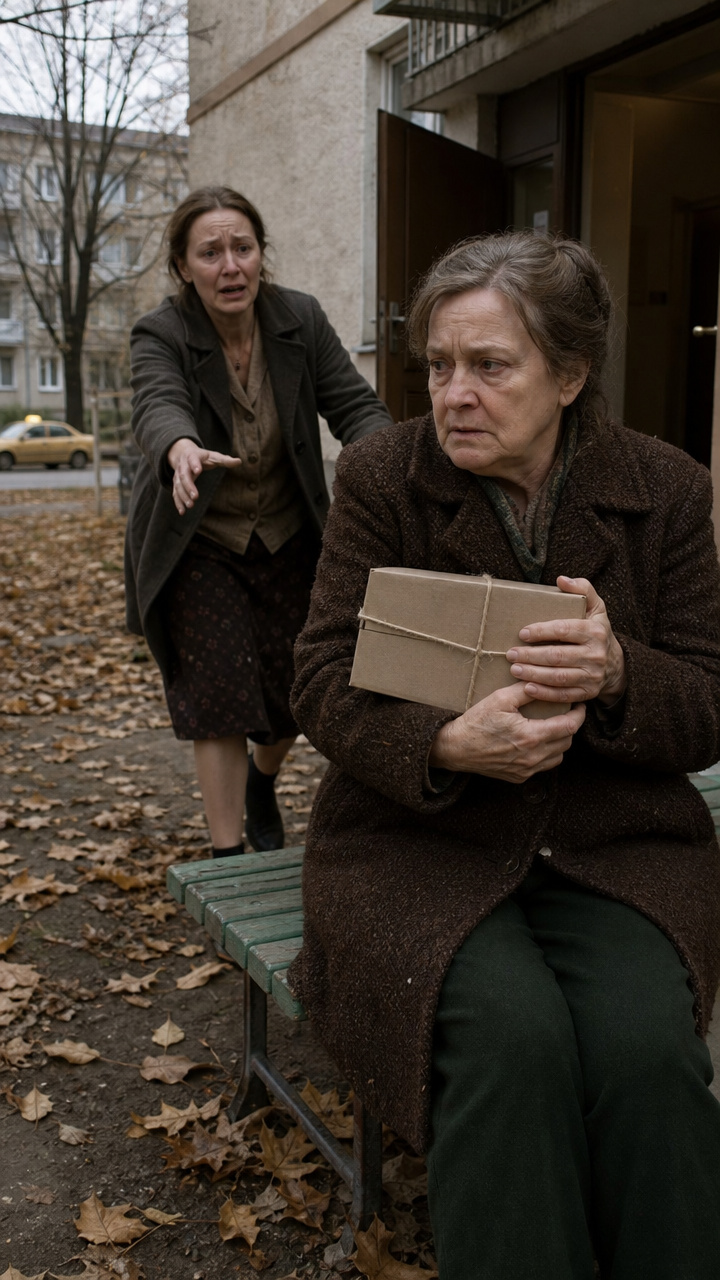
The entrance door slammed so loudly that the groundskeeper turned around.
Emily rushed outside wearing a robe and Daniel’s jacket thrown over it. She had slippers on her bare feet. In one hand she clutched the note with the sunflower magnet.
“Mom! What are you doing?”
“I’m leaving, sweetheart. Don’t shout. People are still asleep.”
“Leaving for where? What room? When did you even find one?”
“Near the market. The landlady is kind and lives with a cat. I’ll be all right there, and you’ll have more room here. Go back inside—you’re practically naked.”
“Mom, why didn’t you tell me?”
Margaret adjusted the box on her knees.
“Because you would have asked me to stay. And then you would have looked at your phone again while I was talking to you.”
Emily opened her mouth, but no answer came.
She sat beside her mother on the cold bench. Damp marks from her slippers darkened the pavement.
For nearly a minute, neither of them spoke.
Then Emily nodded toward the box.
“What’s in there? You wouldn’t let go of it in the car. I noticed.”
“Something that belongs to you.”
“To me?”
Margaret began untying the twine. The knot had been pulled tight years before, and her fingers struggled to loosen it.
The first things inside were drawings.
Dozens of children’s pictures covered school paper and the backs of old wallpaper scraps: a house with smoke rising from the chimney, a cow with five legs, a mother in a red skirt taller than the house itself.
Beneath them lay a first-grade certificate:
“Presented to Emily Foster for excellent grades and exemplary conduct.”
The school seal had blurred with age.
At the bottom of the box was a pair of little brown lace-up shoes. They were so tiny that one could fit in a single hand. On the toe of the left shoe, someone had sewn a neat patch.
“You took your first steps in these,” Margaret said. “From the woodstove to your father. He actually cried. Then he told everyone the smoke had gotten in his eyes.”
Emily picked up one shoe and turned it slowly in her hands. She said nothing.
Finally, she drew out a sheet of paper folded into quarters.
When she opened it, there was a bus on the page, and beside it stood a small girl waving goodbye.
At the bottom, in crooked block letters—some of them written backward—were the words:
“MOM, YOU SAID IT WOULDN’T BE LONG.”
“Do you remember?” Margaret asked softly.
Emily did not.
Then, without warning, the memory returned.
The smell of her great-aunt’s unfamiliar apartment. A gray morning. Her mother’s back beside the bus.
Emily had been six years old. Margaret had gone overseas to pick apples and promised she would be home in three weeks.
Instead, she came back two months later. The employer had delayed payment, and Margaret had been forced to wait.
She brought home chewing gum, a doll with white hair, and enough money for the family to finally put linoleum on the floor.
“You wouldn’t come near me for a whole week,” Margaret said. “You hid beneath the table. Then you brought me this drawing and left it on my pillow. I put it in the box. After that, I kept adding everything connected to you.”
She paused, then continued as though the thought had only just occurred to her.
“Your room stayed untouched in that house, you know. For thirty years. Your father wanted to turn it into a workshop and put his workbench in there. I wouldn’t let him. I kept saying, ‘What if she comes back with children? Where will they sleep?’ I never even replaced the butterfly wallpaper. The buyers have probably torn it all down by now.”
Emily carefully placed the little shoe back into the box, toe to toe with its mate.
For thirty years, her mother had kept a room ready for her, even though Emily had visited no more than twice a year and usually stayed only one night.