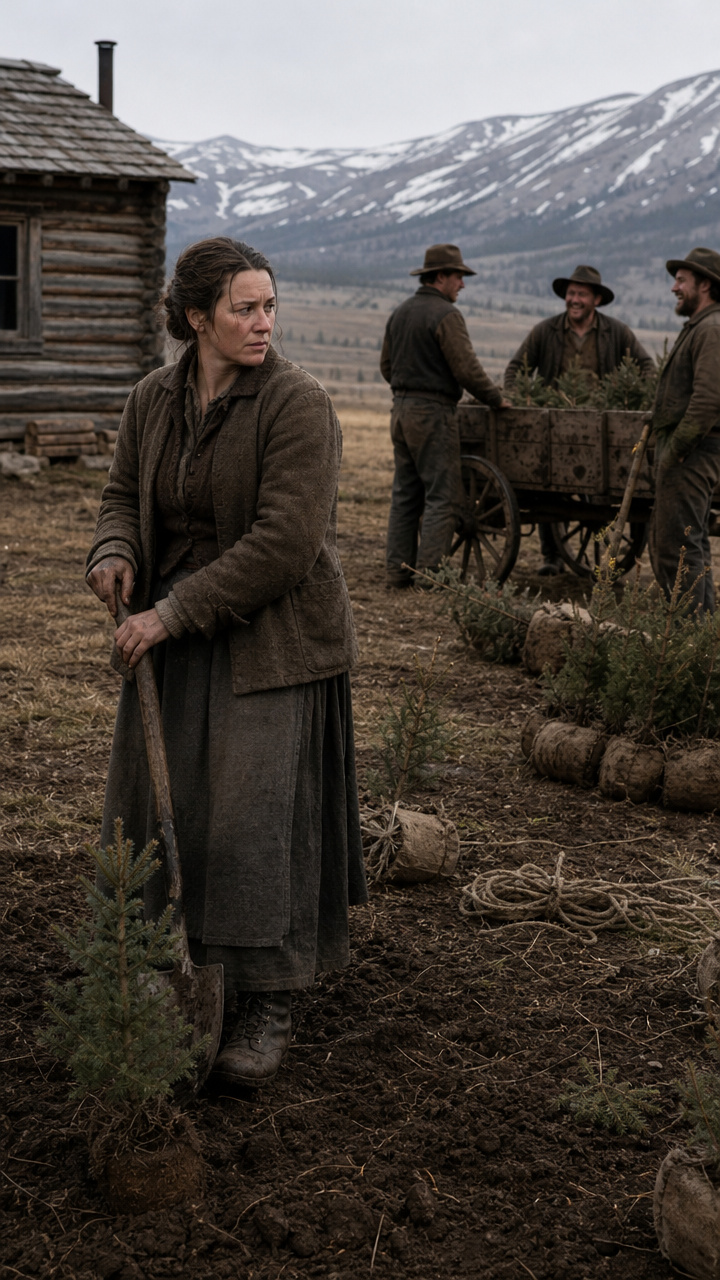
When the first thaw finally loosened the mountain road, Hannah Reed stepped outside carrying a shovel, a length of twine, and forty-three saplings wrapped in damp burlap.
Maple Hollow still slept beneath the last grimy ridges of snow. Smoke drifted sideways from the chimneys. Beneath its crust of ice, the creek had begun murmuring again. But on the northern rise, where Hannah’s cabin stood alone beside the open fields, the wind had never fallen silent.
All winter it had battered her door, pushed through the cracks between the logs, and worried at the roof until the nails squealed. It had buried the porch twice. It had frozen the pump handle against her glove. At night, it pressed against the windows so violently that Hannah slept in her boots, never certain whether morning would find the glass still in its frames.
So when spring arrived, she did not buy curtains or repaint the porch. She did not plant flowers.
She planted trees.
They were not arranged in a tidy ornamental line. Hannah set them in a broad, bending belt along the northern and western sides of the cabin—far enough out to slow the wind before it reached her walls, yet close enough to catch the snow before it buried the doorway.
Black spruce for strength in winter. Willow for its ability to bend without breaking. Red osier dogwood to fill the lower spaces. A few young poplars for height, despite every man at the feed store insisting that poplars were greedy, untidy things.
“Good,” Hannah had replied when Mrs. Pritchard warned her about them. “Let them be greedy. I need something on this hill that wants to live.”
By noon, both her palms were blistered.
By two, mud stained the hem of her skirt.
At three, the first wagon slowed beside the road.
“Well, look at that,” Roy Mercer called from the driver’s bench, his grin wide enough to make him resemble a wolf. “The widow Reed is raising an army of sticks.”
His brother, Glenn, laughed beside him. Two hired men in the back slapped their knees as if Roy had delivered the finest joke in the county.
Hannah drove her shovel into the ground and kept her eyes lowered.
“Maybe she’s teaching them to do housework,” Glenn shouted. “A woman alone needs every servant she can plant.”
The men roared.
The shovel struck stone. Hannah worked the blade around it, levered the rock free, and tossed it into the grass.
“She can hear you,” one of the hired men muttered.
That voice made Hannah look up.
Caleb Hart stood near the road with one hand resting on his horse’s neck. He was tall and broad through the shoulders, with dark eyes and the quiet, weathered appearance of a man who spent more time working than speaking. He served as foreman for Gideon Vale, the richest cattleman in the valley. Hannah had heard that Caleb had once studied surveying and bridge construction before life had dragged him home.
He was not laughing.
That should have eased her.
It did not.
Silence, when courage was required, was only cowardice wearing a different coat.
Roy noticed where Caleb was looking and nudged him with an elbow. “Go on, Hart. Ask her whether she expects those twigs to stop a blizzard.”
Caleb’s expression hardened. “That’s enough.”
The words were quiet, yet every man heard them. The laughter faded—not because anyone felt ashamed, but because men like Roy understood warnings only when they came from another man.
Hannah slowly straightened. Her lower back pulsed with pain. Her knees carried the deep ache of wet ground and old sorrow.
Caleb walked partway toward her.
“What are you building?” he asked.
“A shelterbelt.”
He looked at the slender trees, then at the bare fields stretching north of the cabin.
“With those?”
“For now.”
“The north wind comes off the ridge like a hammer.”
“I have noticed.”
“They’re too small.”
“They’ll grow.”
“Not before next winter.”
“Then I’ll help them.”
Roy laughed again from the wagon. “Did you hear that? She’s going to help trees grow faster.”
Hannah turned toward him. “No. I’m going to help them survive. There’s a difference. You may not know it.”
The wagon fell silent.
Glenn’s grin disappeared. Roy spat into the road, but for once he had nothing to say.
Caleb studied Hannah. Something resembling respect passed briefly over his face before he concealed it.
“You’ll need more than a single line,” he said.
“I know.”
“Brush low between the rows. Wind slips beneath young trunks.”
“I know.”
“And don’t bind them too tightly. The roots need room to strengthen.”
“I know.”
The corner of his mouth moved. “You’ve read about this.”
Hannah lifted another sapling. “I’ve frozen through enough winters to learn about it.”
The almost-smile vanished.
Behind Caleb, the hired men began preparing to leave. They were bored now that the widow refused to cry and Caleb refused to make her the day’s amusement. The wagon rolled toward town, carrying the laughter away with it.
Caleb remained.
“Want help digging the holes?” he asked.
“No.”
“That wasn’t charity.”
“I never called it charity.”
“Then why refuse?”