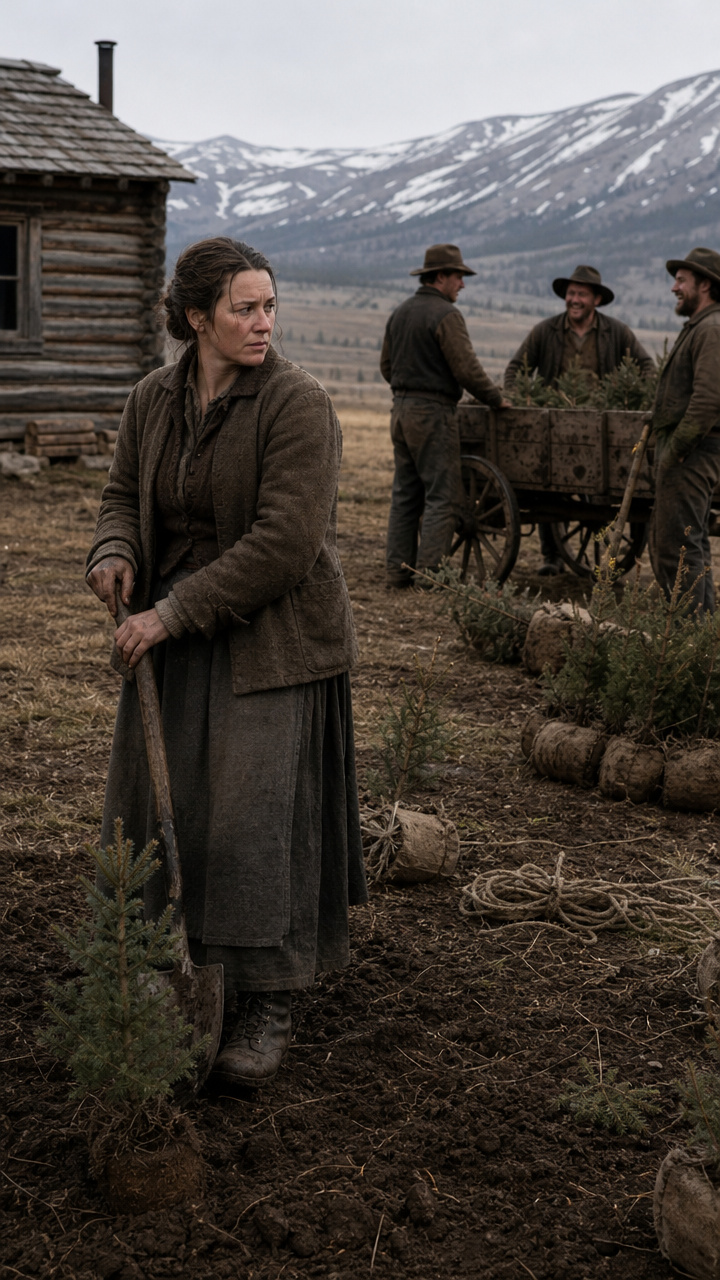
Hannah placed the sapling in the earth and pressed soil around its roots with both hands. “Because I don’t yet know what your help costs.”
Caleb removed his hat. It was a small, old-fashioned gesture. On another day, it might have seemed charming.
Today it only exhausted her.
“I work for Vale,” he said. “That doesn’t mean I belong to him.”
Hannah looked beyond him at the enormous pastures rolling north from her cabin. Gideon Vale owned nearly everything visible from the rise—the road through the hollow, the grazing rights above the creek, half the timber slope, the building that housed the general store, and enough debts in enough hands that even men who despised him tipped their hats when he rode past.
“No,” Hannah said. “But many people who work for him eventually start behaving as if he owns them.”
Caleb took the remark without flinching.
“Fair enough.”
He put his hat back on and returned to the road.
Hannah watched until she was sure he would not glance over his shoulder.
Then she planted another tree.
Three days later, Gideon Vale came himself.
He arrived in a polished black carriage with gleaming brass fittings. His driver remained seated while Vale stepped down, carefully avoiding the mud as though it had been placed there by an insulted servant.
He was perhaps sixty, perhaps older, but he wore his age like armor. Silver hair. Clean gloves. A long dark coat. Pale eyes that measured everything they touched.
First he examined Hannah’s cabin. Then the newly planted trees. Finally, he studied Hannah.
“Mrs. Reed,” he said. “You’ve been busy.”
“Yes.”
“May I come inside?”
“No.”
His eyebrows lifted.
Hannah held the door only halfway open, filling the gap with her body. She was not fragile. Grief had hollowed her face but had not made her small. Winter had stolen sleep, softness, and two fingernails. It had not taken her strength.
Vale noticed.
Men always did.
“I won’t keep you long,” he said.
“That would be considerate.”
He smiled as if she had amused him and he was generous enough to permit it. “I am prepared to make a very generous offer for this property.”
“It isn’t for sale.”
“You should hear the amount.”
“No amount will change the answer.”
“Everyone says that before hearing the right amount.”
“Then everyone has been speaking to you. I have not.”
His smile lost its warmth.
The wind stirred Hannah’s hair. Behind Vale, the young trees trembled in their shallow holes, none taller than a child.
“This is a poor location for a woman alone,” he said. “The rise takes the weather first. The road disappears under drifts. The well is exposed. Your late husband left you in a difficult place.”
“My husband didn’t leave me this land. My father did.”
“Then your father chose badly.”
“My father chose what he could afford.”
“And now you can choose something better.”
“By selling to you.”
“By allowing a practical man to add this useless strip to a working range.”
There it was.
Not land.
A strip.
Not her home.
An inconvenience to be absorbed.
Vale glanced again at the saplings. “I see you’re spending money trying to tame the weather.”
“I’m slowing it.”
“With sticks?”
“With time.”
“Time is expensive.”
“So are mistakes.”
His eyes narrowed. “You think I’ve made one?”
Hannah looked toward his wide northern fields. They lay open and scraped bare, grazed down to the roots. The old brush lines had been cleared years earlier. She had watched snow race across those fields during the winter, finding nothing to slow it, nothing to hold it, nothing to soften its force before it struck her cabin.
“I think you removed every living thing between this hill and the ridge,” she said.
For an instant, his face became empty.
Then he gave a quiet laugh.
“My dear Mrs. Reed, cattle cannot graze through trees.”
“No,” Hannah replied. “But wind can gallop through emptiness.”
The driver shifted on his seat.
Vale noticed. His smile returned, thinner and sharper.
“You have spirit,” he said. “The valley admires spirit in small doses.”
“I’ll try not to spend mine all at once.”
He stepped nearer.
Hannah did not retreat.
“Winter nearly killed you,” he said softly. “Everyone knows it. You burned furniture in February. You traded your wedding silver for flour. Hart found you half-frozen at the pump after the great drift.”
Heat rose into Hannah’s cheeks, but she held his gaze.
“That is not a reason to sell.”
“No,” Vale said. “It is a reason to stop pretending endurance and wisdom are the same thing.”
The words struck because they were not entirely untrue.
Last winter had not made Hannah courageous. It had made her desperate. She had survived by inches, stubbornness, luck, and the mercy of a neighbor who found her before the cold completed its work.
But survival had taught her what comfort never could.
She knew where the wind struck first.
She knew where the snow piled highest.
She knew which corner of the cabin groaned before midnight.
She understood the shape of danger now.
And knowledge, once earned, was something no man could purchase.