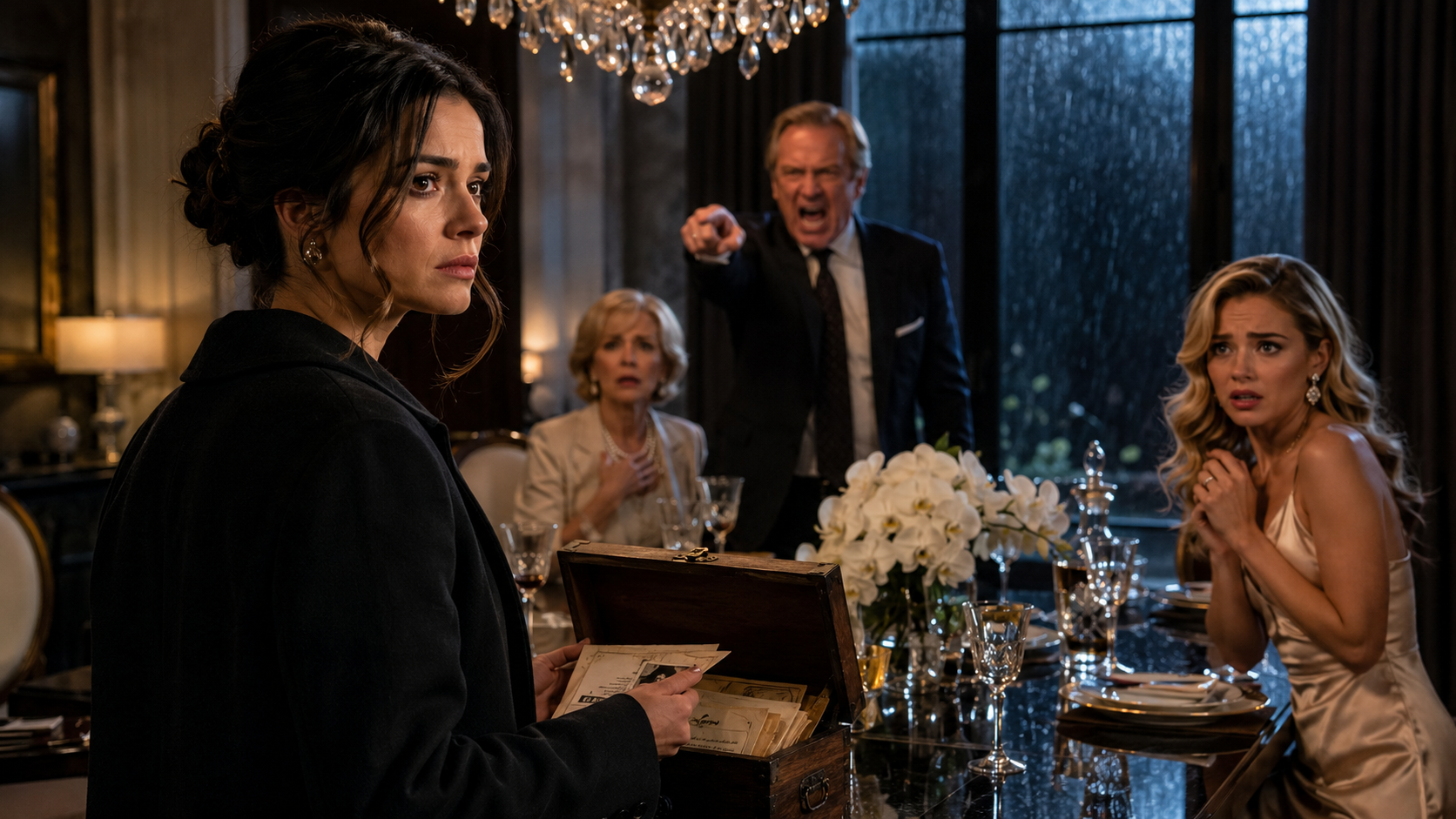
“No inheritance can replace family. But neither can family replace dignity. I would rather sit alone in a house where I am not lied about than be surrounded by people who require my silence as rent.”
Clara looked away first.
That was how Mara knew the sentence had landed.
Irene whispered, “Will you ever forgive us?”
Mara’s throat tightened.
That was the cruel thing about leaving.
People imagined it felt like victory.
It did not.
It felt like carrying your own heart out of a burning house and refusing to run back in just because someone inside was crying.
“I don’t know,” Mara said honestly. “But I know forgiveness will not be another word for access.”
Her mother bowed her head.
Mara looked at the table one last time.
The orchids.
The champagne.
The untouched plates.
The family that had once seemed so large it filled the whole world.
Now it looked like what it was.
A room.
Just a room.
And Mara could leave it.
Noah picked up the cedar box for her.
She almost told him she could carry it herself.
Then she let him.
Not because she was weak.
Because she was learning that accepting help was not the same as surrendering control.
As she walked toward the door, Julian spoke behind her.
“Mara.”
She turned.
He looked devastated.
Not in a way that asked her to comfort him.
In a way that understood he had no right to.
“I’m sorry,” he said. “I should have asked more questions.”
Mara nodded once.
“Yes,” she said. “You should have.”
Then she left.
The hallway outside the dining room was quiet and warm. A waiter carrying a silver tray paused when he saw her face, then quickly looked away with the professional mercy of someone trained not to notice private disasters.
Mara stepped outside beneath the club’s stone awning.
The rain had softened to mist.
Noah came out beside her and handed her the cedar box.
“You okay?” he asked.
Mara almost said yes.
The old answer.
The easy answer.
Instead, she looked down at the box, at the scratches on the wood, at the small brass latch Grandma Ruth had touched a hundred times.
“No,” Mara said.
Noah nodded.
They stood there together, watching headlights move through the wet street.
After a while, Mara added, “But I think I will be.”
For the first time all evening, she believed herself.
Two weeks later, the first correction came.
It was from Aunt Patricia.
A long message sent to the family group chat at 8:17 on a Tuesday morning. No flowery excuses. No softening. No dramatic claims about healing.
Just the truth.
That Mara had been accepted to Westlake.
That Ruth had offered to pay.
That Malcolm had prevented it.
That family members had repeated false stories without proof.
That Mara had been owed better.
Uncle Neil replied next.
Then Owen.
Then two cousins who had not spoken to Mara in years.
Irene sent a private message.
Mara did not open it for three days.
When she finally did, she read it once, then placed the phone face down on the kitchen table.
Her mother had written seven paragraphs.
Only one sentence mattered.
I chose quiet because quiet protected me.
Mara stared at that line for a long time.
Then she wrote back:
I know.
Nothing else.
Not yet.
Maybe not ever.
Clara did not write.
Malcolm did not write.
But a week later, Mara received notice through Grandma Ruth’s attorney that Malcolm had requested copies of the estate documents.
Noah laughed when she told him.
“He’s looking for a crack.”
“Will he find one?”
“No.”
Mara smiled.
It was small.
But real.
The lake cottage looked different in winter.
She went alone the first time.
No family caravan.
No coolers.
No arguments over bedrooms.
No Clara arriving late and somehow still getting the best room.
No Malcolm standing on the porch like a king surveying land he did not own.
Just Mara, the old key, and the sound of pine trees moving in the wind.
Inside, everything smelled like dust, cedar, and cold stone.
Sheets covered the furniture.
The kitchen faucet groaned when she turned it on.
A mouse had clearly declared war beneath the sink.
But the place was hers.
Not because paper said so.
Because for the first time, she stood inside it without feeling like a guest in someone else’s version of her life.
On the mantel, she found a framed photo Grandma Ruth must have placed there before she died.
Mara at nineteen.
Laughing on the porch.
Before.
Mara picked it up and turned it over.
There was a note tucked behind the frame.
Another one.
Shorter this time.
If you are here, then you made it through the worst part. Do not confuse grief with regret. Some doors hurt when they close because our hands are still on them.
Mara sat down on the covered sofa and cried.
Not neatly.
Not beautifully.
Not like Clara, who could make tears look like pearls.