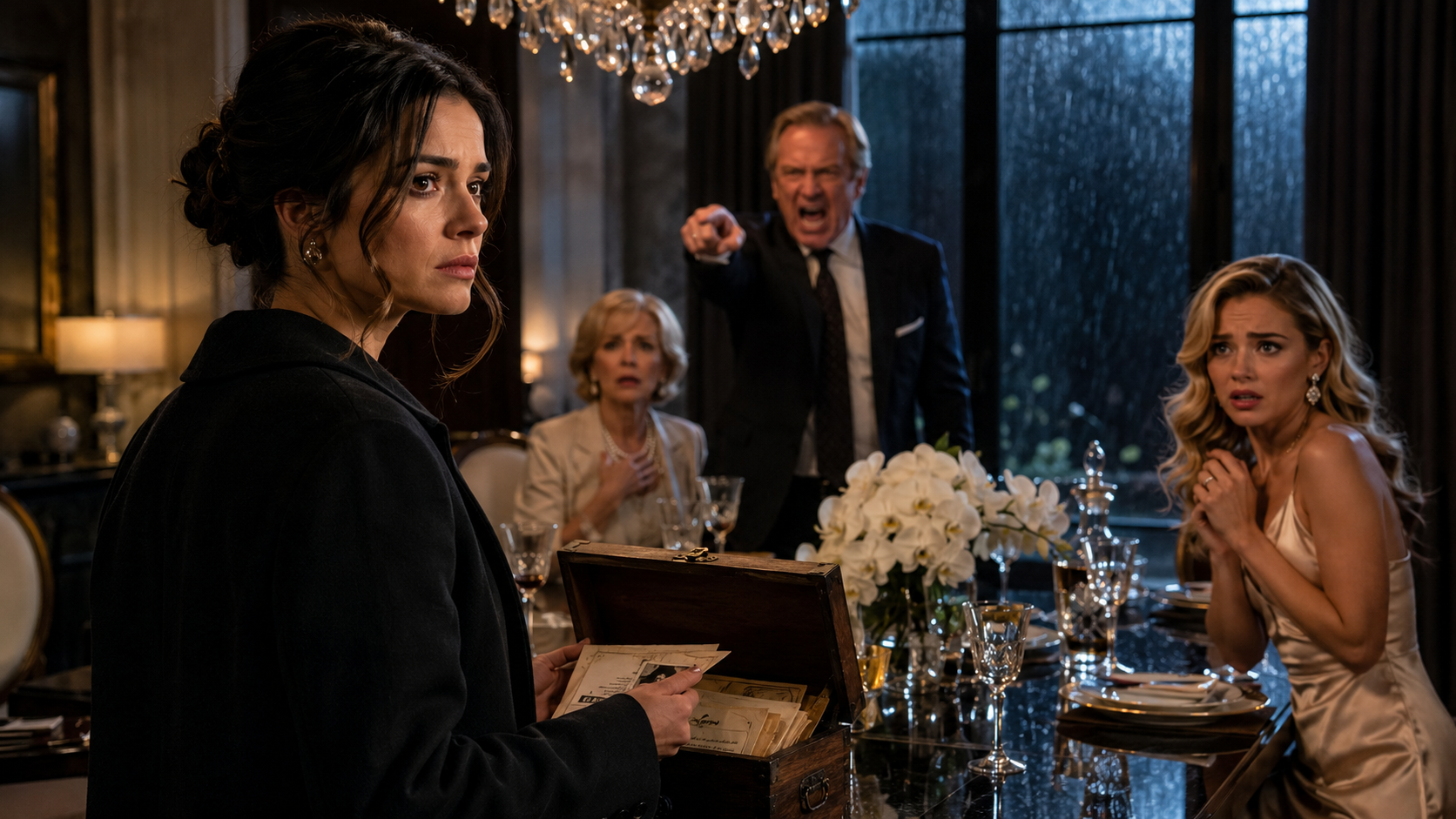
Julian pushed back from the table.
“Clara, maybe you should let her finish.”
Clara turned on him.
“You don’t know this family.”
“No,” he said quietly. “But I’m starting to.”
That landed harder than anything Mara had said.
Clara sat down again, but this time not elegantly.
Mara reached into the cedar box and took out the blue envelope.
Her hands changed when she touched it.
Not shaking exactly.
But softer.
The room seemed to sense it. Even Malcolm stopped moving.
“This,” Mara said, “is a letter Grandma wrote six months before she died. Her attorney gave it to me after probate began. I did not know about it until three weeks ago.”
Irene whispered, “Oh God.”
Mara looked at her.
“Yes. I think that is an appropriate reaction.”
She opened the envelope.
The paper inside was thick and cream-colored. Grandma Ruth’s handwriting slanted slightly upward, as if even at the end, her words were trying to rise.
Mara began to read.
“My dearest Mara,
If this letter has reached you, then I am no longer there to correct the stories that have been told about you. I waited too long. I softened too many truths. I allowed myself to believe that if I loved you quietly enough, it would make up for the noise of everyone else’s neglect.
It did not.
So I am leaving you more than money.
I am leaving you records.
I am leaving you names, dates, copies, and proof, because people who benefit from your silence will often call your memory bitterness.”
Mara’s voice caught.
She stopped.
No one moved.
Then she continued.
“You were never the difficult child. You were the inconvenient witness. You noticed unfairness too early. You asked honest questions in a family that preferred beautiful answers. Your father mistook control for wisdom. Your mother mistook peace for goodness. Your sister mistook attention for love.
And I, shamefully, mistook sympathy for action.
For that, I ask your forgiveness.”
Irene was openly sobbing now.
Malcolm stared at the far wall.
Clara’s face had gone pale and blank.
Mara folded the first page down and looked around the room.
“Grandma left more.”
Malcolm’s head snapped toward her.
“Mara, stop.”
She almost smiled.
Not because she enjoyed this.
Because for once, he had said the quiet part with fear in his voice.
“No.”
One word.
Small.
Plain.
A word she had been trained out of using.
It felt strange in her mouth.
It felt like a key.
Malcolm took a step forward.
Noah moved before Mara even looked at him.
He had been standing near the wall since she arrived, silent in a navy suit, one hand resting on the back of an empty chair. To most of the family, he probably looked like a friend. Maybe a boyfriend. Maybe moral support.
He was, in fact, the forensic accountant who had spent the last month helping Mara trace twelve years of hidden transactions.
“No closer,” Noah said.
His voice was calm.
Malcolm stared at him.
“Who the hell are you?”
“Noah Bell,” he said. “I’m here at Mara’s request.”
Clara gave a bitter laugh.
“You brought backup?”
Mara looked at her.
“No. I brought a witness.”
Noah opened his briefcase and removed a slim laptop.
Several people at the table shifted as if the temperature had dropped.
Mara turned back to the letter.
“Grandma left me the lake cottage,” she said.
The room erupted.
Not loudly at first.
More like air breaking.
Aunt Patricia gasped.
Uncle Neil muttered something under his breath.
Irene pressed both hands over her mouth.
Clara stood so quickly her chair almost tipped.
“No.”
Mara looked at her.
“Yes.”
“That cottage belongs to the family.”
“No,” Mara said. “It belonged to Grandma.”
Malcolm’s face had gone red.
“We have held holidays there for thirty years.”
“And for thirty years,” Mara replied, “I washed dishes in that kitchen while Clara opened gifts in the living room and everyone joked I was ‘helpful.’ For thirty years, I slept on sofas so Clara and her guests could have bedrooms. For thirty years, Grandma watched it happen and hated herself for not stopping it sooner.”
Clara pointed at the box.
“You’re using a dead woman to punish us.”
Mara’s voice dropped.
“No. A dead woman finally told the truth because the living refused.”
Noah connected his laptop to the wall screen.
The Ashbourne Club used the screen for charity presentations, anniversary slideshows, and corporate announcements. Tonight, it displayed a scanned copy of Grandma Ruth’s trust amendment.
Mara did not need to explain much.
The words were plain.
The cottage went to Mara.
The private trust went to Mara.
The authority over all related family access went to Mara.
Clara read the screen like it was written in a language she hated but understood perfectly.
“That can’t be legal.”
Noah answered.
“It is.”
Malcolm turned on him.
“You are not this family’s attorney.”