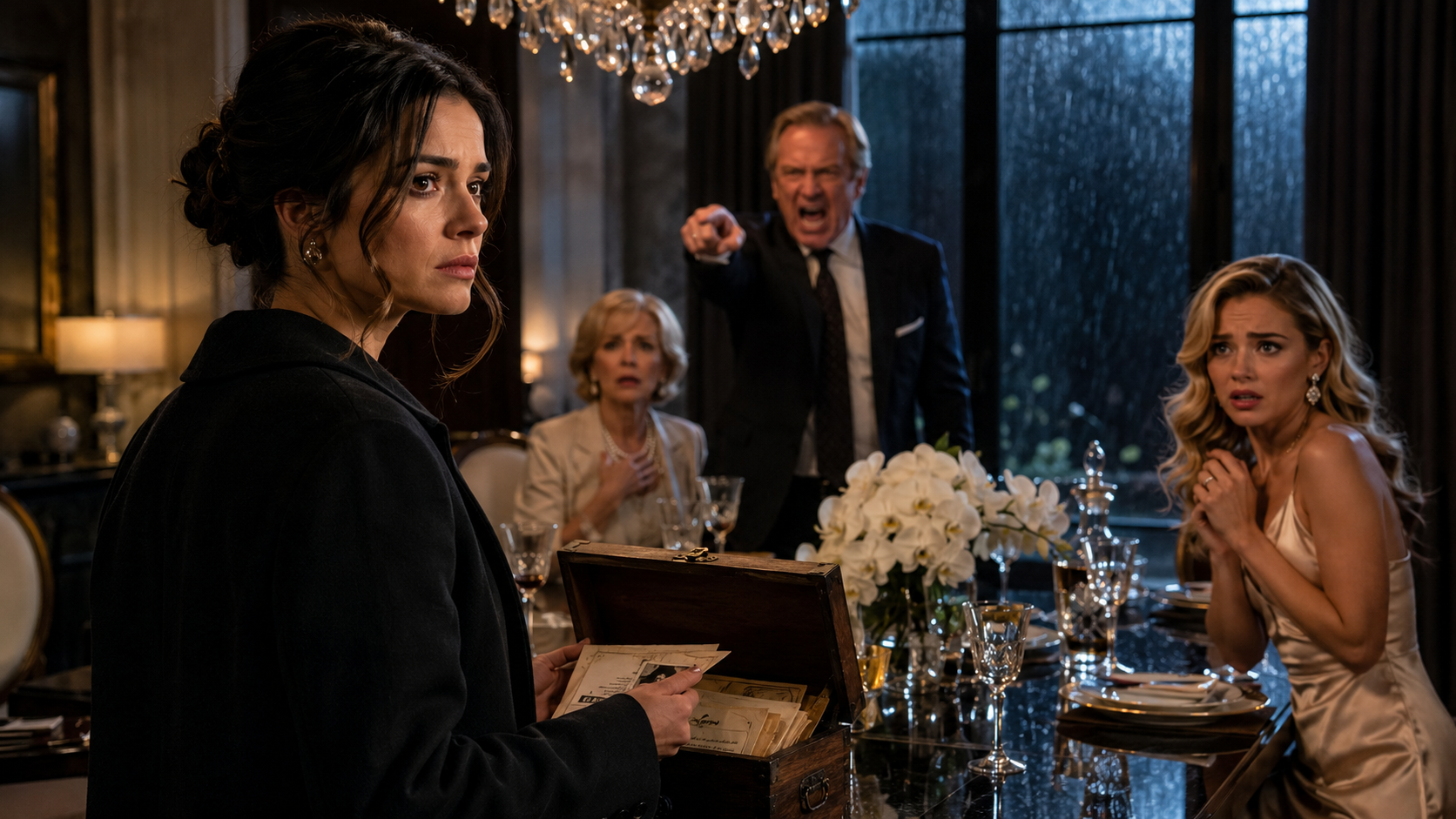
“No,” Noah said. “Which is fortunate, because this family appears to have a complicated relationship with disclosure.”
Aunt Patricia inhaled sharply.
Mara almost told Noah to stop.
Then she remembered every time someone had not stopped Clara.
So she said nothing.
Malcolm faced Mara again.
“What do you want?”
The question was smaller than she expected.
For years, she had imagined this confrontation. In her mind, her father would shout. Clara would cry. Her mother would collapse into apologies. The family would finally see everything clearly.
But reality was not clean.
Her father looked angry and old.
Her sister looked cornered, not sorry.
Her mother looked broken, but Mara no longer trusted brokenness as proof of love.
And the relatives looked uncomfortable in the specific way people look when they realize they have benefited from not asking enough questions.
“What do I want?” Mara repeated.
She glanced down at the cedar box.
Then at Grandma Ruth’s letter.
Then at Clara.
“I want the lies corrected.”
Clara laughed.
“There it is. You want a public apology.”
“No,” Mara said. “I want public correction. Apologies are optional. Truth is not.”
Malcolm’s voice hardened.
“You cannot force people to rewrite the past.”
“No,” Mara said. “But I can stop funding the version that erased me.”
She took out the final folder.
“This contains copies of the letters Clara sent Grandma during the last two years of her life.”
Clara’s entire face changed.
Not a lot.
Enough.
Julian saw it.
Mara saw him see it.
“Don’t,” Clara whispered.
For the first time all evening, her voice held no polish.
Mara looked at her sister for a long moment.
Somewhere inside her, a younger Mara still wanted Clara to be better than this. Still wanted the older sister who once braided her hair before school, who once killed a spider in their bedroom and made Mara laugh until she forgot to be scared.
But memory was dangerous when used as a blindfold.
Clara had not been only cruel.
That was what made it complicated.
She had also been funny, protective when it cost her nothing, generous when being generous made her look good, affectionate when no one was watching too closely.
But she had also known.
Maybe not everything.
But enough.
Mara opened the folder.
“Grandma, I am worried about Mara,” she read. “She has become increasingly resentful and unstable. If you leave her significant property, I fear she will use it to divide the family.”
Julian closed his eyes.
Clara whispered, “I was trying to protect everyone.”
Mara continued.
“She has always struggled with comparison. Dad and Mom have done their best, but Mara interprets normal family dynamics as rejection.”
Aunt Patricia covered her mouth.
Uncle Neil stared at Clara as if he had never seen her before.
Mara read the next line.
“If you insist on leaving her anything, please consider appointing Dad or me as trustee. Mara does not need independence right now. She needs guidance.”
Mara lowered the page.
“Guidance,” she said softly.
Clara’s eyes filled with tears.
Mara almost admired the timing.
“I was scared,” Clara said.
“Of what?”
“Of you doing exactly this.”
Mara tilted her head.
“Exposing what you did?”
“No,” Clara snapped. “Destroying us.”
Mara stared at her.
There was the difference.
At last.
Clara could look at a room full of lies and call the truth destruction.
“I did not destroy this family,” Mara said. “I just stopped letting myself be the place where everyone hid the damage.”
Irene suddenly stood.
“Mara, I knew some things.”
The room turned toward her.
Malcolm said sharply, “Irene.”
She flinched.
That old reflex.
Mara knew it well.
But this time Irene did not sit down.
“I knew your grandmother wanted to help with school,” Irene said, crying harder now. “I knew your father thought it was a mistake. I knew he redirected some of the money, but I told myself he had a plan, that he understood finances better than I did, that maybe you really weren’t ready.”
Mara felt something cold pass through her.
Not shock.
Confirmation.
It was heavier than shock.
“How much did you know?” Mara asked.
Irene looked at her.
Really looked.
For once, she did not hide behind softness.
“Enough,” she whispered.
A single word.
The cruelest honest answer.
Mara nodded.
It felt like something inside her had been waiting years to stop asking.
“Thank you,” Mara said.
Irene blinked through tears.
“For what?”
“For finally not lying.”
Irene reached for her.
“Mara—”
Mara stepped back.
Her mother’s hand hung in the air.
For a second, Mara saw her as she had always wanted her to be: protective, brave, willing to choose her when choosing her cost something.
Then the image vanished.
All that remained was a woman who had spent decades mistaking surrender for peace.