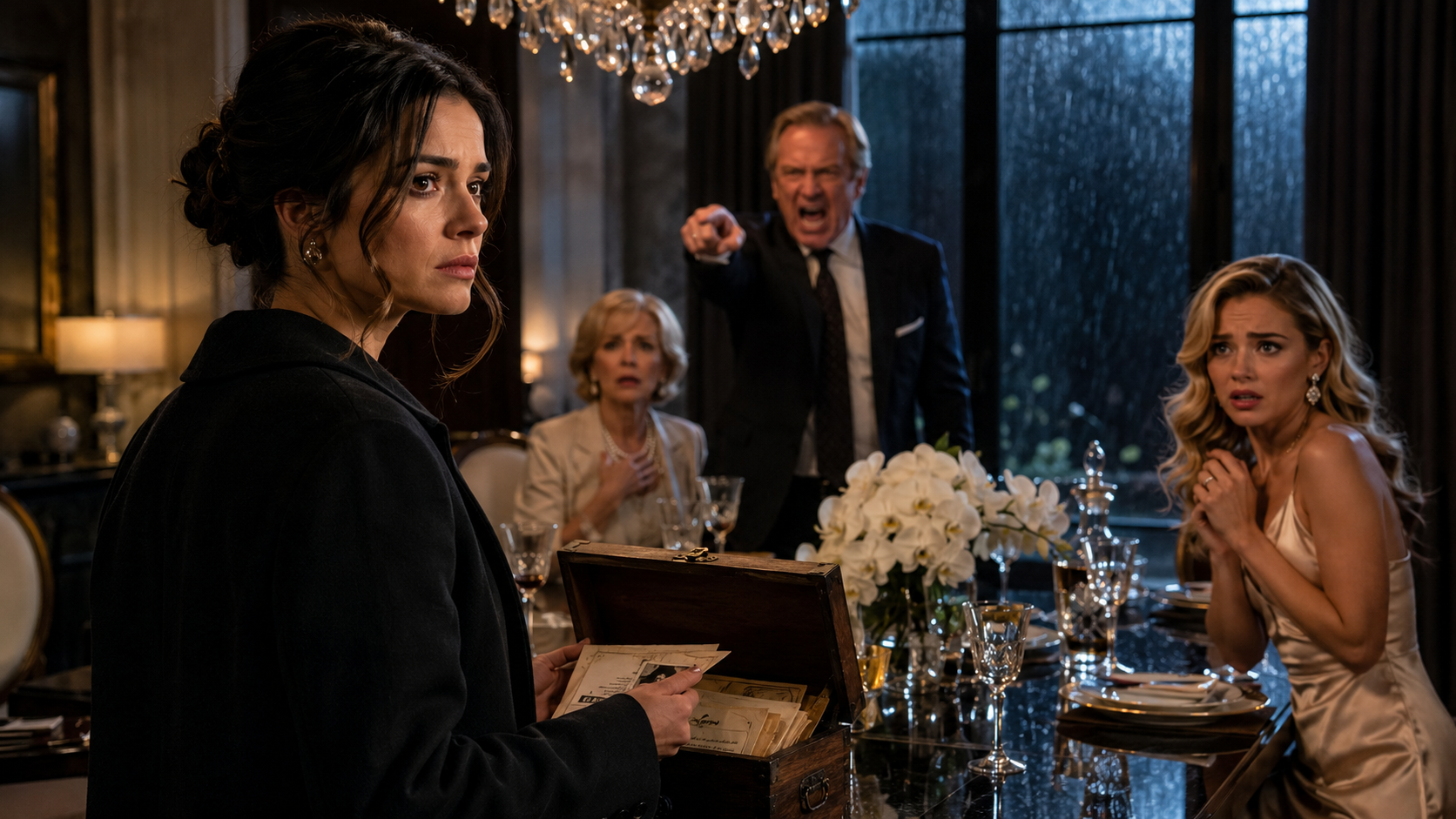
Her father’s eyes dropped to the box.
“What is that?”
Mara removed her coat and laid it neatly over the back of a chair.
“Something Grandma Ruth left for me.”
Her mother’s face lost color.
Clara’s hand closed around the stem of her champagne glass.
Malcolm’s jaw tightened.
The room understood something before anyone said it.
Whatever was inside that box had not been invited.
“Mara,” Irene said carefully, “today is not the day for difficult conversations.”
“That’s interesting,” Mara replied. “Because difficult conversations always seemed perfectly acceptable when I was the subject and not the speaker.”
Aunt Patricia looked down at her salad plate.
Uncle Neil cleared his throat.
Clara gave a soft little sigh.
“There it is,” she said. “I wondered how long it would take.”
Mara turned toward her.
“How long what would take?”
Clara tilted her head with practiced sadness.
“The performance.”
A few people shifted uncomfortably.
It was a perfect Clara sentence. Gentle enough to sound concerned. Sharp enough to wound. Vague enough that anyone could pretend she hadn’t meant harm.
Mara had spent thirty-four years being cut by those kinds of sentences.
Tonight, for the first time, she did not bleed.
“I’m not here to perform,” Mara said.
“Then why bring a box?” Clara asked.
Mara smiled faintly.
“Because people in this family have a strange relationship with memory. I thought objects might help.”
Malcolm stepped forward.
“You will not turn your sister’s celebration into another scene.”
Another scene.
That was what they called it when Mara told the truth in the wrong tone.
She looked at him calmly.
“I’m not turning it into anything. I’m finishing something that started before I was old enough to understand it.”
Her mother whispered, “Please.”
Mara almost looked away.
Almost.
Irene had mastered that voice.
The wounded voice.
The frightened voice.
The voice that made Mara feel cruel for noticing her own pain.
But Grandma Ruth’s letter sat inside the cedar box, folded in a blue envelope, and Mara had read it so many times the words no longer felt like ink. They felt like a hand on her back.
Your mother knows more than she admits. That may hurt you most. I am sorry.
Mara opened the box.
The old brass hinges gave a quiet creak.
Clara sat down.
No one told her to.
She simply did, as if her knees had lost interest in holding her.
Mara took out the first folder.
It was not dramatic.
That was almost the cruelest thing about it.
The truth did not come wrapped in thunder.
It came on thin paper, with dates, signatures, bank logos, and careful handwriting from dead people who had finally become braver than the living.
“This,” Mara said, holding up a copy of a letter, “is from Westlake University. Dated March 14, twelve years ago.”
Malcolm’s expression did not change.
But his fingers tightened on the chair.
Mara continued.
“It confirms my acceptance into the graduate design program.”
Cousin Owen looked up sharply.
“You got into Westlake?”
Mara glanced at him.
“Yes.”
“I thought you didn’t apply.”
“That’s what I was told too.”
The first crack opened at the table.
Small.
Audible.
Clara’s eyes moved toward Malcolm.
Mara laid the letter on the table.
“Grandma offered to pay the tuition. All of it. Not a loan. Not conditional. Not something I would need to earn by being grateful enough. She wrote directly to Dad because she wanted to make sure the paperwork was handled quickly.”
Her father’s voice came low.
“Mara.”
She took out the second page.
“This is his response.”
Irene closed her eyes.
That was when Mara knew.
Some part of her had still hoped.
Pathetic, maybe.
Human, definitely.
She had still hoped her mother had been ignorant. Weak, perhaps. Frightened, perhaps. But not fully aware.
Yet Irene’s face was not confused.
It was ashamed.
Mara read the letter aloud.
“Ruth, I appreciate your generosity, but Mara is not suited for that kind of pressure. Clara has the discipline and social instincts to make use of real opportunity. Mara needs stability, not ambition.”
The room became very still.
Rain tapped lightly against the windows.
Somewhere outside the private dining room, a waiter laughed in the hallway, and the sound felt obscene.
Mara placed the page beside the acceptance letter.
“For twelve years,” she said, “I believed I had lost that program because our family couldn’t afford it.”
Uncle Neil frowned.
“But your father told us you decided not to go.”
Mara looked at him.
“Yes. He told everyone different versions. To some of you, I was afraid to leave home. To others, I was too depressed. To others, I had missed the deadline. I heard all of them eventually.”
Clara set down her glass.
“Mara, this is ancient history.”
Mara turned.