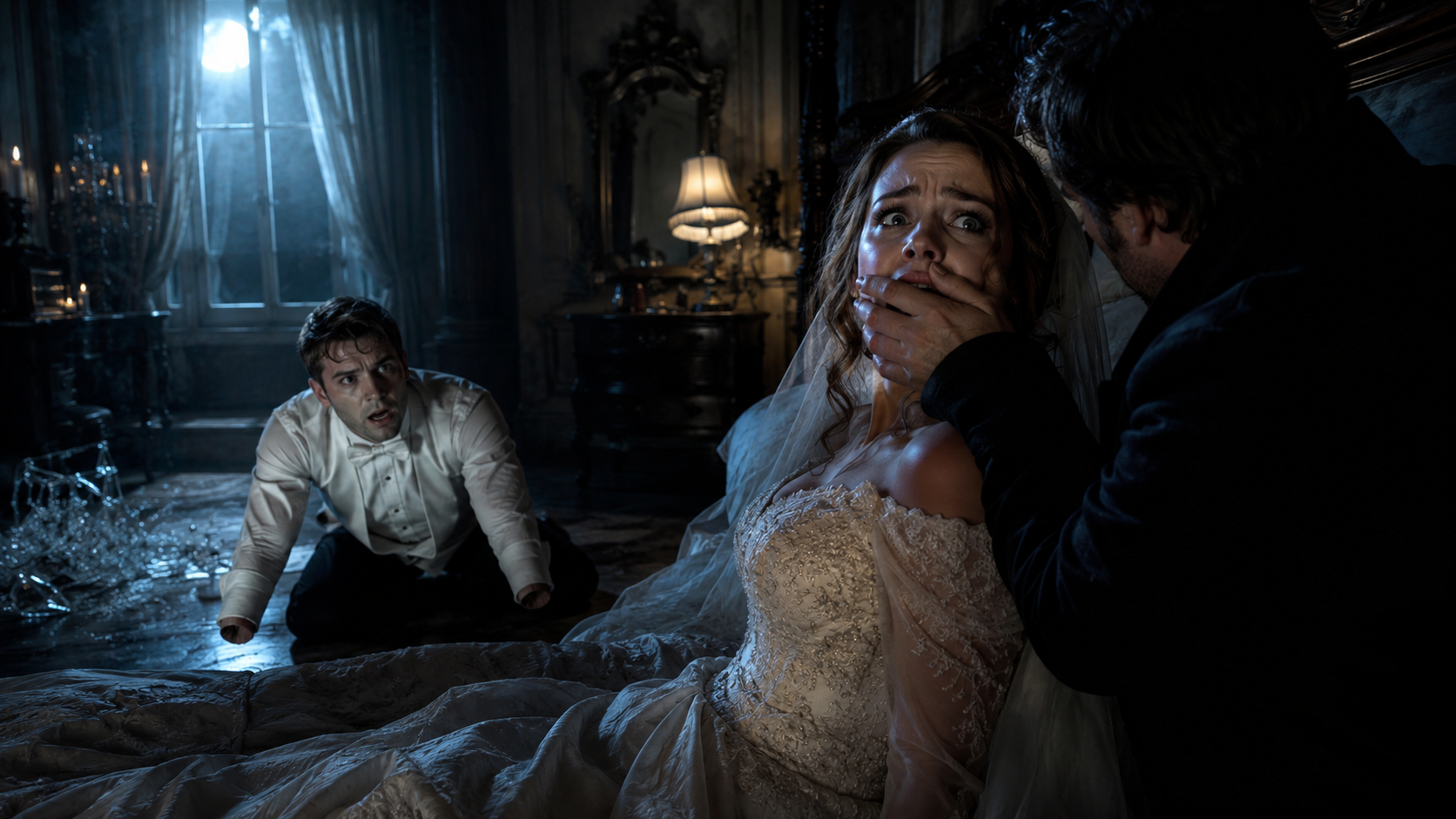
Not like a fairy tale.
More like cloth being repaired after a tear: patient, careful, reinforced where the strain had been worst.
Nora learned Silas hated pity but appreciated being asked. Silas learned Nora went quiet when afraid and sharp when cornered. They argued sometimes. They apologized better. They went to therapy separately and together. They built habits no one had forced on them.
One evening, a year after the wedding night that had almost destroyed them, Silas came into the shop wearing a charcoal jacket Nora had made for him. It fastened with hidden magnets and fit his shoulders perfectly.
He looked nervous.
Nora narrowed her eyes. “What did you do?”
“Nothing illegal.”
“That is a low standard, but continue.”
Using the speaker attached to his chair, Silas played a message he had prepared in his own voice.
“Nora, our first wedding was a contract signed under fear. Neither of us chose it freely. So I am asking now, with no money between us, no threat over your mother, no locked door, and no Blackthorne watching from the hallway…”
His eyes shone.
“Would you go on a real first date with me?”
Nora covered her mouth.
Silas looked terrified. “You can say no.”
“I know.”
“And?”
She stepped closer.
“Yes.”
Their first real date was at a diner with bad coffee and excellent pie. Silas knocked over a water glass with his elbow. Nora burned her tongue on soup. They both laughed so hard the waitress smiled from across the room.
Love did not arrive overnight.
Trust did not bloom because a judge had signed papers.
But it grew.
Stitch by stitch.
Two years after the trial, Nora and Silas stood outside the old Blackthorne House.
The mansion had been sold to pay restitution, then purchased by a nonprofit that planned to turn it into a rehabilitation center for survivors of abuse and workplace injury. The bridal bedroom had been stripped. The locks had been changed. The sewing room was preserved as a workshop.
Mrs. Rowe attended the opening ceremony.
She cried when Nora hugged her.
“I should have helped sooner,” she said.
Nora held her tightly. “You helped when you could finally breathe.”
Silas looked up at the front entrance, where workers were building a wide ramp.
“For years,” he said, “I thought this house was where my life ended.”
Nora stood beside him. “Maybe now it becomes where someone else begins again.”
He glanced at her. “That sounds like something embroidered on a pillow.”
“I am a seamstress,” she said. “I am allowed.”
He laughed.
At the ceremony, Nora gave a short speech.
She did not tell every detail. Some wounds did not belong to the public. But she told enough.
“I once believed desperation had forced me to sell my life,” she said. “But desperation did not create the evil in that house. People did. People who knew that medical bills, poverty, disability, and silence can be twisted into chains.”
The crowd listened.
“I learned that a person can be trapped in a mansion more completely than in a cell. I learned that a man without hands can still reach for courage. I learned that a frightened housekeeper can become a witness. I learned that a sick mother can still teach her daughter what freedom costs.”
Silas lowered his head.
Nora continued.
“If someone controls your medicine, your money, your family, your mobility, your reputation, or your fear, and calls it love, hear me clearly: you are not property. A contract signed in terror is not devotion. A locked room is not a home.”
Applause rose slowly.
Then strongly.
Lucia sat in the front row with a blanket over her knees, crying openly.
That evening, Nora and Silas returned to The Second Seam. Rain tapped against the window. They ate noodles from paper cartons on the cutting table between sketches, fabric rolls, and half-finished orders.
Silas looked around the shop.
“Do you ever regret marrying me?”
Nora set down her fork.
She thought about the hospital bill. The wedding dress. The almond milk. The dark room. The hand over her mouth. Silas on the floor. The trial. The slow work afterward.
Then she looked at him.
“I regret why I married you,” she said. “I do not regret knowing you.”
Silas’s eyes softened.
“That may be the kindest honest thing anyone has ever said to me.”
“I specialize in repairs.”
“Is that what we are?” he asked.
Nora smiled.
“No. We are not something repaired.”
She reached across the table and touched his sleeve.
“We are something remade.”
Years later, when people told the story, they always began with the shocking part.
The poor seamstress.
The husband without hands.
The wedding night terror.
The cruel brother.
The saintly mother who was never a saint.
But Nora always corrected them.
“The story is not about the hands that hurt me,” she would say. “It is about the people who helped me reach the door.”