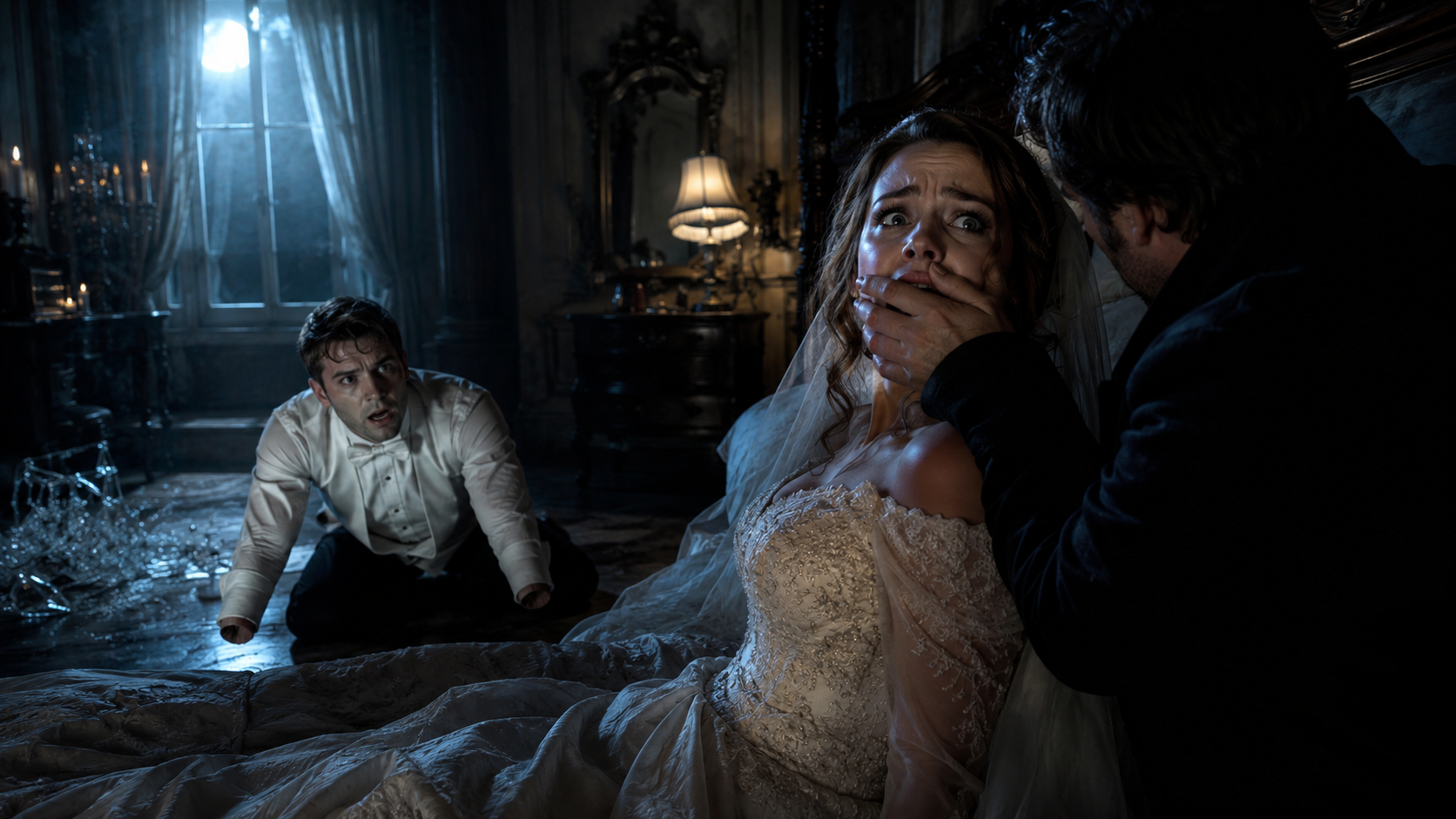
“My name is Mabel Rowe,” she said, voice trembling but clear. “Send officers to Blackthorne House. A woman has been drugged. A disabled man has been restrained and abused. There is evidence connected to the old glassworks accident.”
Evangeline tore the phone from the wall.
But the call had gone through.
Within minutes, sirens cut through the night.
Before the officers arrived, Evangeline transformed.
Her hair was smoothed. Her robe was replaced with a black dress. Her cross hung at her throat. Her voice became soft, wounded, maternal.
“Officers,” she said at the door, “my new daughter-in-law is unstable. The marriage has overwhelmed her. My son Silas is fragile, and my elder son was trying to calm everyone.”
Nora stood beside Silas, torn sleeve visible, bruises already rising on her wrist.
Mrs. Rowe stood behind them holding the drive.
Rowan shouted that Nora was a thief.
Silas spoke before anyone else could.
“My mother and brother are lying,” he said. “My wife is in danger. So am I.”
Evangeline sighed sadly. “You see? He has been like this since the accident.”
Silas looked straight at the officers.
“Ask her why she refused me adaptive therapy for four years. Ask her why my medical funds disappeared. Ask why the worker who saw my accident left town the next morning. Ask why my wife was given sedatives on her wedding night.”
One officer’s expression changed.
Nora added, “The cup is still in the bridal room. Test it.”
Evangeline’s face went still.
That was the first crack in the saintly mask.
The police separated everyone.
Nora and Silas were taken to the hospital. Rowan was detained after officers documented Nora’s bruises, his injured hand, the damaged room, and signs that Silas had been restrained. Evangeline was not arrested that night, but her world had begun to split open.
At the hospital, Nora sat under a blanket with her knees drawn up, staring at nothing.
Silas waited beside her in his wheelchair.
For a long time, neither spoke.
Then he said, “I am sorry.”
Nora closed her eyes. “Don’t.”
“I should have stopped the wedding.”
“You tried.”
“Not enough.”
“You were tied to the floor with no hands and still tried to save me.” She turned to him. “Do not insult that by calling it nothing.”
Silas’s eyes filled.
Nora reached toward his sleeve, then paused. “May I?”
He nodded.
She touched the cloth gently where his hand should have been.
“I don’t know what this marriage is,” she said. “But I know what it is not.”
Silas looked at her.
“It is not theirs anymore.”
The drive changed everything.
It contained copies of safety reports, payroll records, letters between Evangeline and local officials, photographs from the glassworks, and a recorded argument between Rowan and Silas from the day before the accident.
Rowan’s voice was clear.
“If you expose me, little brother, you will never sign another report again.”
Two days later, investigators searched Blackthorne Glass.
They found forged inspections, hidden worker injuries, unpaid settlements, missing pension money, and chemical waste dumped near the river. Former employees began speaking. A safety inspector resigned. A judge ordered Silas removed from Evangeline’s control. Nora’s marriage contract was challenged as coercive.
The Blackthorne name, once polished like silver, began to blacken in public.
Evangeline appeared outside church in mourning black, telling reporters, “A greedy young woman married my disabled son for money and is now trying to destroy our family.”
Nora watched the clip from her mother’s hospital room.
Lucia Vance lay weak but awake, her hand resting over Nora’s.
“Did you suffer because of me?” Lucia whispered.
Nora bent her head. “No, Mama.”
“Do not lie to a woman who raised you.”
Nora broke then.
She cried the way she had not cried in the locked room, not in the police car, not under the hospital lights.
Lucia touched her cheek.
“I cleaned houses until my hands cracked so you would never have to sell your life for mine.”
“I thought you would die.”
“I know.” Lucia’s eyes shone. “But a mother does not want her child breathing in a cage.”
Nora lowered her head onto the bed and wept.
For the first time, she allowed herself to understand the trap fully.
Poverty had pushed her toward that house.
But poverty had not drugged her.
Poverty had not tied Silas to the floor.
Poverty had not covered crimes with prayers and polished silver.
People had done that.
Powerful people.
People who knew desperation could be used like a leash.
The trial took nearly a year.
During that time, Nora moved into a small apartment near the hospital. Silas moved into a rehabilitation center where, for the first time since the accident, he received proper therapy, adaptive equipment, trauma counseling, and legal protection from his mother.
He learned to use voice-controlled software.