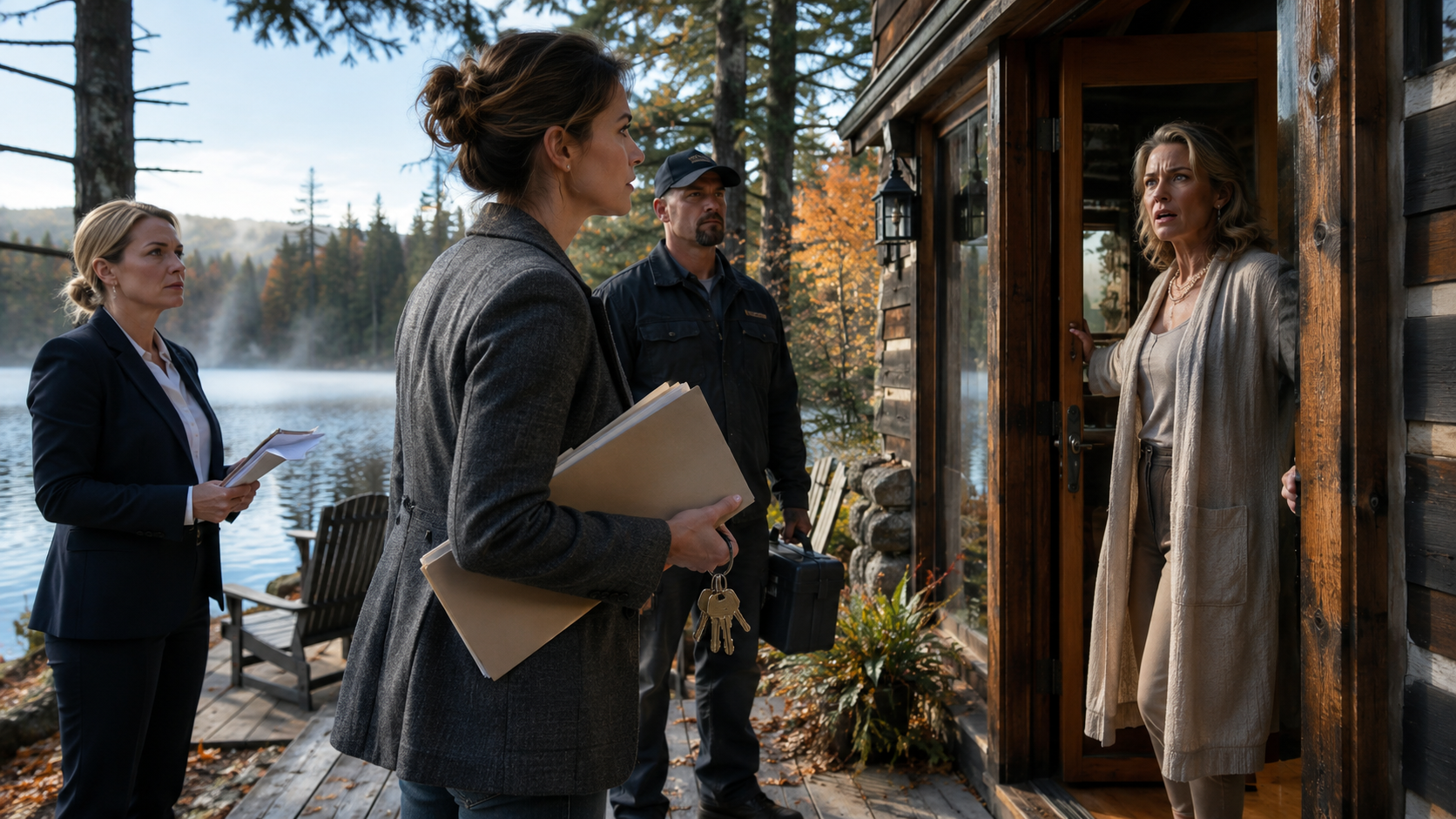
Tessa’s tears stopped.
Only for a second.
But long enough.
Mara handed her a packet.
“Permission to occupy has been revoked. Multiple notices have been delivered. You have no lease, no rental agreement, and no ownership interest. We are here for inspection and documentation of unauthorized alterations and commercial use.”
Tessa crossed her arms.
“I live here.”
“That claim can be addressed through the proper process,” Mara said. “Today, the owner is exercising her rights with witnesses present.”
The deputy added, “We’re here to keep the peace.”
Tessa looked at him.
“This woman is weaponizing the law because she can’t stand that I turned a dead little cabin into something meaningful.”
Evelyn flinched.
Dead little cabin.
Claire inhaled sharply behind her.
Mara lifted one finger without turning around.
Claire stayed silent.
Evelyn stepped closer.
“My father’s hands are in that porch railing,” she said. “My savings are in those walls. My weekends are in that dock. My grief is in that bedroom. You did not make it meaningful. You made it useful to you.”
Tessa’s mouth tightened.
“You abandoned this place.”
“I worked to afford it.”
“You let it sit empty.”
“I let you stay because you said you were breaking.”
“I was.”
“No,” Evelyn said. “You were waiting for me to feel too guilty to say no.”
For once, Tessa had no immediate answer.
The inspection began.
Every room told on her.
The downstairs bedroom had been repainted cream. Evelyn’s quilt was stained with candle wax. Two floorboards near the fireplace were scorched. A closet had been cleared and filled with folding mats, incense, and boxes of journals labeled for retreat guests. The smoke detector in the hallway had been removed because, according to Tessa, “it kept interrupting ceremonies.”
The inspector photographed everything.
Mara took notes.
The deputy remained by the door.
The locksmith examined the changed lock and confirmed it had been replaced recently.
Evelyn walked through slowly, trying not to break.
In the kitchen, she found her father’s mug shoved into the back of a lower cabinet, cracked down one side.
She picked it up with both hands.
Tessa saw it and shrugged.
“It was chipped already.”
Evelyn closed her eyes.
A memory rose: her father sitting on the porch, drinking black coffee, saying, “You know what makes a place yours? Not the deed. The work. Every nail remembers who drove it.”
She opened her eyes.
“No,” she said. “It wasn’t.”
Upstairs in the loft, they found six sleeping pallets arranged close together. There were handwritten notes taped to the wall.
I release shame.
I claim abundance.
I deserve a home that holds me.
Claire muttered, “Apparently she claimed yours.”
Mara looked at her.
Claire pressed her lips together.
On a small desk by the loft window sat a folder.
Mara opened it carefully.
Inside were printed booking confirmations, deposit records, guest waivers, and a draft of a document titled Residential Contribution Agreement.
Mara’s face changed.
“What is that?” Evelyn asked.
Tessa moved quickly.
“That’s private.”
Mara did not hand it to her.
“This appears to be a document asking participants to pay monthly contributions for extended stays at this property.”
Tessa’s voice sharpened.
“It was an idea.”
“For property you do not own?”
“I was creating community.”
“You were preparing to sublet,” Mara said.
Tessa’s eyes snapped to Evelyn.
“You had everything. You had a job. You had savings. You had this place. I had nothing.”
Evelyn looked at her.
There it was.
Not apology.
Not confusion.
Not friendship.
Resentment.
The honest thing beneath all the soft words.
“I helped you because I thought you had nothing,” Evelyn said. “I didn’t understand that nothing was just what you planned to leave me with.”
The inspection continued for two hours.
By the time they returned to the porch, Tessa’s performance had collapsed into fury.
“You think this makes you strong?” she demanded. “You think standing here with a lawyer makes you better than me?”
“No,” Evelyn said. “It makes me finished.”
Mara turned to Tessa.
“You need to gather essential personal belongings for today. A full inventory and arrangement for remaining items will be handled through written communication.”
Tessa laughed.
“You can’t just change the locks.”
The deputy spoke calmly.
“Ma’am, you need to follow the instructions being given. This is a civil matter, and you’ve been advised.”
Tessa looked from face to face.
No one moved toward her.
No one comforted her.
No one asked Evelyn to be reasonable.
That seemed to frighten her more than anything.
For twenty minutes, Tessa packed with angry, dramatic movements. She took clothes, jewelry, a laptop, two bags of toiletries, three boxes of candles, and several bundles of sage. She tried to take the clay mugs from the kitchen.