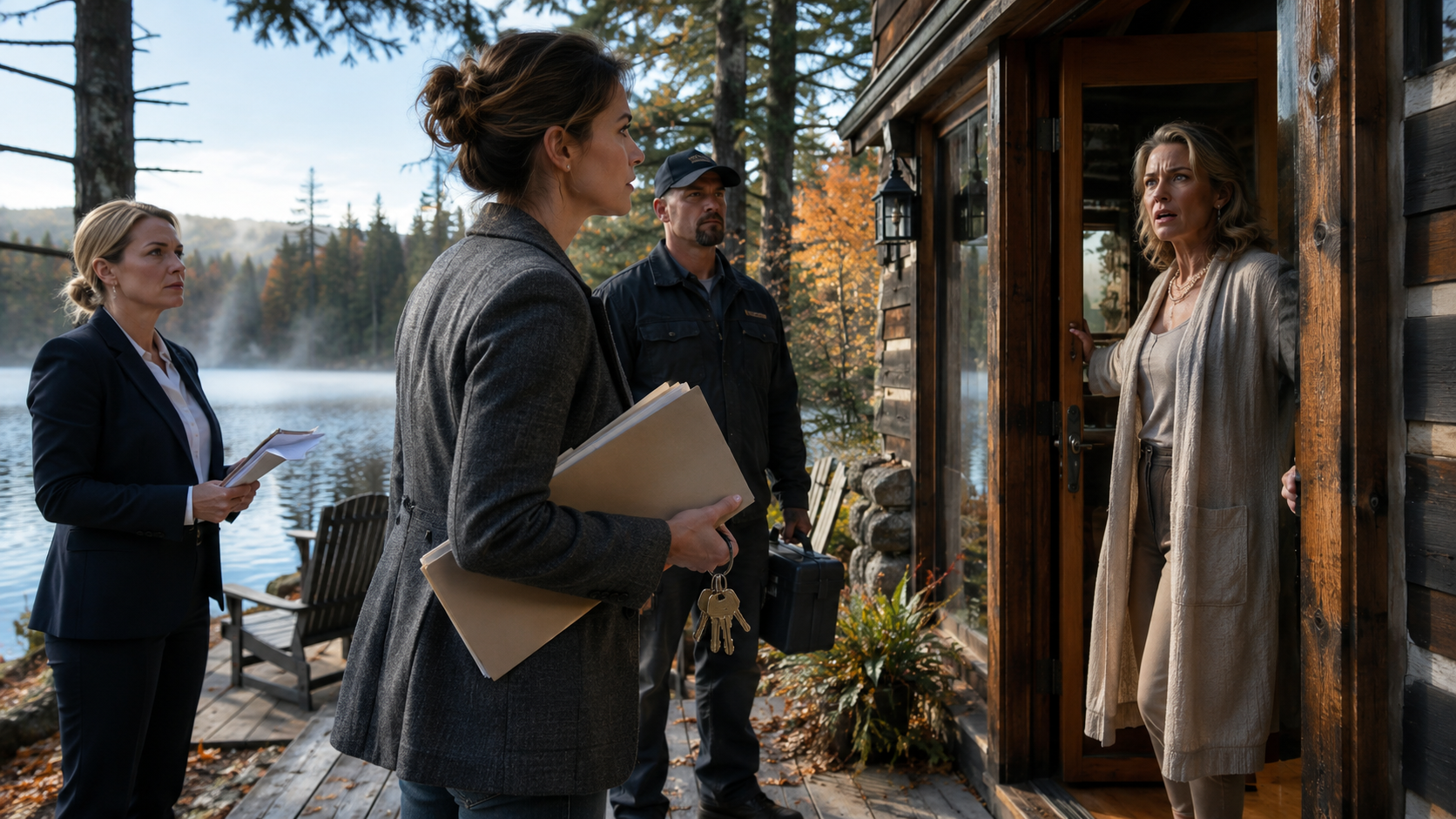
Evelyn said, “Those are mine.”
Tessa scoffed.
“You hated them.”
“I hated that you replaced mine with them. But I bought the shelf. I bought the kitchen. I bought the cabin. Leave them.”
Tessa slammed the cabinet shut.
At the door, she paused.
She looked smaller with her bags in her hands.
For a moment, Evelyn almost saw the girl from college again, the one who had danced barefoot in the dorm hallway and shared cheap noodles during finals week.
Then Tessa said, “You’re going to be lonely here.”
Evelyn glanced at the lake.
The cold silver water.
The pines.
The porch her father had helped repair.
The cabin wounded but standing.
“No,” she said. “I was lonely when you were here.”
The locksmith changed the lock after Tessa left.
The sound of the drill echoed across the quiet lake.
Evelyn stood on the porch holding the new keys in her palm.
They looked ordinary.
Small.
Silver.
Almost disappointing, considering what they meant.
Claire came to stand beside her.
“You okay?”
Evelyn looked through the open doorway.
The cabin smelled of smoke, wax, perfume, and something sour beneath it all. Her furniture was wrong. Her walls were wrong. Her door was wrong. Her father’s mug was broken.
But the cabin was still there.
So was she.
“I don’t know,” Evelyn said.
Claire nodded.
“That’s allowed.”
For the next month, Evelyn worked every weekend.
She scrubbed wax from the floor. She washed curtains. She boxed Tessa’s remaining belongings with Mara’s instructions and photographed every item. She had the smoke detectors replaced, the wiring inspected, the scorched floor repaired, and the blue paint stripped from the front door.
Underneath, the old green remained in thin stubborn streaks.
Evelyn cried when she saw it.
Not because paint mattered.
Because something of hers had survived beneath what Tessa had put over it.
In the back of the closet, behind a stack of retreat mats, Claire found the old guest book.
The cover was bent.
A few pages had been torn.
But most of it remained.
Evelyn sat at the kitchen table and turned the pages slowly.
Friends who had visited years ago.
Her father’s blocky handwriting.
First night on the repaired dock. Evie did most of the work. Don’t let her tell you otherwise.
She laughed through tears.
Near the back, there was one entry in Tessa’s handwriting from the first week.
Thank you, Evie, for giving me seven days in a place that is yours in every beautiful way. I needed this more than I can say. I promise to leave it as gently as I found it.
Evelyn stared at the words.
Seven days.
Yours.
Promise.
Mara used a copy of that page later.
Tessa did not return quietly.
She posted one last video accusing unnamed people of using legal systems to destroy women-led healing spaces. But by then, too many people had heard enough of the truth.
Deposits had been refunded by force or embarrassment.
Mutual friends had gone silent.
Hannah posted a careful message saying she had unknowingly booked a retreat at a property the host did not own.
The story shifted.
Not all at once.
But enough.
One evening, Evelyn received a text from Tessa.
No apology.
No accountability.
Just one sentence.
I hope the cabin was worth losing me.
Evelyn sat on the porch at sunset, reading it twice.
The lake moved gently against the dock.
The repaired front door stood open behind her.
Inside, the house smelled of lemon oil, cedar, and coffee.
She thought about answering.
She thought about writing something sharp.
She thought about sending a photograph of the guest book, or the broken mug, or the new lock.
Instead, she blocked the number.
Then she made coffee in her father’s chipped backup mug, carried it down to the dock, and watched the last light burn across the water.
For the first time in almost a year, no one was performing grief on her porch.
No one was renaming her life.
No one was turning her kindness into a contract.
The cabin was quiet.
Not empty.
Quiet.
There was a difference.
In the spring, Evelyn repainted the front door herself.
Not the exact old green.
Something deeper.
Pine green, with a black iron handle and a lock that opened only for people she chose.
Claire helped plant lavender along the steps.
Mara sent the final paperwork in a thick envelope and included a note written on a small square of office stationery:
Never feel guilty for locking a door you paid to build.
Evelyn pinned it inside the pantry.
That summer, she invited people back to the cabin.
Carefully.
Her sister first.
Then Hannah, who brought a bottle of wine and apologized three more times than necessary.
Then two coworkers who asked before moving a chair.
No one stayed longer than agreed.
No one painted anything.
No one called it theirs.
On the anniversary of the day Tessa first called asking for one week, Evelyn drove up alone.
She arrived before sunset, unlocked the door, and stepped inside.
The cabin looked imperfect again.
Her kind of imperfect.
The floorboards creaked. The porch screen still needed patching. The old stove still clicked before lighting. The mantel held her father’s photograph. The guest book sat on the coffee table.
On the first blank page after the damaged section, Evelyn wrote:
I came back with a lawyer and a locksmith because I forgot, for a while, that kindness without boundaries becomes an invitation to people who do not love you.
Then she paused.
Added another line.
This cabin is not a sanctuary because someone named it one. It is a sanctuary because I learned how to protect it.
She closed the book.
Outside, the lake darkened.
A loon called once from somewhere beyond the reeds.
Evelyn locked the door behind her, walked down to the dock, and sat with her feet above the water.
For years, she had believed being good meant keeping doors open.
Now she knew better.
Some doors prove your heart by opening.
Others save your life by staying locked.
And this time, when the cabin settled behind her in the evening wind, Evelyn did not feel selfish.
She felt home.