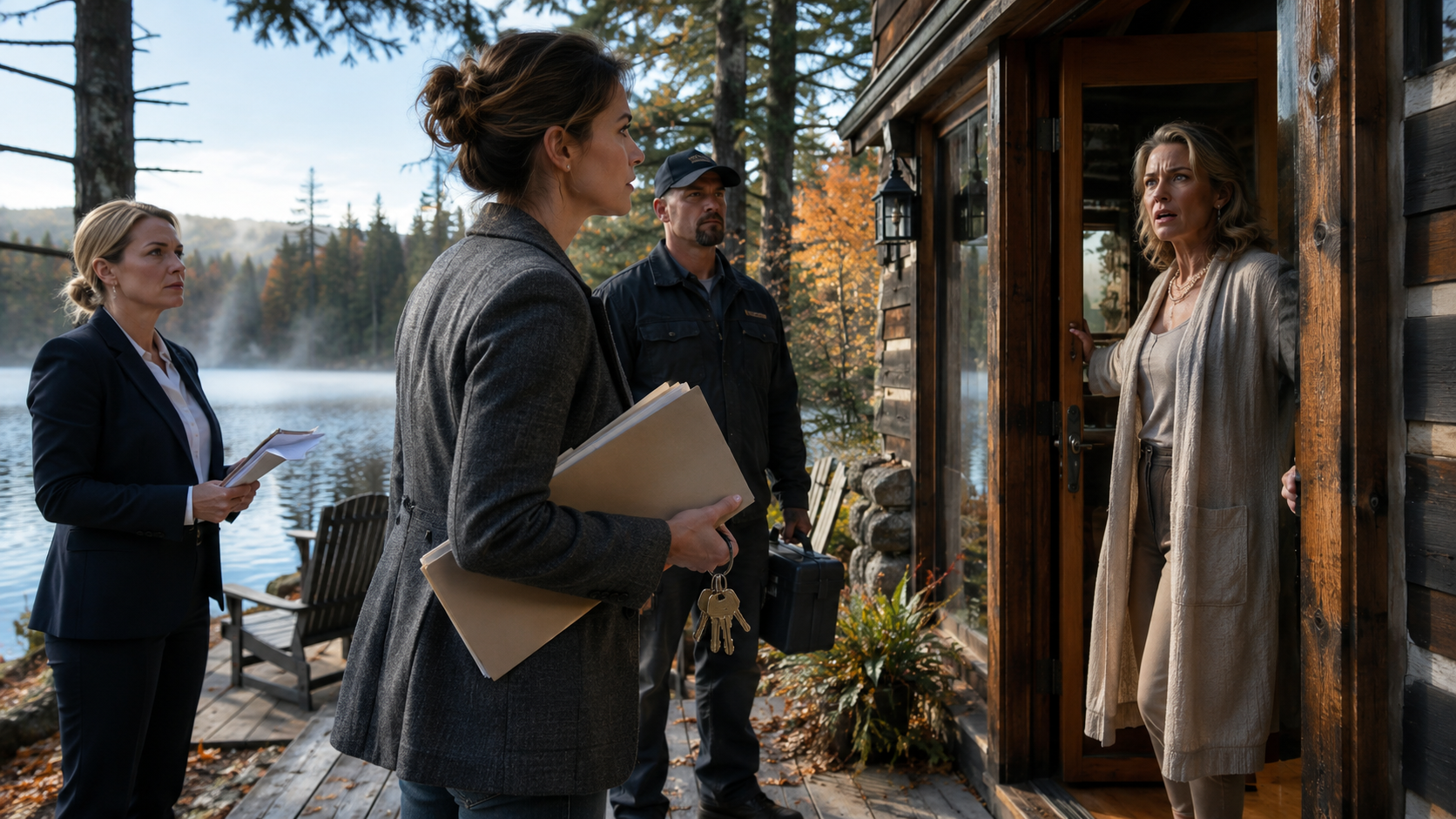
When Evelyn Mercer gave Tessa Rowe the spare key to her lake cabin, she thought she was offering her oldest friend a place to cry in private.
One week.
That was all Tessa had asked for.
“One week away from everything,” Tessa had whispered over the phone, her voice shaking in that familiar way that always made Evelyn forget every lesson she had ever learned about boundaries. “I just need silence. I need trees. I need water. I need to remember who I am.”
Evelyn had been standing in the break room of the hospital billing office where she worked, holding a vending machine coffee that tasted like burnt pennies. She had a stack of rejected insurance claims waiting on her desk, a headache pulsing behind her right eye, and exactly twelve minutes left of lunch.
Still, when Tessa cried, Evelyn’s first instinct was always to help.
“You can use the cabin,” Evelyn said.
There was a pause.
A small gasp.
“Evie, no. I couldn’t.”
“You can,” Evelyn said, softer now. “It’s empty this week. I wasn’t going up until next month anyway. Go. Sleep. Breathe. Leave the place exactly as it is, lock up when you go, and bring the key back next Sunday.”
“Next Sunday,” Tessa promised.
Evelyn believed her.
That was the mistake.
The cabin sat on the eastern side of Briar Lake, where the water turned copper at sunset and loons called across the fog before dawn. It was small, plain, and stubbornly old-fashioned: one bedroom downstairs, a sleeping loft upstairs, a green-painted kitchen, a stone fireplace, and a crooked screened porch that Evelyn had repaired twice with her own hands.
It was not a mansion.
It was not an investment property.
It was not a rental.
It was the first place in Evelyn’s life that had ever truly belonged to her.
She had bought it after twelve years of saying no to herself. No vacations. No new car. No pretty apartment with wide windows. No impulsive dinners, no expensive boots, no weekend trips with coworkers. She had lived in a gray one-bedroom apartment beside a laundromat and saved every extra dollar until the day the old cabin came on the market.
The realtor had apologized when she showed it.
“It needs work.”
Evelyn had looked at the sagging porch, the scratched floors, the smoke-stained mantel, the weeds growing around the dock, and felt something inside her settle.
“So do I,” she had said.
For four summers, she repaired it piece by piece. She sanded the kitchen cabinets. She replaced broken windowpanes. She learned how to patch screens, seal gaps, fix a leaky pipe, stack firewood, and make coffee on a stove that took ten minutes to decide whether it wanted to cooperate.
Her father had helped her with the dock before he died.
The last photograph she had of him showed him sitting on the cabin steps, laughing with a hammer in his hand, sawdust on his jeans.
After his funeral, Evelyn drove to the cabin alone and slept under a quilt that still smelled faintly of cedar. At sunrise, she walked down to the lake and promised herself she would never let anyone make her feel homeless inside her own life again.
Then Tessa called.
They had been friends since freshman year of college, back when Evelyn was shy and careful and Tessa entered every room as if it had been waiting for her. Tessa was magnetic. She could borrow a dress, lose it, apologize beautifully, and somehow make the owner comfort her. She could cancel plans at the last second and leave people worrying about her instead of being angry. She cried easily, laughed loudly, and collected wounded people the way some women collected candles.
Evelyn had been one of them.
Over the years, she had paid Tessa’s phone bill once, then twice, then stopped counting. She had driven across town at midnight after breakups. She had defended Tessa when other friends said she used people. She had told herself Tessa was simply dramatic, not dangerous.
The first week at the cabin passed quietly.
Tessa sent a photo of the lake with the message:
I can finally breathe.
Evelyn smiled.
On Sunday evening, no key appeared.
At nine, Evelyn texted:
Everything okay? Are you back?
Tessa replied at 11:48 p.m.
I’m so sorry. I had a panic spiral today. Could I stay until Wednesday? I swear I’ll be out then.
Evelyn stared at the message for a long time.
Then she typed:
Wednesday is fine. Please make sure the place is clean before you leave.
Wednesday became Friday.
Friday became the following Monday.
Monday became, “I just need until the end of the month.”
By the second month, Evelyn began to feel embarrassed for wanting her own cabin back.
Tessa always had a reason.
Her therapist said sudden displacement would be harmful.
Her mother was being cruel.
Her ex-boyfriend was harassing her.
Her nervous system was “finally learning safety.”
Evelyn tried to be patient. She told herself real friendship was not convenient. She told herself the cabin was empty most weekdays anyway. She told herself Tessa would leave soon.