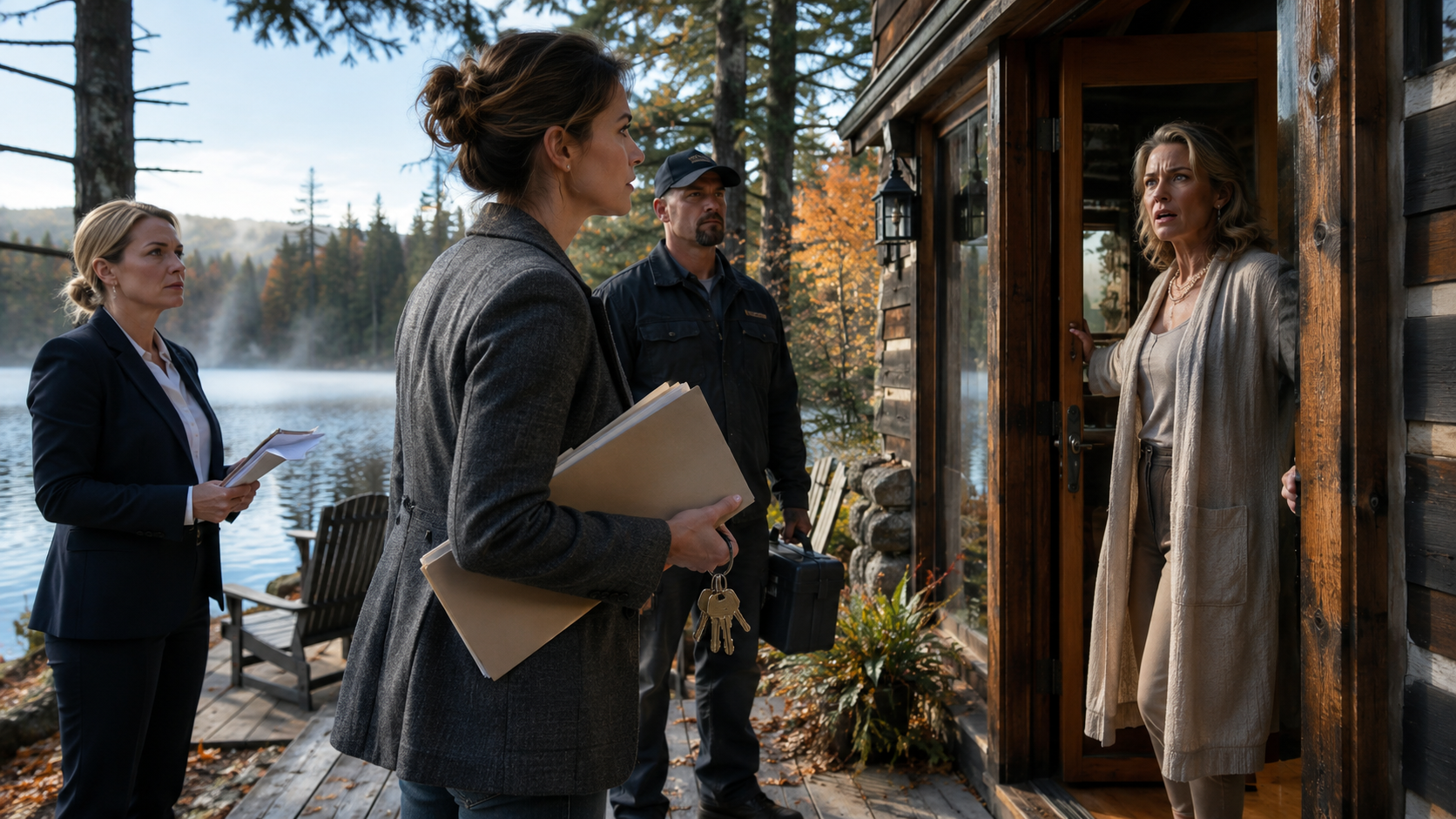
Then she drove up one Saturday morning without warning and found the front door painted blue.
Not the careful, weathered green Evelyn had chosen after three weekends of sanding and priming.
Blue.
Bright, glossy, theatrical blue.
There were wind chimes on the porch. Her father’s old fishing creel had been moved from the wall and replaced with a circular mirror framed in shells. Inside, the furniture had been rearranged. Her books were stacked in boxes near the back door. Her coffee mugs were gone from the shelf and replaced with handmade clay cups Tessa called “intention vessels.”
Evelyn stood in the doorway, her overnight bag still on her shoulder.
Tessa emerged from the kitchen in a linen robe.
“Oh,” she said. “You should’ve told me you were coming.”
Evelyn blinked.
“Tessa. This is my cabin.”
Tessa smiled gently, as if Evelyn were a frightened child.
“I know. Of course. I just mean, I’m in a very delicate place right now. Surprise energy can be hard for me.”
“Surprise energy?”
“Evie.”
That tone. Soft, hurt, disappointed. The tone that always made Evelyn feel cruel before she had even spoken.
“I painted the door,” Tessa said. “I hope you’re not upset. The old color felt heavy.”
“My father helped me paint that door.”
Tessa’s face softened instantly.
“Oh, honey. I didn’t know.”
“You didn’t ask.”
Silence stretched between them.
Then Tessa touched Evelyn’s arm.
“I’m sorry. Truly. I thought I was bringing life into the space.”
“The space is my home.”
Tessa withdrew her hand.
For one second, Evelyn saw irritation flash behind her eyes.
Then it vanished.
“Of course,” Tessa said. “I never meant to make you feel that way.”
But Evelyn did feel that way.
She felt like a guest.
In her own cabin.
By the fourth month, Tessa was receiving packages there.
By the fifth, she had changed the bedroom curtains.
By the sixth, she had removed the guest book from the coffee table because, according to her, “the energy of strangers signing ownership over a place is very colonial.”
Evelyn did not know how to respond to that.
By the eighth month, an acquaintance sent Evelyn a screenshot.
Isn’t this your cabin?
Evelyn opened it at her desk between two billing disputes and felt the blood leave her face.
The image showed Tessa on the dock at sunrise, arms spread wide, wrapped in a cream shawl. Behind her, Evelyn’s lake glittered like something sacred.
The caption read:
Join me at The Blue Heron House for a three-day private renewal retreat. Limited spaces. Fire circle, lake meditation, grief release, sisterhood meals, and sacred rest. This home has held my transformation. Let it hold yours.
Evelyn read it twice.
Then again.
The price was listed at the bottom.
Seven hundred dollars per person.
Her hands began to tremble.
The cabin Tessa had begged to use for one week had become a business.
Evelyn called immediately.
Tessa did not answer.
Evelyn texted:
Are you charging people to stay at my cabin?
Three dots appeared.
Disappeared.
Appeared again.
Then Tessa replied:
Please don’t reduce healing work to money.
Evelyn laughed once, sharply, in the silent office.
She typed:
Are people paying you to stay at my cabin?
Tessa replied:
They are contributing to the container.
Evelyn stood up so fast her chair rolled backward into the filing cabinet.
Her supervisor asked if she was all right.
“No,” Evelyn said.
For once, the word came easily.
That night, she drove to her sister’s house with a folder of printed screenshots, months of texts, and a rage so heavy it felt calm.
Her sister, Claire, read everything at the kitchen table.
Claire was older by six years, blunt in the way Evelyn had always envied, and immune to Tessa’s charm because she had disliked her since 2009.
When Claire reached the message about “the container,” she put the papers down.
“I’m going with you tomorrow.”
“No.”
“Yes.”
“I don’t want a scene.”
Claire stared at her.
“Evelyn, she painted your door, moved your furniture, opened a business, and made you ask permission to enter your own cabin. The scene started months ago. You’re just late.”
Evelyn looked away.
Claire’s voice softened.
“Call a lawyer.”
“I don’t want to ruin her life.”
“She is living in yours.”
The lawyer’s name was Mara Ellison.
She worked out of a narrow brick office above a bakery downtown and wore black reading glasses on a chain around her neck. She was in her fifties, calm, precise, and had the unnerving habit of letting silence do half the questioning.
Evelyn told her everything from the beginning.
The phone call.
The one-week promise.
The delayed departure.
The painted door.
The packages.
The retreats.
The posts.
The way Tessa had started saying “our little lake home” when talking to mutual friends.
Mara listened without interrupting.