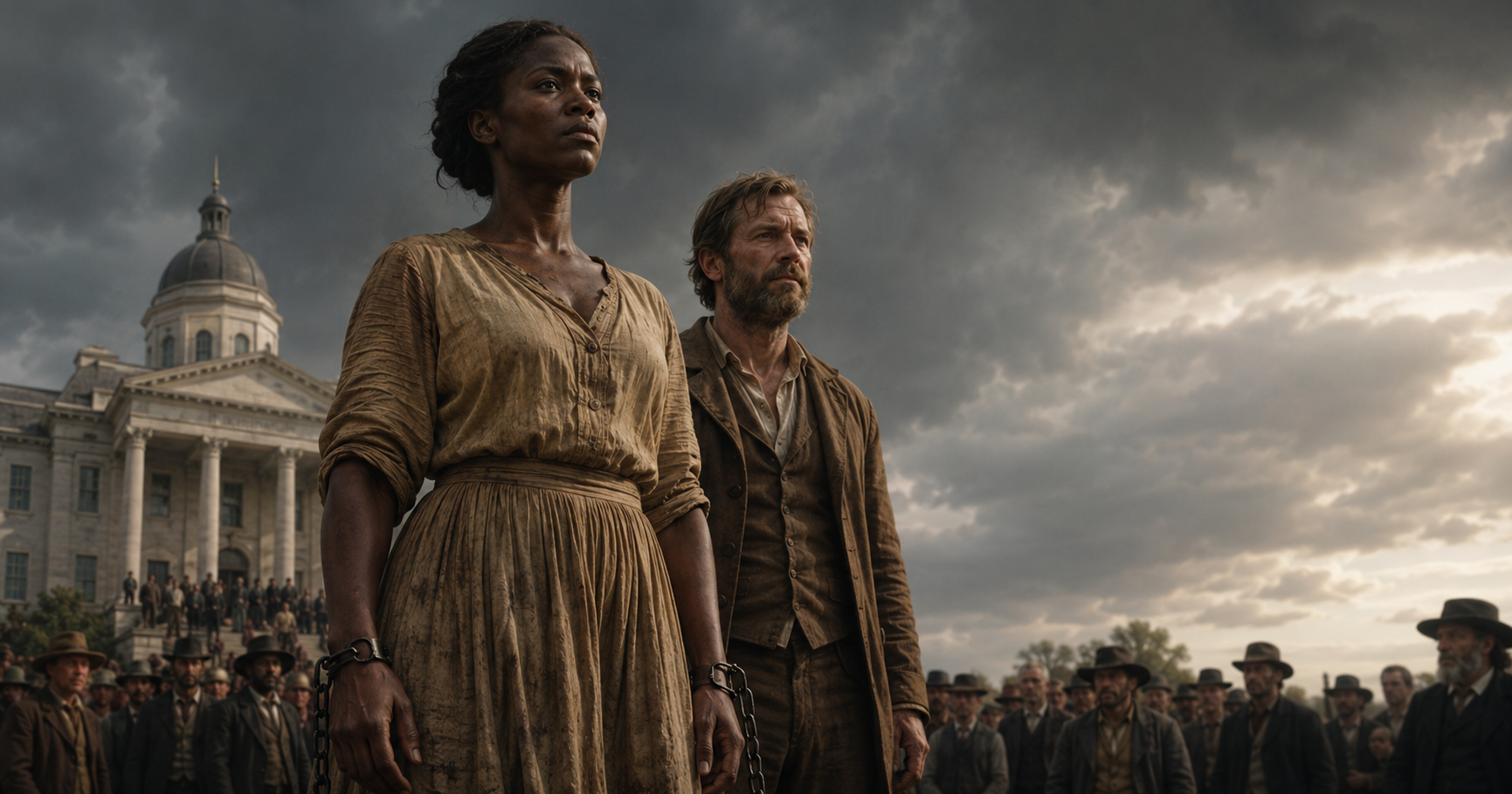
“Unlock her cuffs,” he said.
Crane snorted. “You unlock them when you get her home.”
“I paid.”
“You paid seven cents.”
“And you took it.”
The crowd murmured.
Crane stepped close. “You are not leaving this yard with her hands free.”
Jonah looked past him toward the courthouse. Two deputies stood beneath the awning, watching for entertainment, not justice.
“I bought what your paper claimed you had the right to sell,” Jonah said quietly. “If you refuse delivery, we can ask the clerk whether the sale was lawful.”
Crane’s eyes narrowed.
The auctioneer cursed under his breath. He wanted the day finished.
“Unlock her,” he snapped.
The cuffs came off.
Red grooves circled her wrists.
The woman did not rub them. She simply flexed her fingers once.
The sound of knuckles cracking made three men step back.
Jonah turned away first.
“My wagon is behind the cooper’s shed,” he said. “You may ride in it or walk beside it. There is bread under the seat. I won’t touch you.”
She did not move.
Then she said, “Why?”
Her voice was low, rough, and controlled so tightly that rage could be heard beneath every word.
Jonah should have answered with the whole truth.
He should have said: Because I knew your mother.
He should have said: Because the men who sold you stole more than your body.
He should have said: Because I was a coward when courage was required, and I have been paying interest on that cowardice ever since.
Instead he said, “Because seven cents was all I had.”
Her stare did not change.
“That is not an answer,” she said.
“No,” Jonah admitted. “It is only the first one.”
She stepped down from the platform.
The boards groaned beneath her.
No one laughed then.
The wagon ride out of Carter’s Landing passed beneath a sky the color of old pewter. Jonah drove. The woman sat behind him on the wagon bed, not on the bench, with her back against a barrel and her eyes on the road they had left.
The bread remained untouched.
So did the canteen.
When the town was a mile behind them, Jonah stopped beside an abandoned smokehouse at the edge of a flooded field. He climbed down, took a knife from his boot, and cut the rope that had been tied around the woman’s ankles for transport.
She watched his hands.
“You expect gratitude?” she asked.
“No.”
“Fear?”
“No.”
“Then what do you expect?”
Jonah folded the rope and dropped it in the mud. “Nothing tonight.”
Her eyes narrowed. “Men who buy people always expect something.”
“Yes,” he said. “They do.”
“You saying you are different?”
“No.”
That answer finally disturbed her.
Jonah took the receipt from his coat and held it out.
She did not take it.
“That paper says I own you,” he said. “It lies. But lies written on paper have power in this country. I bought the lie because leaving it in Crane’s hand would have killed you.”
“Many things have tried.”
“I know.”
“You know nothing about me.”
“I know the name on that paper is false.”
The air changed.
The woman’s face did not move, but every part of her became more alert.
Jonah lowered his voice. “I know you had a brother once. A younger one.”
Her hand closed around the edge of the wagon plank. The wood cracked.
Jonah did not step back.
“What did you say?” she asked.
“I said you had a younger brother.”
“Had?”
“I don’t know if he is alive.”
The plank split under her grip.
Jonah kept his hands visible. “But I know where he was taken.”
She rose.
She did not rush him. That might have been less frightening. She simply stood, unfolding to her full height, the gray rain behind her, her shadow falling over him like a storm cloud.
“Say his name,” she said.
“I don’t know his true name.”
“Then you know nothing.”
“I know the men who took him called him Little Ben.”
Her breath left her once.
Not a sob.
Not a gasp.
A wound opening.
Jonah saw it and hated himself for using it.
She looked away toward the field, where crows walked through the mud like black-coated judges.
“My brother’s name is not Ben,” she said.
“I believe you.”
“And mine is not Bina.”
“I believe that, too.”
“Then why did you buy me under that name?”
“Because dead lies are easier to carry than living people.”
She turned back slowly.
“What do you want from me, farmer?”
Jonah took off his hat. Rain silvered his hair. He was not old, not exactly, but grief had done work on him that age had not yet had time to finish.
“There is a plantation south of here called Redfern Hall,” he said. “The man who owns it, Colonel Darius Havelock, has been stealing free people and selling them under false names for years. Children, widows, river workers, laundresses, men with trade papers, women with family deeds. He changes names, burns certificates, bribes clerks, and sells the stolen twice over.”
The woman said nothing.