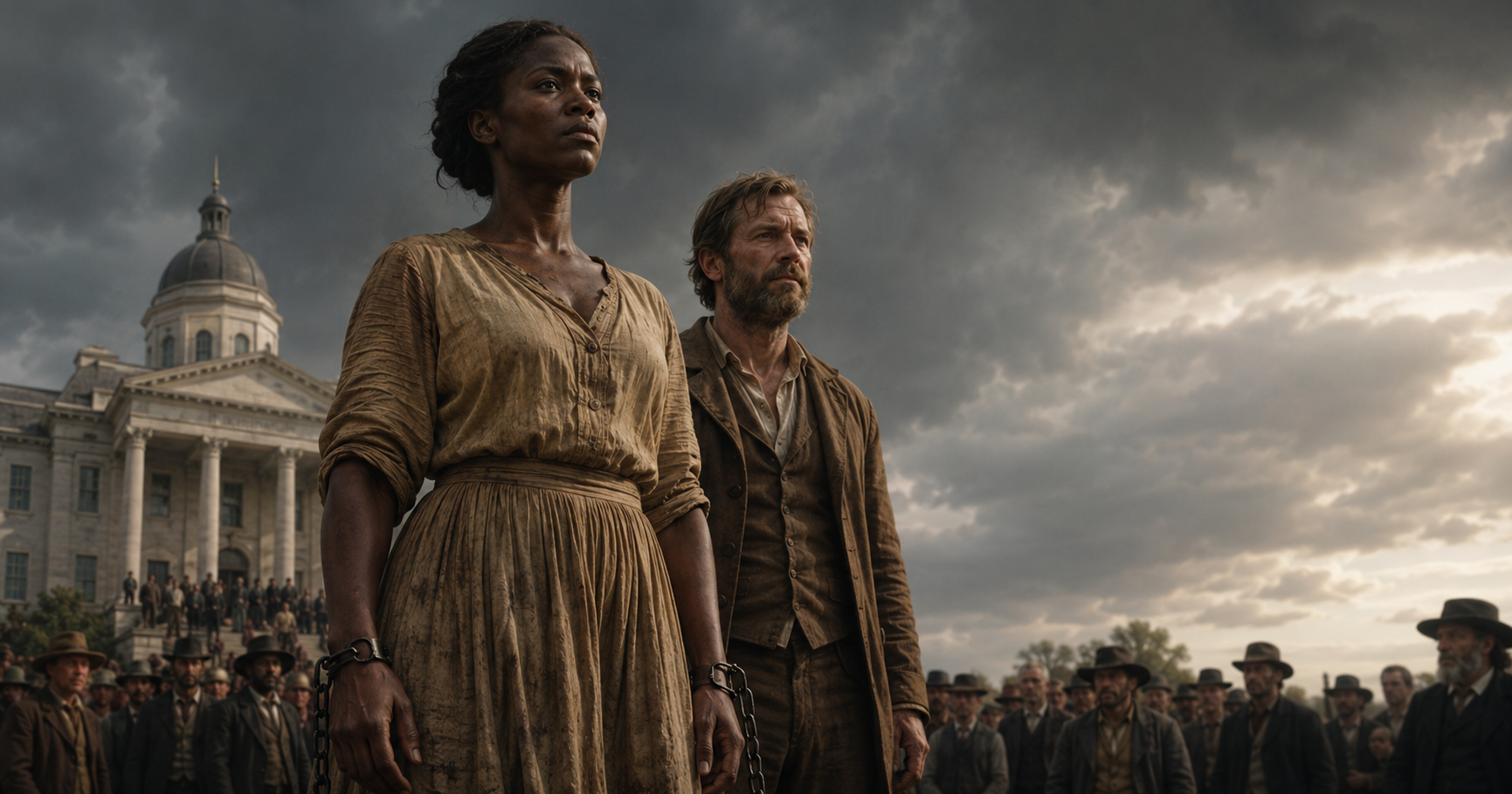
Jonah continued, “I have pieces of proof. Not enough. A torn ledger page. Two statements. A map. And one deed hidden where no one has found it.”
“Why tell me?”
“Because your name is tied to that deed.”
Her eyes sharpened.
“My name?”
“Your real one.”
She crossed the distance between them so quickly that Jonah had no time to move.
Her hand closed around his coatfront and lifted him until his boots barely touched mud.
“Do you know it?” she whispered.
Jonah’s throat worked against the pressure of his collar.
“Yes.”
“Say it.”
He did not.
Her hand tightened. “Say it.”
“If I say it here, before you know why I know it, you may run straight back toward the man who holds your brother. And if you run now, with no plan, you die before sunset.”
“I have died before.”
“No,” Jonah said, voice rough. “You have survived men who wanted you to. That is not the same.”
For a moment he thought she would throw him through the smokehouse wall.
Instead she lowered him.
He stumbled, caught himself, and did not touch his bruised throat.
She turned away. “You talk like a preacher.”
“I am not a preacher.”
“Good. I have no use for men who sell heaven while standing in hell.”
“Nor do I.”
The rain softened.
The woman looked toward the road. “Where is your farm?”
“Briar Creek. North of the river bend.”
“Is it a trap?”
“Yes.”
She looked at him sharply.
Jonah met her gaze. “Everything in this country is a trap for someone like you. My farm is simply one where you will see the doors.”
That answer did not satisfy her.
But it made her climb back into the wagon.
Briar Creek was not much to look at.
There was no white-columned house, no avenue of oaks, no iron gate. Jonah Vale’s farm crouched between river cane and poor soil, a low farmhouse with a crooked chimney, a barn too large for the acreage, and a springhouse built of limestone blocks. The fences were mended with whatever wood had not been needed for heat. The yard held chickens, a black mule, three children chasing a hoop, and a woman with a rifle across her arms.
The woman was small, dark-skinned, gray at the temples, and unimpressed by everything in the world.
She stood on the porch as Jonah drove up.
“You bought her,” she said.
Jonah climbed down. “I bought the paper.”
“That is not what I asked.”
“I know.”
The woman on the wagon studied the porch woman.
The porch woman studied her back.
Finally the porch woman said, “I am Aunt Lottie to people I like and Mrs. Lottie Green to people who test me.”
The tall woman did not answer.
Lottie looked at Jonah. “Did you tell her?”
“Some.”
“Meaning no.”
“Meaning enough for tonight.”
Lottie shook her head. “White men can make a meal out of half a crumb and call it supper.”
A boy of about fourteen appeared behind her, carrying kindling. He stared at the tall woman with open astonishment until Lottie snapped, “Caleb, if your eyes fall out, do not ask me to put them back.”
The boy dropped his gaze.
Jonah said, “This is not a slave farm.”
The tall woman’s face hardened. “Every man says what makes him look clean.”
Lottie nodded. “True.”
Jonah looked at Lottie. “You could help me.”
“I am helping you. I did not shoot you from the porch.”
The tall woman almost smiled.
Almost.
Inside the farmhouse, the table was already set. Cornbread. Beans. Onion broth. Apples dried on a string above the stove. Five people sat or stood in the room: Lottie; her husband Abram, broad and quiet; Caleb; a young woman named Pearl with a baby sleeping against her shoulder; and an old man called Mr. Finch, who watched the windows as if the trees might inform on them.
No one asked the tall woman to sit.
No one ordered her to stand.
That confused her more than either would have.
Jonah placed the auction receipt on the table.
“Seven cents,” Lottie read.
Abram took the paper and made a sound of disgust. “They put a price lower than a bent nail.”
“Because they wanted her gone,” Jonah said.
The tall woman spoke from the doorway. “Because they were afraid I would remember.”
The room quieted.
Lottie looked at her. “Do you?”
The woman’s jaw tightened.
“Pieces.”
“What pieces?”
“A river at night. My mother’s yellow shawl. My brother crying because he lost one shoe. A man with a scar across his lip. Fire. A cellar door. Someone singing through wood.”
Jonah closed his eyes briefly.
Lottie saw it.
The tall woman saw Lottie see it.
“What?” she demanded.
Lottie did not soften her voice. “You will get the truth in this house. But truth is heavy. You want all of it dropped on your head tonight?”
“I have carried heavier.”
“Maybe. But heavy things still break bones.”
The woman’s gaze moved around the room. “Are you free?”
Abram answered first. “By paper.”
Pearl said, “By running.”
Lottie said, “By refusing to answer when liars call.”