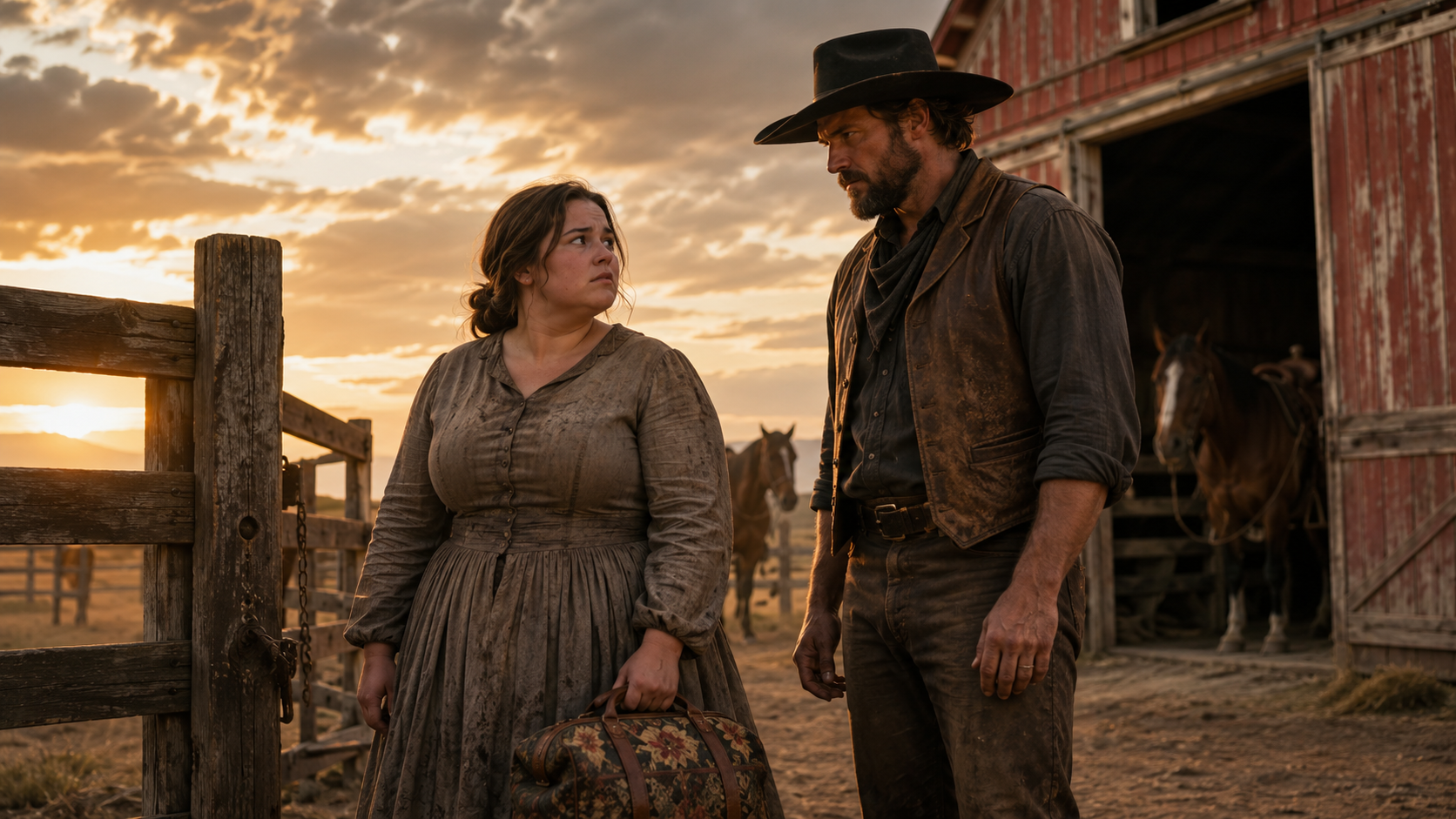
Lottie stepped forward and pressed an old bonnet into Mara’s hands. It was faded brown with one crushed side. “Wear this. The sun is cruel to delicate things.”
Another burst of laughter.
Mara did not answer. She tied the bonnet under her chin, picked up her carpetbag though she did not need it for stable work, and started north.
She heard them behind her.
“Ask him if he keeps a stall big enough!”
“Maybe he wants a mule, not a maid!”
“Careful, Mara. If he feeds you, he’ll never get rid of you.”
Mara kept walking.
The road out of Dry Hollow climbed in long pale curves through sagebrush and brittle grass. Every step lifted dust around her skirts. The sun rose higher, burning the back of her neck. By the second mile, sweat ran beneath her collar. By the third, her thighs ached. By the fourth, she had begun to wonder whether Mrs. Pruitt had invented the entire message and sent her toward humiliation for sport.
Then Broken Spur Ranch appeared beyond a line of wind-bent cottonwoods.
It was not the ruin she expected.
The house was old, yes, with weathered boards and a porch that sagged on one end, but the fences were mended. The water troughs were full. A vegetable patch grew beside the kitchen. The barn stood wide and red against the low hills, one door hanging crooked, the other open like a dark mouth.
A man was working near the corral, driving a post into the ground with slow, punishing swings of a sledgehammer.
Mara stopped at the gate.
The man did not look up.
She could turn around. She could walk back and say no one answered. She could sleep behind the church if Mrs. Pruitt meant what she said. She could pretend she still had choices.
The hammer fell again.
Mara lifted the latch.
It squealed.
The man turned.
Gideon Ash was not handsome in the way shop windows made men handsome. His face was too severe, his nose once broken, his jaw dark with stubble. A scar cut through his left eyebrow, pale against sun-browned skin. His eyes were gray, cold at first glance, but not empty.
They moved over Mara once.
Not the way men in town looked at her.
Not measuring. Not mocking. Not licking cruelty from the corners of their mouths.
He looked at her the way a man looks at a storm cloud and decides whether it carries rain or lightning.
“Who sent you?” he asked.
His voice was low. Rough. Unwelcoming.
Mara gripped the paper. “Mrs. Pruitt. From the boardinghouse.”
Something changed in his expression.
Not surprise.
Recognition.
“Of course,” he muttered.
Mara’s stomach dropped.
He knew.
One look and he knew she had been sent as a joke.
“I can work,” she said quickly. “I know I don’t look like—”
“I didn’t ask what you look like.”
The words struck the yard clean.
Mara stopped.
Gideon leaned the sledgehammer against the post. “I asked who sent you.”
She stared at him.
He was angry. That much was plain. But the anger did not seem aimed at her, and that unsettled her more than contempt would have.
“They thought it would be funny,” she admitted.
His jaw tightened.
“For you,” he asked, “or for me?”
Mara had no answer.
The wind dragged dust between them. Somewhere in the barn, a horse stamped hard enough to rattle boards.
Gideon looked past her toward the road to town. Then he opened the gate wider.
“Stable’s through there,” he said. “Broom hangs on the right. Forks are on the wall. Don’t go near the roan mare in the back stall unless I’m with you. She bites first and regrets nothing.”
Mara blinked. “You’re letting me work?”
“I’m letting you decide whether they get the laugh they wanted.” He picked up the sledgehammer. “And one more thing.”
“Yes, sir?”
His eyes narrowed slightly at the word.
“Don’t ‘sir’ me like you’re begging not to be hit. My name is Gideon. If you work here, you work standing up. You don’t fold yourself smaller to make fools comfortable.”
Mara’s throat tightened.
No one had ever accused her of making herself smaller.
Everyone else accused her of being too much.
Too wide for the aisle. Too heavy for the stairs. Too hungry. Too slow. Too visible. Too plain to be proud and too large to be pitied prettily.
She stepped into the yard.
The stable smelled of hay, leather, dust, and old neglect. Saddles lay slumped over rails. Harness straps tangled like dead snakes. Feed sacks had been chewed open by mice. The center aisle was clotted with straw, mud, and forgotten tools. Sunlight poured through cracks in the boards, turning every drifting speck into gold.
Mara stood in the doorway and looked at the work.
Then she took off the ridiculous bonnet.
She hung it on a nail, found the broom, and began.
At first, every sound made her flinch: Gideon’s hammer outside, the roan mare’s kick, the creak of rafters, the sudden snort of a gelding watching from his stall. Dust rose into her face and made her cough until her eyes watered. Her palms softened, then burned, then split. Sweat ran down her spine. Hay clung to her sleeves.