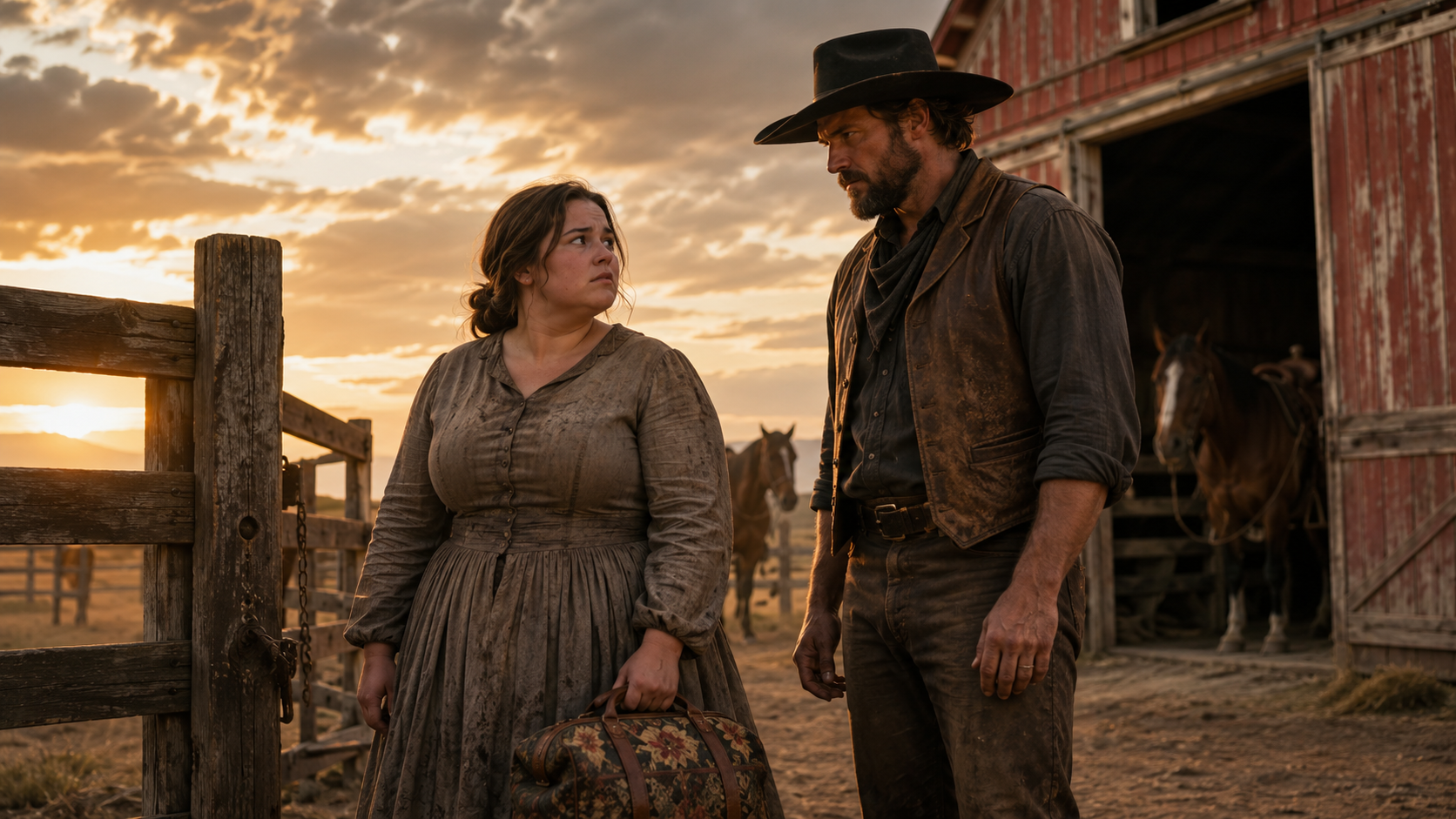
But work had one mercy that people did not.
Work did not laugh.
Work asked only to be done.
Mara cleared the aisle. She stacked usable wood near the wall and carried rotten boards to a burn pile. She sorted tools by purpose because her mother had once told her that order was what a tired soul could give the world when it had nothing else. She untangled harness, shook out blankets, swept old grain from the corners, scrubbed the troughs, and opened both doors to pull air through the stale heat.
Once, near noon, she paused to press her aching hand against her side and saw Gideon standing outside the stable door.
She straightened at once.
He said nothing.
Then he set a tin cup and a bucket of fresh water on a crate.
“Drink,” he said.
“I’m not finished.”
“I didn’t say retire. I said drink.”
She drank.
The water was cold enough to hurt her teeth.
It tasted like kindness, and that nearly made her cry.
By sunset, the stable no longer looked abandoned. It looked tired but breathing. The floor was clear. The tack wall made sense. The feed sacks were sealed in bins. The horses could look out without cobwebs hanging over their eyes.
Mara stood in the doorway, her arms trembling.
Gideon entered with a lantern.
The light made his scar sharper and his eyes less hard. He walked the aisle slowly, inspecting the pegs, the bins, the swept corners, the fresh straw.
Mara braced herself.
At Pruitt House, finished work only meant someone had found the next thing to criticize.
Gideon ran two fingers along the top rail of a stall, looked at them, and said, “Clean.”
Mara’s breath caught.
“I tried to—”
“You did.”
Two words.
Only two.
But they landed inside her like bread in an empty stomach.
She turned away quickly, pretending to coil a rope.
Gideon noticed anyway.
“You not used to hearing that?”
Mara gave a small laugh. It broke in the middle. “No.”
He was quiet for a long time.
“Come back tomorrow,” he said.
She turned. “You mean it?”
“I don’t decorate lies.”
“What about Mrs. Pruitt? She’ll expect—”
“She doesn’t run my ranch.”
Mara looked toward the road. The hills had turned purple. The first stars trembled above the ridge. She should have been afraid to walk back alone.
But for the first time in many months, she was more afraid of where she was returning than where she had been.
When Mara entered the boardinghouse kitchen that night, the girls fell silent.
Then Lottie began to clap slowly.
“Well,” she said, “the beast didn’t eat her.”
Pearl leaned back in her chair. “Maybe he hired her to scare away wolves.”
Ruthie smiled over her teacup. “Or maybe he likes his help sturdy.”
Mara kept walking.
That was new.
Usually she stopped. Usually she blushed. Usually she tried to offer them the apology they wanted without knowing what she had done wrong.
Tonight, her feet hurt too badly and her hands burned too fiercely to perform shame for anyone.
Mrs. Pruitt appeared at the foot of the attic stairs. “Where is the money?”
“He pays at week’s end.”
“Convenient.”
“He asked me back tomorrow.”
The kitchen changed.
Lottie’s smile faltered first.
Ruthie’s teacup paused halfway to her mouth.
Mrs. Pruitt’s eyes narrowed. “Did he?”
“Yes.”
“And what did you do for him?”
Mara met her gaze.
“I worked.”
The word sounded plain.
It also sounded like a door closing.
Mara climbed to the attic, lay down on her narrow cot, and stared into the dark while her body throbbed. Below, the girls whispered. Someone laughed once, then went quiet.
She closed her eyes.
Clean.
You did.
She held the words in her hands until sleep came.
The days that followed did not become easy. Nothing at Broken Spur was easy.
Gideon expected work to begin before sunrise and did not appear to understand the meaning of “almost finished.” He pointed with his chin more often than his hand. He spoke little, praised less, and never asked Mara to do anything he had not already done himself.
But he was fair.
If she lifted wrong, he showed her how to turn her shoulder. If she dropped a bucket, he waited until she picked it up. If she was too proud to admit a sack was too heavy, he took one end without comment and said, “Weight shared is not weakness.”
On the second morning, a pair of leather gloves waited on the fence post.
Mara stared at them.
Gideon passed with a coil of rope over his shoulder. “Your palms are torn.”
“I didn’t complain.”
“I didn’t accuse you.”
On the third morning, a plate of eggs and biscuits sat on the porch rail.
“I already ate,” Mara lied.
Her stomach growled so loudly that a horse lifted its head.
Gideon looked at her. “Your belly has more honor than your mouth.”
To her own surprise, Mara laughed.
It came out rusty.
Gideon looked startled by the sound, then looked away as if he had not heard it.