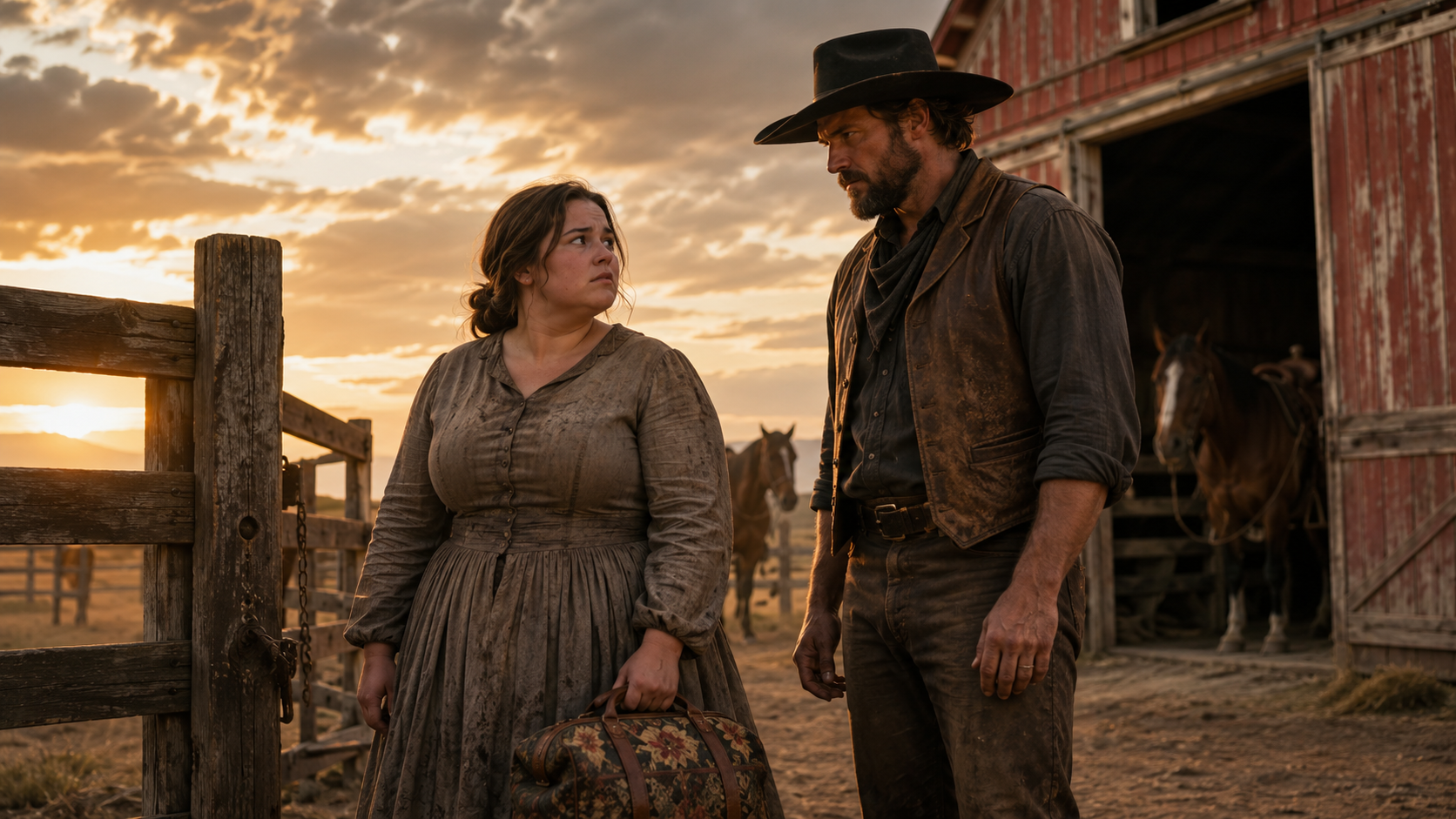
When Mara Ellison stepped down from the back of the supply wagon, every window on Mercy Row seemed to blink open at once.
The town of Dry Hollow was small enough to hear a kettle whistle three houses away and mean enough to turn that sound into gossip by supper. Dust sat on the porch rails. Flies circled the trough outside the livery. The church bell leaned crooked in its tower as if even God had grown tired of standing straight in that place.
Mara held her carpetbag with both hands and tried not to breathe too loudly.
That was one of the first things she had learned after her mother died: be quiet. Do not take the last biscuit. Do not ask why the other girls get ribbons while you get chores. Do not sit where chairs complain. Do not laugh too freely, because laughter from a woman shaped like you makes people look twice.
She had learned all of it from Mrs. Octavia Pruitt, who ran the boardinghouse with a Bible in the parlor and a ledger in her apron pocket. Mrs. Pruitt believed every girl owed the world rent simply for existing, and Mara, being larger than most, owed double.
“Stand up straight,” Mrs. Pruitt hissed from the porch of the boardinghouse. “You look like a sack of meal about to split.”
The girls behind her giggled.
There were four of them: Lottie Price with her yellow curls, Pearl Ames with her sharp little chin, Ruthie Vale with her pretty gloves, and Nell Ward, who laughed whenever the others did because she was afraid not to. They had been standing there since sunrise, waiting for Mara to return from delivering mended sheets to the hotel.
Mara knew that waiting look.
Something had been planned.
Mrs. Pruitt descended the porch steps, her black dress swishing around her ankles. She carried a folded paper between two fingers.
“Mara,” she said, falsely sweet, “you’ve been asked for.”
Mara’s fingers tightened around her carpetbag. “Asked for?”
Lottie covered her smile with one hand.
Mrs. Pruitt unfolded the paper with the solemn pride of a judge reading a sentence. “Mr. Gideon Ash of Broken Spur Ranch sent word that he needs help in his stable.”
The girls burst into bright, delighted laughter.
Mara did not understand at first. Broken Spur Ranch lay five miles beyond the north ridge, past the creek bed and the old burned mill. Gideon Ash owned it. Everyone knew that. Everyone also knew he was the last man a decent woman approached without a reason and the first man a foolish one feared.
They called him Ash the Hammer because he had once broken a man’s wrist against a saloon bar for striking a horse. They said he slept with a rifle across his lap. They said his father had been worse than a wolf and his son had inherited the teeth. They said his ranch hands never lasted and that animals obeyed him because they recognized another beast.
Mara had never seen him up close.
She had seen him once from the mercantile doorway, a tall man in a black hat loading grain sacks into a wagon, his face hidden beneath the brim, his shoulders broad enough to look carved from timber. People had stepped aside for him without being asked. Even the sheriff had nodded first.
Mrs. Pruitt’s mouth thinned with satisfaction. “He told the stable boy, ‘Send me someone strong. Send the big girl if she wants wages.’”
Pearl laughed so hard she nearly dropped her parasol.
“The big girl,” Ruthie repeated, sweet as poison.
Mara’s face burned.
“I have laundry to finish,” Mara said.
“You have an opportunity,” Mrs. Pruitt corrected. “Unless you believe yourself too fine for honest work.”
The girls giggled again.
Mara looked from one face to another and understood the shape of the trap. Gideon Ash had not asked for her by name. Maybe he had asked for a worker. Maybe he had not asked for anyone at all. It did not matter. Mrs. Pruitt was sending Mara because it amused them to imagine her walking into that man’s yard, frightened and sweating, only to be shouted back to town.
“Will he pay?” Mara asked.
The question silenced them for one breath.
Mrs. Pruitt’s smile sharpened. “If you manage not to offend him.”
Mara swallowed. “And if I don’t go?”
“Then you can collect your things from the attic before dark.”
There it was.
The door beneath the joke.
Mara had lived at Pruitt House for nearly two years, working in exchange for half her board and owing the other half no matter how many floors she scrubbed. She had no family left. Her mother had died in spring rain, coughing blood into a handkerchief she kept trying to hide. Her father had left before Mara could remember the sound of his boots. There was no aunt, no cousin, no husband, no savings.
Only the attic cot and the girls’ laughter below it.
So Mara took the folded paper, though she could not read Mrs. Pruitt’s cramped handwriting well enough to know what it truly said.
“When should I go?”
“Now,” Mrs. Pruitt said. “Best get there before he changes his mind.”