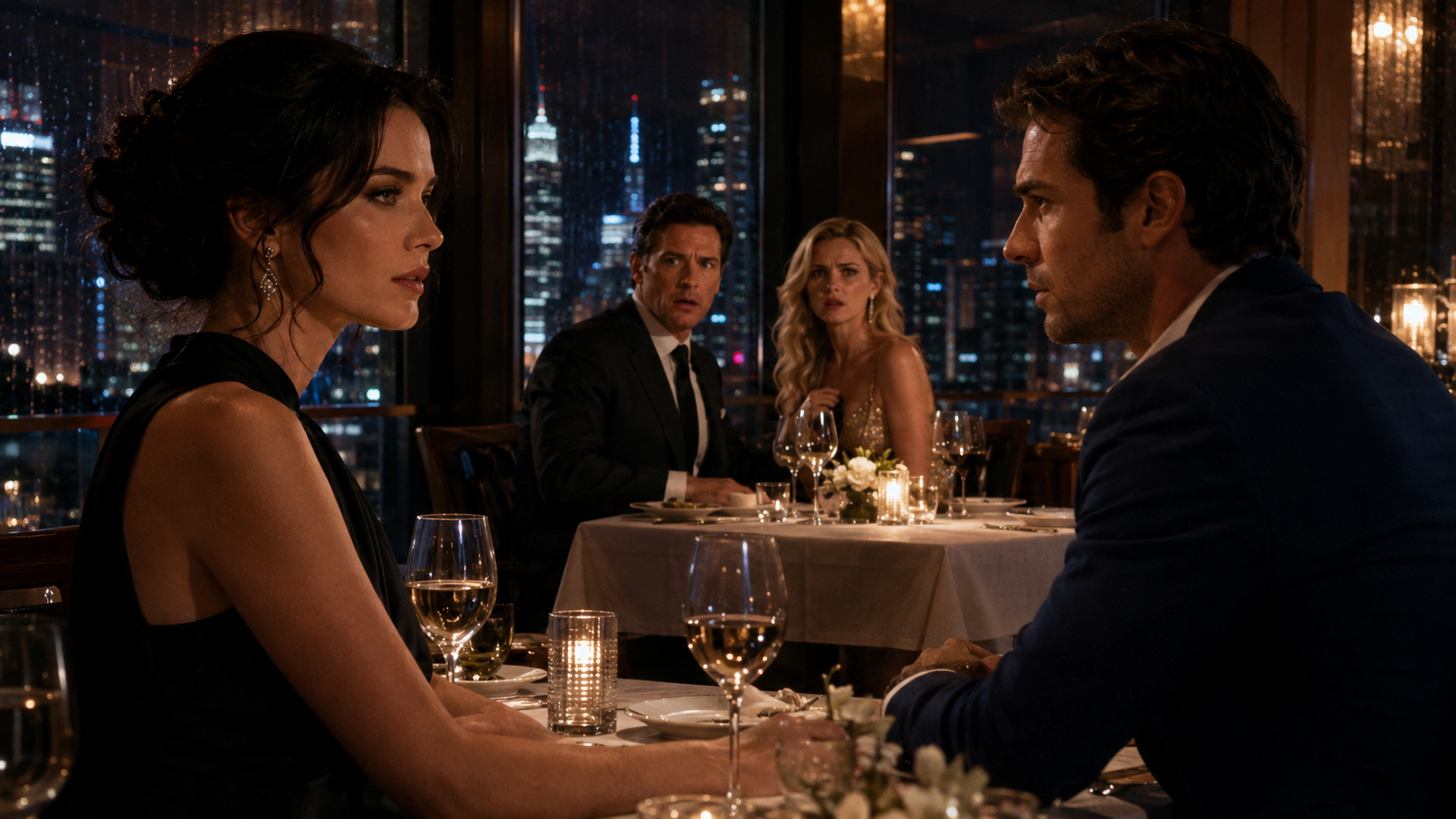
Evelyn pulled out a thinner stack of papers. “These are payments made from one of my restaurant operating accounts. Small enough not to trigger the usual internal review. All marked as consulting, brand partnership, or event strategy.”
Simon’s expression sharpened immediately. Not like a jealous husband now. Like a man returning to his profession.
Before becoming a lecturer in financial ethics at Northridge University, Simon Ellery had spent eleven years as an investigator for the federal financial crimes unit. Evelyn had learned that the night they met, when Adrian had mocked him afterward in the car.
“Poor man,” Adrian had said. “Imagine spending your life reading other people’s lies for a government salary.”
At the time, Evelyn had thought it was only arrogance.
Now she understood it was fear disguised as contempt.
Simon took the papers.
“Who received these?” he asked.
“Luna Crest Advisory.”
His face changed.
Evelyn did not miss it.
“That’s Celeste’s company,” she said.
Simon looked up at her. “It was. On paper. She created it for consulting work years ago, but it never became much. Mostly nonprofit introductions, social events, donor dinners.”
“Adrian has paid it almost six hundred thousand dollars in eighteen months.”
Simon’s hands went very still.
Evelyn continued, “Some of that money came from Lark & Vine.”
“Your restaurant?”
“My family’s restaurant.”
His eyes lowered again to the papers.
Outside, rain slid down the café window in thin, silver lines.
Evelyn hated how calm everything looked. She had imagined betrayal would make the world theatrical. Thunder. Breaking glass. A woman screaming in a marble foyer.
Instead, it had arrived through bank statements.
Simon read the columns once, then again.
“These payment amounts are strange,” he said.
“I thought so too.”
“No round numbers. Nothing above ten thousand. Different invoice descriptions. Similar spacing between transfers.” His voice had gone flatter. Colder. “This is not romantic carelessness.”
“No,” Evelyn said. “I don’t think it is.”
He sat back and looked at her for a long moment.
“Why come to me?”
“Because Celeste is your wife.”
“That explains the photographs. Not the financial records.”
Evelyn folded her hands in her lap so he would not see them tremble.
“Because my attorney said the money trail could matter, but I don’t know what I’m looking at yet. Adrian knows I don’t. He counts on that. But when I saw your name, when I remembered what you used to do, I thought…” She stopped, then finished honestly. “I thought you might be the one person he would not want sitting across from me.”
Simon’s face did not soften, exactly, but something in his eyes shifted.
“You’re not asking me to save you.”
“No.”
“Good,” he said. “I would have refused.”
She almost smiled despite everything.
“I’m asking you to help me understand whether my husband used my family’s business to fund his affair, hide expenses, or move money.”
Simon looked at the papers again.
“Possibly all three.”
The words were quiet.
They still split Evelyn’s life in half.
She exhaled slowly. “They’re going to The Aurelia Room tonight.”
Simon looked up.
“Eight o’clock,” she said. “Adrian thinks I’m at a supplier dinner. Celeste thinks you’re at a faculty reception.”
A bitter smile touched Simon’s mouth and vanished.
“They’ve become very efficient with our lives.”
“I made a reservation,” Evelyn said. “Near theirs.”
He stared at her.
“You’re going there?”
“Yes.”
“To confront them?”
“To be seen,” Evelyn said. “There’s a difference.”
Simon leaned back. “That is an insane idea.”
“I know.”
“It will be humiliating.”
“It already is.”
He looked at her for several seconds. Then he gave a short, humorless laugh.
“You want me to sit beside you while my wife sits beside your husband.”
“Yes.”
“And eat dinner.”
“If you can.”
“That sounds less like dinner and more like surgery.”
Evelyn finally lifted her cold coffee and took one sip. It tasted terrible.
“My mother used to say some wounds have to be cleaned in bright light.”
Simon was silent.
Then he said, “What time should I meet you?”
At seven-thirty that evening, Evelyn stood in front of her closet and realized how little space she occupied in her own house.
Adrian’s suits filled the left wall. Adrian’s shoes lined the custom shelves. Adrian’s watches rested in velvet trays inside the drawer he had insisted was too small for both of them. Her dresses had been pushed to the far end, crowded behind garment bags from galas she had hated and fundraisers where she had smiled until her jaw hurt.
She moved hangers aside until she found the black dress.
Not funeral black.
Not obedient black.
It was the black of ink, of iron gates, of a night before a storm. She had bought it two years earlier in Florence when Adrian had canceled their anniversary dinner to take a “critical investor call” that lasted three hours and ended with lipstick on his shirt collar.