She had never worn the dress.
It still fit.
Evelyn looked at herself in the mirror.
For months, perhaps years, she had dressed like a woman trying not to embarrass a powerful man. Elegant but not distracting. Beautiful but not demanding. Expensive but not memorable enough to become a headline.
Tonight, she did not look like an accessory.
She looked like evidence.
Downstairs, Simon waited beside a black town car. He wore a navy suit, white shirt, and a tie so severe it almost made her laugh.
“You dressed for a sentencing,” she said.
“I dressed for documentation,” he replied.
“That’s worse.”
“It usually is.”
The ride to The Aurelia Room was quiet.
Manhattan moved around them in wet reflections, taxi lights stretching over the pavement, towers rising into low clouds. Evelyn watched the city pass and wondered how many windows contained people discovering quietly that their lives were not what they had been told.
Halfway there, Simon said, “You don’t have to prove pain in public.”
She turned from the window.
“I mean it,” he said. “Men like Adrian know how to use a woman’s anger. They provoke it, then call it instability. They injure you privately and judge your bleeding in public.”
Evelyn stared at him.
Simon gave a small shrug. “I investigated financial fraud for more than a decade. Half the job was watching powerful men rename consequences as attacks.”
“You sound like you’ve given that lecture before.”
“I have.”
“Was it popular?”
“With students, yes. With trustees, less so.”
For the first time all day, Evelyn laughed.
It did not last long.
But it was real.
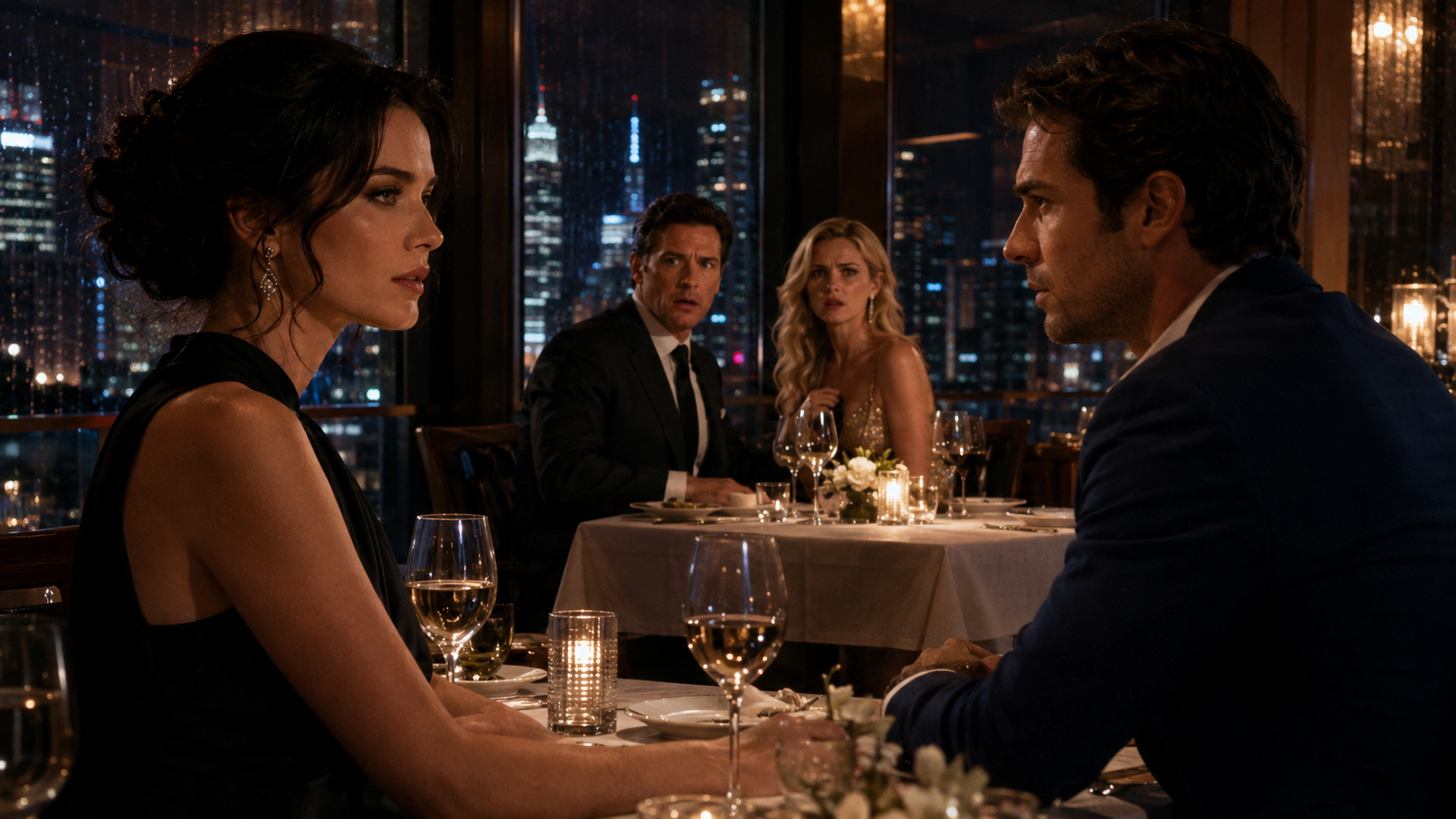
The Aurelia Room sat on the top floor of a glass hotel Adrian had once tried to buy and failed, which Evelyn found almost poetic. The elevator opened directly into a dining room made of gold light, cream stone, tall windows, and the kind of quiet that only wealth could purchase.
Nobody stared openly.
Everyone noticed.
The hostess looked up. “Mrs. Marlowe?”
“Reservation for two.”
“Of course. This way.”
Evelyn had requested a table near the west windows, close enough to Adrian’s favorite corner to hear him if he became careless, far enough to pretend coincidence if needed.
She wanted to be seated first.
That mattered.
Simon pulled out her chair with simple courtesy, not performance. Evelyn sat, unfolded her napkin, and placed it in her lap.
For five minutes, they looked at menus.
The absurdity of it almost made her dizzy.
“What are you ordering?” Simon asked.
“The lamb.”
“Good choice.”
“And the most insulting bottle of Burgundy they have by the glass.”
His mouth twitched. “By the glass?”
“I’m angry, not irresponsible.”
“An important legal distinction.”
Then she heard Adrian’s voice behind her.
“Order whatever you want, darling. My wife’s account can survive it.”
Evelyn did not turn.
The words entered her body like ice water.
Simon went completely still.
Adrian laughed softly, pleased with himself. “She thinks I’m trapped at a private equity dinner. Poor Evelyn. She always did prefer menus to mathematics.”
A chair scraped.
Celeste’s perfume arrived before her voice: rose, amber, expensive guilt.
“You’re terrible,” Celeste whispered.
“No,” Adrian said. “I’m generous.”
Evelyn folded her hands on the table and looked at Simon.
His face had gone pale, but his eyes were clear.
“You okay?” he asked.
“No,” Evelyn said. “But I’m not leaving.”
“That may be enough for tonight.”
Adrian sat.
The moment took only three seconds.
He glanced toward the window, saw Evelyn, and froze.
His smile died so quickly it looked like a light being switched off.
Evelyn let him look.
Then she lifted her glass of water in a small, polite greeting.
“Adrian.”
Celeste turned.
Her face drained of color. “Simon?”
Simon looked at his wife, not with rage, but with such controlled grief that Evelyn almost looked away.
“Celeste.”
Adrian recovered first. Of course he did. Recovery had made him rich.
“Evelyn,” he said, smooth as polished stone. “What a surprise.”
“Isn’t it?” she replied. “New York is enormous until it becomes very small.”
Celeste’s lips parted, but no sound came.
Simon opened his menu. “Evelyn, you said the lamb?”
“Yes.”
“Then the lamb.”
Adrian stared at them as if they had violated a rule he had written without telling them.
The waiter arrived. Evelyn ordered the Burgundy. Simon ordered sparkling water. At the next table, Celeste whispered, “Adrian, what is happening?”
Adrian’s answer was too low to hear, but Evelyn knew the tone.
Manage. Control. Contain.
She ate one piece of bread.
It tasted like victory, which surprised her.
Fifteen minutes later, Adrian came to their table.
He did not storm. Men like Adrian did not storm in expensive restaurants. They bent slightly, placed one hand on the back of a chair, and made threats look like concern.