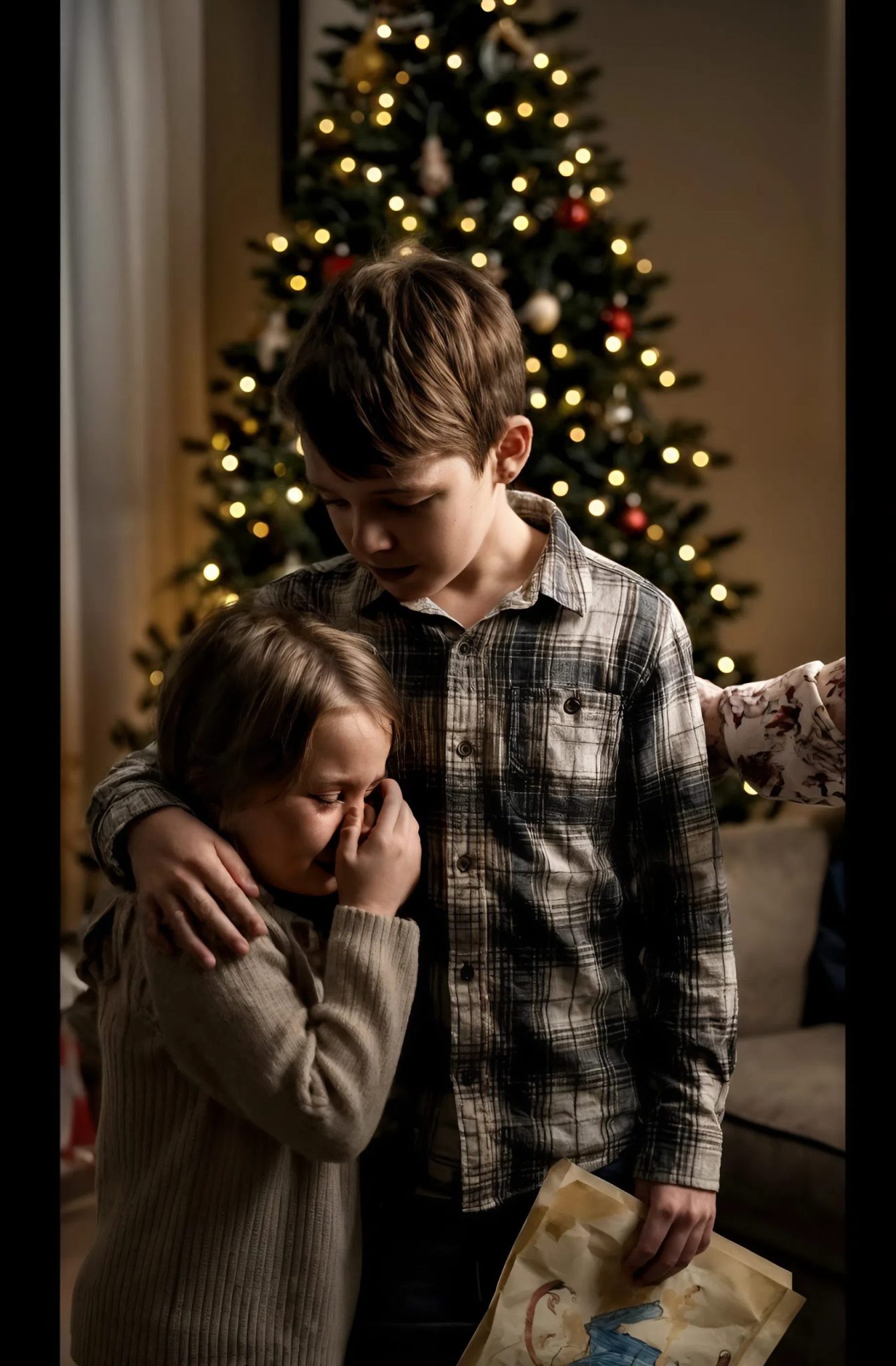
He jumped up so abruptly that his chair scraped across the parquet floor with a piercing screech. Everyone flinched. He walked straight up to Sharon, his jaw clenched, fire in his eyes — with a fury I had never seen in him before, something fierce and frighteningly adult.
He reached out and took the drawing he had given her earlier — the one with the sled she had praised so highly. His little fingers were trembling. Then he bent down and placed a huge radio-controlled car — the perfect, expensive, coveted gift — right at her feet.
The room gasped. Even Melanie blinked — her mask faltered.
And then Noah spoke, his voice steady but broken at the edges:
‘If my sister can’t call you Grandma… then neither can I.’
Silence. Thick, stunned, suffocating silence. Bella stared, not understanding. Melanie’s mouth opened. Sharon stepped back as if she had been struck.
Noah turned to Mia and took her hand. Gently, as if she were something infinitely precious and fragile. Then he looked at me and said,
‘Mum, can we leave? I don’t want to be here.’
It wasn’t a question. It was a statement.
Everything instantly fell into place for me. The shock dissipated, replaced by icy clarity.
‘Yes,’ I said. ‘We’re leaving.’
Thomas followed me, slowly but determinedly. There was something on his face — shame, perhaps, or the first signs of horror. Or maybe just the realisation that his mother had just burned a bridge that could never be rebuilt.
No one stopped us. No one tried. We walked through the house to the door, all four of us, holding on to each other like soldiers crossing a minefield.
When I put my hand on the handle, I was overcome by a sharp, nauseating feeling: this was only the beginning. The real explosion hadn’t even started yet.
We stepped out into the crisp December air, and the door closed behind us with a dull, final click, like a lock being closed forever.
If someone had told me a few years ago that Sharon would one day accuse me of cheating in front of my six-year-old daughter, I wouldn’t have believed them. Not because she wasn’t capable of it — oh no, she was beyond cruel — but because I didn’t think the universe could be so… literal.
And yet, looking back, the signs were everywhere. I just kept convincing myself they weren’t there.
Let’s start at the beginning.
I met Thomas at a gaming party that I wasn’t even supposed to be invited to. I was having a terrible day — the kind that makes you aggressively rethink every choice you’ve ever made in your life — and my friend dragged me out.
‘There’ll be food,’ she promised. ‘And maybe someone cute.’
There was food. As for ‘attractive,’ that’s debatable. I walked in and saw him: tall, nervous, wearing a NASA T-shirt, sorting game chips by colour with such concentration that he looked like he was defusing a bomb. He looked up, adjusted his glasses on his nose, and said with complete composure:
‘The odds in this game greatly favour the player who goes first.’
Reader, I fell in love.
Because underneath all that awkwardness and mini-lecture on statistics, he was kind. He listened when I spoke. He was deeply interested in things, but not in a loud, ostentatious way like most people. It was refreshing. He wasn’t charming. He wasn’t ‘smooth.’ But he was so sincere that it made you believe every word he said.
Unfortunately, he was raised by people for whom sincerity was a genetic defect.
The first time he brought me to meet his parents, Sharon opened the door and looked at me as if I were an overdue library book she had never requested.
‘Oh,’ she said. ‘Is that you, Emily?’
‘Yes,’ I replied, extending my hand. ‘And you are—’
‘Sharon?’ Her smile stiffened. ‘You’re smaller than I expected.’
‘Fine. Great. We’re off to a great start.’
Lawrence stood behind her, like a man waiting for permission to breathe. He shook my hand with the confidence of someone trained never to express independent thoughts.
Inside, the house was like a shrine dedicated to Thomas’s academic achievements. The walls were covered with photographs—from childhood to the awarding of his doctorate—capturing the evolution of an outstanding laboratory specimen. This dinner was an interrogation disguised as polite conversation.
‘What do your parents do?’
‘What are you studying?’
‘Can you cook?’
‘Are you good with money?’
‘Thomas is very special, you know,’ Sharon said, sticking her fork into a cherry on top of her salad. ‘He needs the right wife.’
Under the table, Thomas squeezed my knee. Hang in there, the movement said. It’s just one evening.
I hung in there. Barely.
What I didn’t know yet was that I wasn’t just interviewing for the role of wife — I was competing against his family… for his wallet.
I found out by accident.
Early in our marriage, I walked past his computer. The banking website was open. I wasn’t snooping — just my peripheral vision did its job.