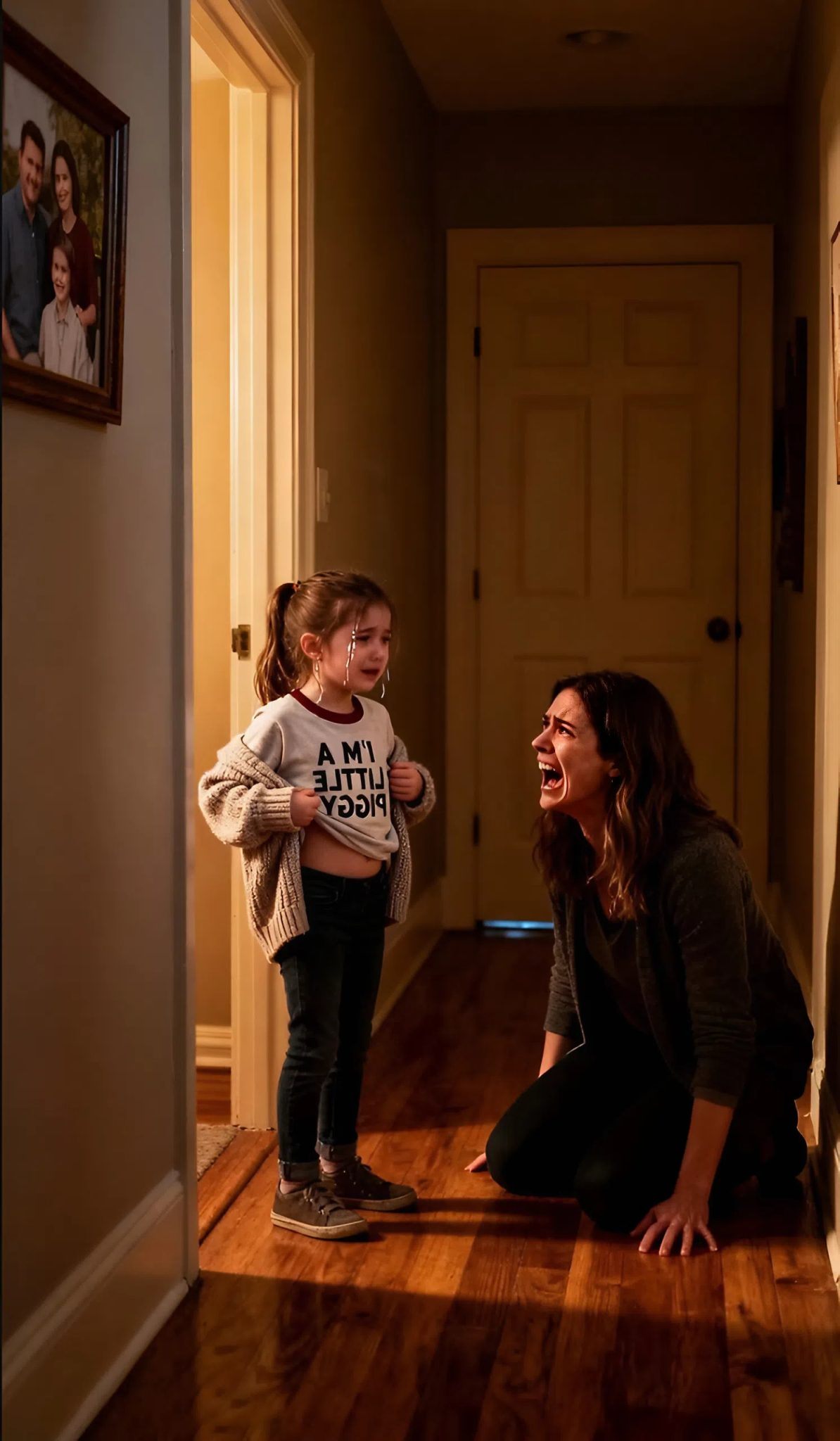
I became a forensic photographer of my own child’s pain.
I photographed everything.
Every bruise, every mark, every red line on her skin.
I photographed the bin bag.
I recorded Lily’s voice describing what had happened — her little words painted a picture of torture.
‘She made me wear this so I would sweat and lose fat, Mummy.’
‘She said I was sinful.’
The following week, while Victoria was at her bridge club, I went to her house again.
I had a key — given to me years ago ‘in case of an emergency’.
It was an emergency, but not the one she had in mind.
I installed small, high-resolution cameras in the living room, kitchen, and guest room where Lily stayed during her visits.
They were expensive, almost invisible, with a tiny, quiet red light promising the truth.
I didn’t do it because I was physically afraid of her.

I did it because I knew who she was.
She was a pillar of the community.
A saint.
Without proof, I would have been just a jealous daughter-in-law.
I quietly hired a solicitor.
Mr Vance was a shark in a grey suit — a man who specialised in destroying families.
I didn’t tell my husband, David.
David was a good man, but he was her son.
He had lived under her thumb for forty years, trained to believe that her cruelty was love.
If I had told him too soon, he would have gone to her, she would have cried, and the cycle would have started all over again.
No.
I had to cut off the snake’s head with one blow.
I started gathering evidence.
Her messages came late at night, vibrating in my phone like threats.
‘Has she been behaving well today?’
‘You need to control her diet, Elena.’
‘She looks bloated.’

‘I’m just trying to help.’
‘God hates gluttony.’
I saved everything.
I made backups on three different hard drives.
I contacted the school psychologists.
I consulted doctors.
I built up documentation like a slow, silent wall — brick by brick, fact by fact.
Weeks passed.
The cameras recorded everything.
Not just physical abuse, but verbal poison too.
‘You’re disgusting,’ Victoria’s voice rang out clearly on the recording as she snatched the biscuit from Lily’s hands.
‘No man will ever love a pig.’
‘Do you want to be alone?’ Like your mother?
I watched these recordings in the dark, tears streaming down my face, my hand pressed against my mouth to stifle my sobs.
Every instinct screamed at me to rush over there and burn her house to the ground.
But I waited.

I was waiting for Christmas Eve.
The church was her world.
St. Jude’s Church was her pride and joy, her kingdom, the stage on which she played her greatest role — Matriarch.
It was Christmas service.
The air was thick with the scent of pine needles and burning wax.
The light fell softly, casting long shadows on the high vaulted ceilings.
The children were dressed in white, their parents looked proud, and the choir sang a melody of peace.
Victoria, of course, sat in the front row.
Perfect posture.
Perfect hair, lacquered into a silver helmet.
Perfect false piety.
She wore a red velvet coat — the image of a kind grandmother.
People waved at her.
The pastor nodded to her.
She absorbed their admiration like a vampire absorbs blood.
It was time for testimonials.
It was a tradition — ‘Words of Joy.’
An opportunity for the elders to bless the community.

Victoria had just finished her speech, dabbing her dry eye with a lace handkerchief after her monologue on ‘sacrificial love.’
The congregation murmured their approval.
And then I stood up.
My husband, David, gently squeezed my wrist.
‘Elena? What are you doing?’
‘Testifying,’ I whispered.
The hall fell silent as I approached the microphone.
My heels tapped out a rhythmic count on the marble floor.
My hands weren’t shaking.
My heart was beating slowly and heavily, like a military drum.
I stood behind the lectern.
Victoria smiled at me from the front row — tensely, confusedly.
She nodded slightly, urging me to ‘play my part.’
‘I want to talk about family,’ I began, and my voice filled the vast space.
“About trust.
About grandparents who claim to protect.
The hall smiled.

They were waiting for a tribute.
‘We are taught that love is kind,’ I continued, looking at the faces in the pews.
“We are taught that love does not envy, does not boast, is not proud.
“But we often forget that love does not harm.
I took a small remote control out of my pocket.
I had made arrangements with the audio-visual team beforehand, telling them I had a ‘touching family montage.’
They didn’t check the file.
‘This month, my daughter Lily learned a lesson about love,’ I said, my voice growing firmer.
‘She learned it from her grandmother.’
I pressed the button.
The huge screen behind the altar, usually reserved for hymns and scripture, came to life.