There was no blurring.
There was no filter.
There was no soft music.

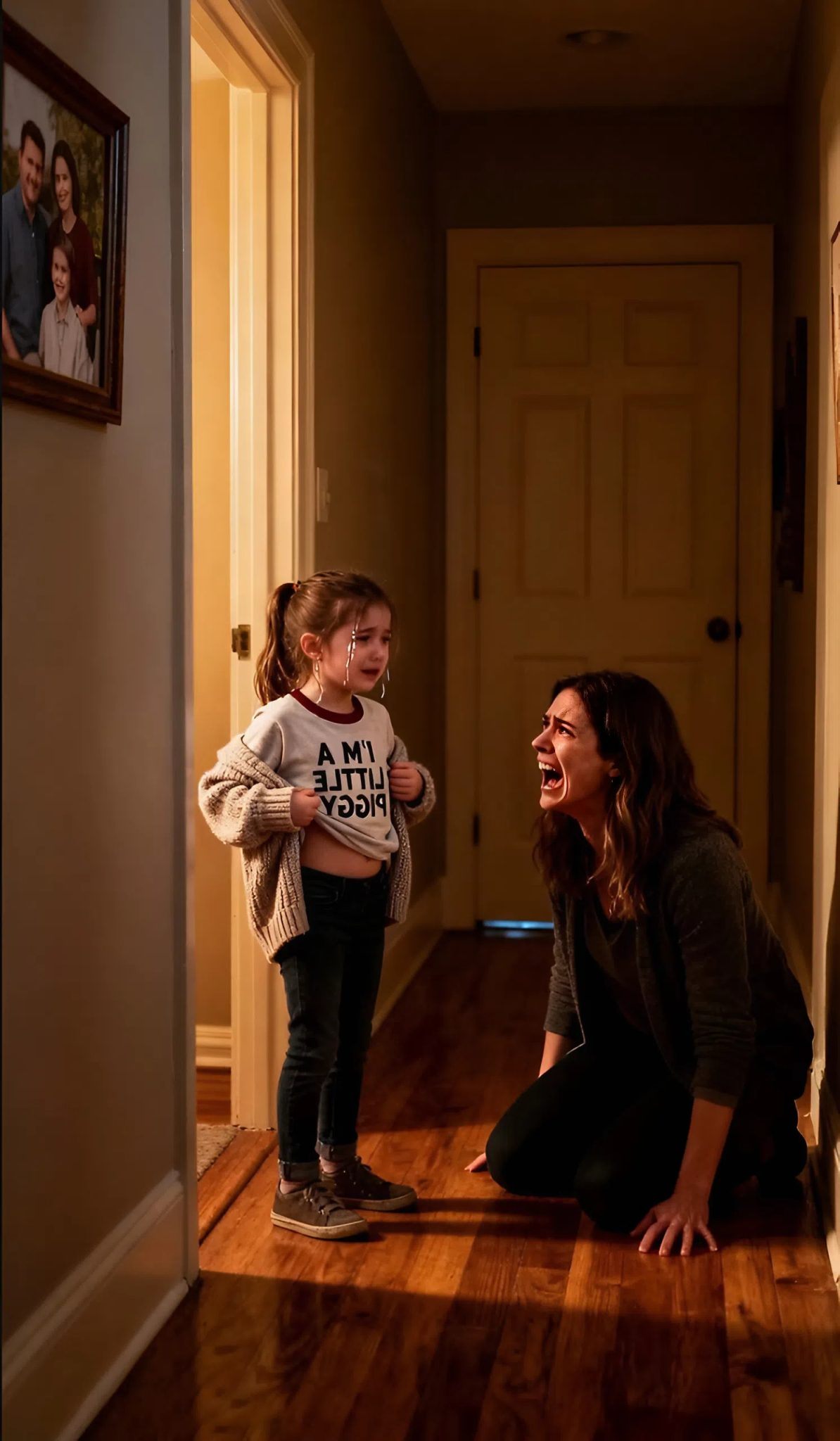
The first image was a rubbish bag.
Black plastic clinging to Lily’s sobbing body.
The second was the back of her legs, covered in scars and purple bruises.
The third was a video clip.
Victoria’s voice boomed through the church’s powerful sound system — distorted, but unmistakable:
“You’re disgusting.
No man will ever love a pig.”
A collective sigh swept through the hall, as if the air had been sucked out of it.
A woman in the second row dropped her psalter.
I didn’t look at the screen.
I looked at Victoria.
She tried to stand up, but couldn’t.
Her legs wouldn’t hold her.
Her mouth opened — a black hole of shock — but no sound came out.
She looked around desperately for an ally, a sympathetic glance.
She found none.
‘This,’ I said, pointing to the screen, which now showed a photograph of a hand-shaped bruise on Lily’s arm, ‘was done in the name of discipline.’
It was hidden behind a smile.
The silence was absolute.
Heavy. Suffocating.
The pastor stood to one side, frozen, clutching his Bible to his chest.
‘The police?’ I said into the microphone, answering the question hanging in the air.
‘No.’
‘Not yet, anyway.’
‘The law will come later.’
‘Quiet.’
‘Clean.’
I leaned closer to the microphone.
‘But the damage? Really?’
‘They belong to you.’

‘To her community.’
I looked directly at Victoria—her face had lost all colour, and she looked like a wax figure melting in the heat.
‘Merry Christmas, Victoria.’
I dropped the microphone.
It didn’t clatter — just fell silently onto the carpeted step.
I walked down the aisle.
David was staring at the screen, his face a mask of horror and realisation.
He wasn’t looking at me.
He was looking at his mother and seeing a monster for the first time in his life.
I walked out through the double doors into the cold winter night.
The air was clean and sharp.
The consequences were not a fiery storm.
It was frost.
We didn’t go to the police right away, although my solicitor filed a restraining order the next morning.
But the real punishment was not legal.
It was social.

Victoria was not arrested.
She was erased.
That was my plan.
Arrests can be distorted.
Lawyers can argue about context.
But shame?
Shame in a city like this is a life sentence.
Her neighbours stopped visiting her.
The postman stopped chatting.
The church ladies, her praetorian guard, no longer sat next to her.
They formed a new circle — without the woman who beat her child.
Her phone stopped ringing.
Her respect evaporated like water on hot asphalt.
She became a ghost in her own life.
That night, David stepped out of the shadows of his childhood.
He cried for three days.

He begged Lily for forgiveness until his voice was hoarse.
He wasn’t perfect, but he had finally woken up.
We severed all ties.
No financial support.
No visits.
No phone calls.
Weeks later, she tried to talk to me.
I was in the shop, in the fruit section, choosing apples.
Lily was with me — in a bright yellow summer dress, laughing at something on her tablet.
She didn’t see her grandmother approaching her.
Victoria looked smaller.
Thinner.
The red velvet coat was gone, replaced by a dull grey cardigan.
Her hair was no longer styled; it hung lifelessly around her face.
She looked like a building slated for demolition.
She stopped her trolley next to mine.

She didn’t look at Lily.
She couldn’t.
‘I didn’t mean to hurt her,’ she croaked.
Her voice was brittle, stripped of its former haughtiness.
‘I… I was trying to save her from…’
She fell silent, her hands trembling on the trolley handle.
I looked through her.
I no longer saw the matriarch.
I no longer saw power.
I saw a sad, broken old woman who used terror to feel important.
‘I know,’ I said calmly, without pity.
‘You wanted to break her so you could mould her in your own image.’
‘Elena, please,’ she whispered, tears filling her eyes.
‘I have no one.’
‘The phone… it never rings.’
I smiled.
It wasn’t a warm smile.
It was the smile of a predator who had finished its meal.

‘That’s the point, Victoria.’
I turned to Lily.
‘Let’s go, sunshine.’
‘Let’s get some ice cream.’
Lily looked up, saw the old woman and froze for a second.
I thought she would be scared.
But she looked at Victoria with indifference towards the stranger.
‘Okay, Mummy!’ Lily said happily.
We left.
We didn’t look back.
Now my daughter wears dresses she chooses herself.
Sometimes they don’t match.
Sometimes they’re tight.
Sometimes they’re loose.
It doesn’t matter.

She eats when she’s hungry.
She stops when she’s full.
She laughs loudly, with her mouth open, without shame.
The bin bag is gone.
The bruises have faded, becoming invisible memories, processed by her resilience.
But the memory lives on in me.
Not as pain, but as a reminder.
Like a totem.
Sometimes I sit on the porch, drink coffee and watch the leaves fall.
I hear rumours about Victoria.
She’s selling the house.
Moving to a small town two states away.
Running from the silence she created herself.
I didn’t swing a belt.
I didn’t raise my fist.
I didn’t scream until my throat bled.
I took her power, her image, her position, her world.
I took it all away piece by piece — quietly, legally, perfectly.
When she opened that door many weeks ago, I embraced her.
And when she closed her eyes, thinking she had won, I destroyed her without regret, without mercy, without noise.
I did it the way monsters deserve.
And I would do it again.