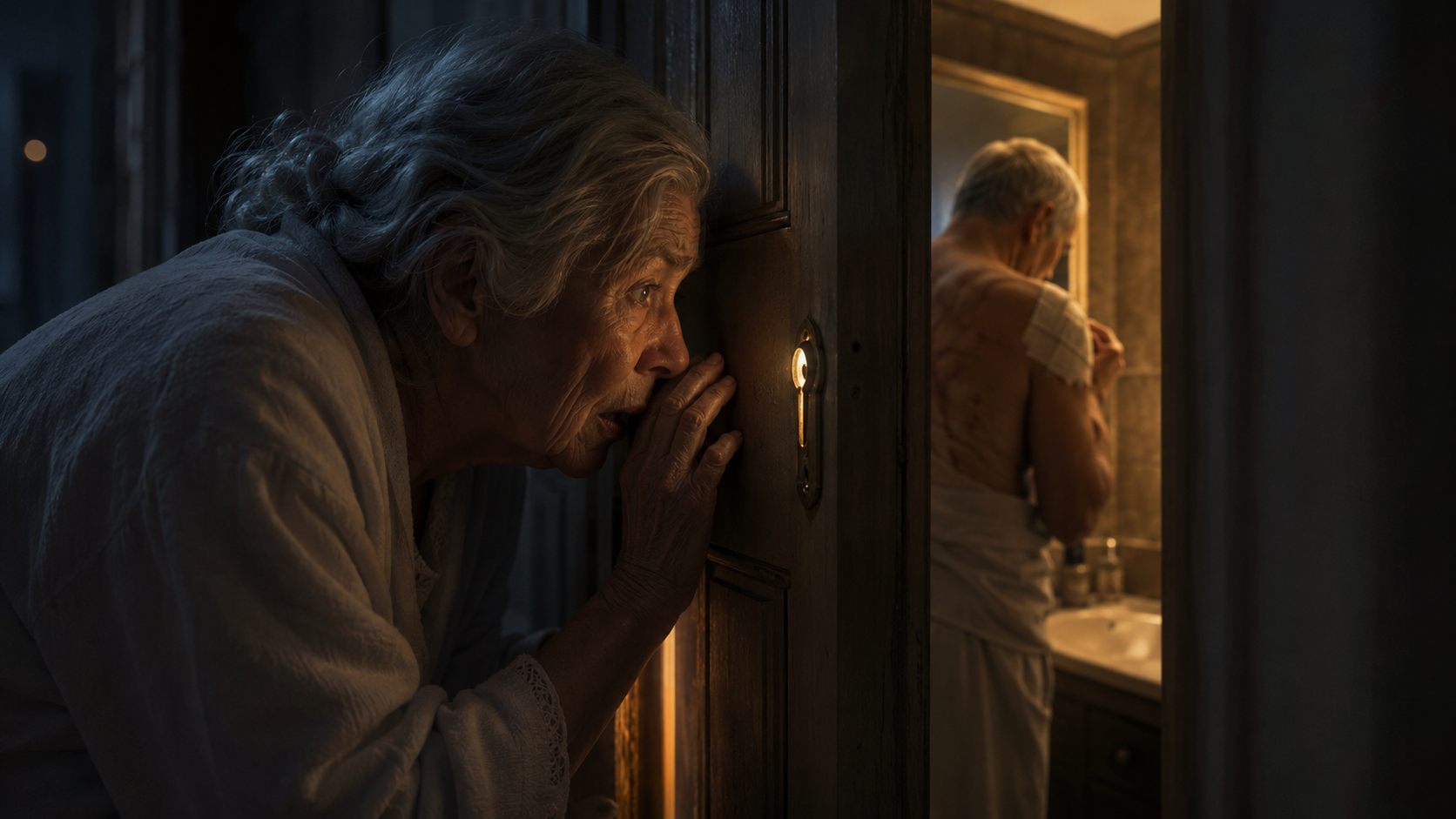
The first time Simon helped tape a bandage to his father’s shoulder, his hands were clumsy.
Thomas said, “You don’t have to do this.”
Simon kept his eyes on the gauze.
“I know.”
“I mean it.”
“So do I.”
Thomas said nothing.
Simon smoothed the tape down.
After a moment, he said, “When I was twelve, I thought you didn’t come to my baseball games because you were disappointed in me.”
Thomas looked up sharply.
“I went to every game.”
“You stood by the fence.”
“I didn’t want to embarrass you.”
“I wanted you in the stands.”
Thomas closed his eyes.
“I didn’t know how to sit with other fathers.”
Simon’s mouth tightened.
“You could’ve just sat with me.”
The words struck deeper than blame.
Thomas nodded slowly.
“I’m sorry.”
Simon finished the bandage.
Then, awkwardly, almost roughly, he placed his hand on his father’s good shoulder.
Thomas froze.
Simon almost pulled away.
Evelyn watched from the doorway, not breathing.
Then Thomas leaned into his son’s hand.
Only a little.
But enough.
A week later, Thomas gave Evelyn the black metal box.
It had sat in the bathroom drawer for decades. She had seen it only in glimpses, heard it open in the dark, imagined it full of shame. Now it rested on the kitchen table between them.
“What’s in it?” she asked.
“My proof,” he said. “And my punishment.”
Inside were things wrapped in cloth: a hospital bracelet with a name that was not his, a brittle newspaper clipping about the fire, a black-and-white photograph of four children standing in front of a brick building, and a small brass button.
Evelyn picked up the photograph.
“Which one is Lila?”
Thomas pointed.
The girl was thin, maybe thirteen, with chopped dark hair and fierce eyes. She looked directly at the camera as if daring the world to lie about her.
“She saved you,” Evelyn said.
Thomas swallowed.
“I left her.”
“She saved you,” Evelyn repeated.
His hands curled into fists.
“For fifty years, I have lived because she didn’t.”
“No,” Evelyn said. “For fifty years, you have carried the life she handed you.”
He looked at the photograph for a long time.
“I didn’t know how to make it worth what it cost.”
Evelyn reached for his hand.
“You married me. You raised Mara and Simon. You fixed boilers, roofs, bicycles, kitchen drawers, broken fences. You planted lavender because I missed my mother. You lived quietly, yes. Fearfully, yes. But you lived. Maybe that was the first way of honoring her.”
Thomas’s face folded.
He did not cry loudly.
He never did.
But he cried with the exhaustion of a man who had finally set down a weight and discovered it had shaped his bones.
In spring, Mara found a survivors’ advocacy group that investigated abuses in closed state institutions. Thomas refused at first. He said he was too old. He said no one would care. He said the dead did not need his voice anymore.
Then Simon said, “Maybe the living do.”
Thomas looked at his son for a long time.
Three weeks later, he attended a meeting in Portland.
Evelyn went with him but waited in the hallway because he asked her to. When he came out, he looked pale and drained, but different. Not healed. Not free. Different.
“There was a woman there,” he said as they walked to the parking lot.
“Yes?”
“She was at the home two years after me.”
Evelyn stopped.
“She knew about Lila.”
The name hung between them.
Thomas looked at the sky as if he expected smoke.
“She said Lila opened more doors than I knew.”
Evelyn took his hand.
This time, he held it in public.
That summer, Thomas gave a recorded statement.
He sat in a plain room with two investigators, a lawyer from the advocacy group, Mara, Evelyn, and a pitcher of water he never touched. Simon waited outside because he said if he heard too much, he might break something.
Thomas spoke for four hours.
He gave names.
Rooms.
Smells.
Rules.
Punishments.
He described the east wing, the locked laundry door, the key ring, the fire, the girl who pushed him into smoke and shouted, “Run like you owe me your life.”
At that part, Thomas stopped.
Evelyn reached for his hand under the table.
He looked at the recorder.
“I did,” he said. “I ran like I owed her my life. Then I spent fifty years afraid to spend it.”
The investigation did not bring perfect justice. Most of the guilty were dead. Some records had been destroyed. Some names remained protected by time, money, and official cowardice. But the advocacy group uncovered enough to correct several death records, restore names to children listed only by numbers, and place a memorial plaque where the old building had once stood.
In October, Thomas stood before that plaque wearing a blue shirt with the sleeves rolled to his forearms.
Not all the way.
But enough.
Evelyn saw people glance at the scars.
Thomas saw them too.
His hands shook.