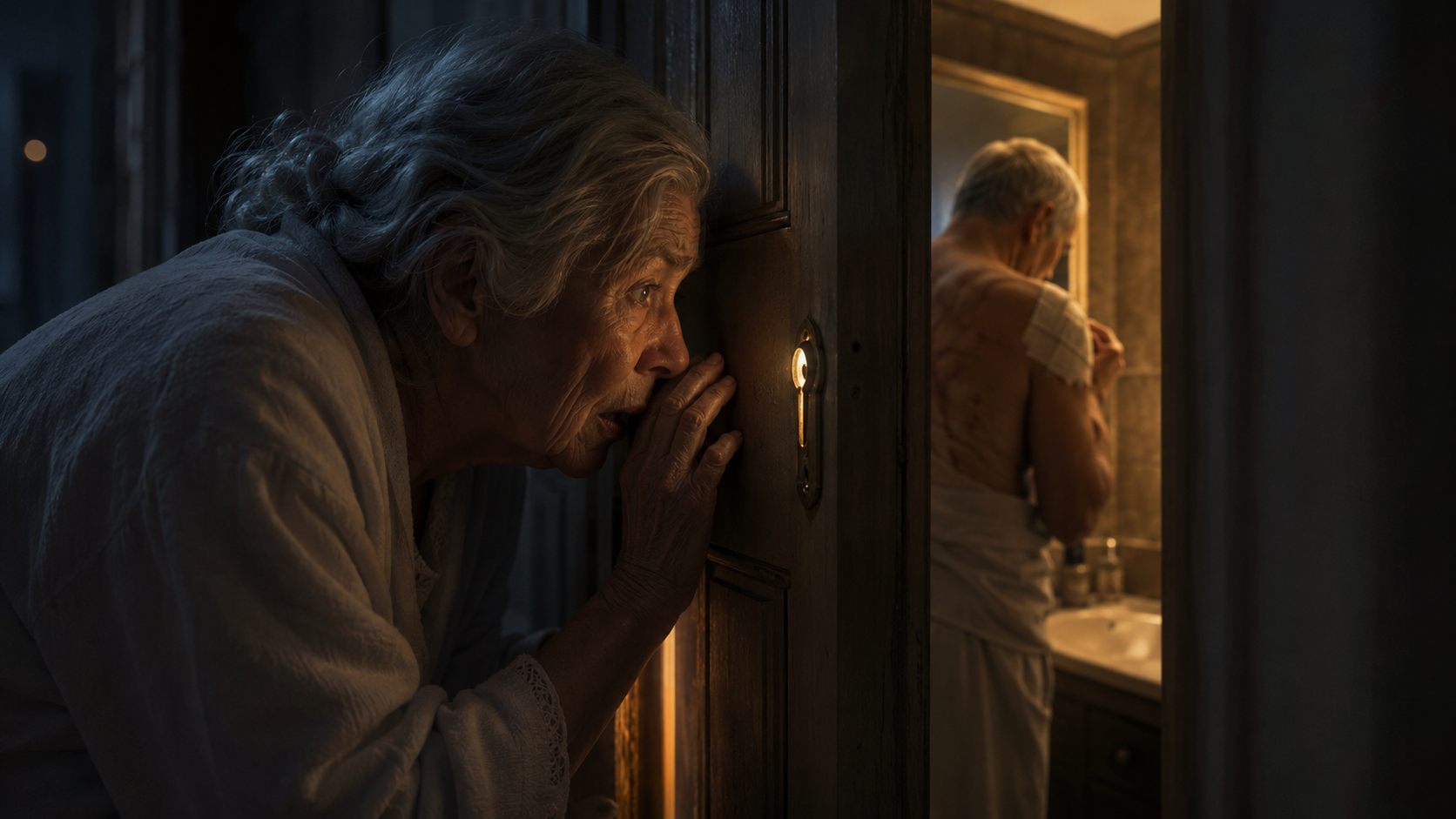
But he did not roll the sleeves down.
Mara stood on one side of him. Simon on the other. Evelyn held the photograph of Lila in both hands.
The plaque listed twenty-three names.
Lila Warren was number seventeen.
Thomas touched her name with two fingers.
For a long time, he said nothing.
Then he whispered, “I lived.”
The wind moved through the trees.
“I’m sorry it took me so long to mean it.”
Simon stepped forward and placed the small brass button from the metal box at the base of the plaque. Thomas had once told him it came from Lila’s coat, torn loose the night of the fire.
Mara wiped her eyes.
Evelyn slipped her hand into Thomas’s.
He did not flinch.
On their thirty-sixth wedding anniversary, their children threw them a dinner in the backyard. It was simple: folding chairs, grilled salmon, potato salad, too many pies, grandchildren running between adults with the wild joy of people who did not yet understand how many ghosts had been invited to the table.
Thomas wore short sleeves for the first time since Evelyn had known him.
Not confidently.
Not comfortably.
But willingly.
The scars showed.
So did his arms, thinner now, sun-spotted, human.
His youngest granddaughter, Lucy, climbed into his lap without asking. Everyone froze for half a second. Thomas froze too. Then he placed one careful hand on her back.
Lucy touched a scar near his wrist.
“Did that hurt, Grandpa?”
Mara inhaled sharply.
Simon looked down.
Evelyn waited.
Thomas looked at the child in his lap.
“Yes,” he said. “A long time ago.”
“Does it still hurt?”
“Sometimes.”
Lucy considered this with serious eyes.
Then she kissed the scar because children understand healing in ways adults forget.
Thomas closed his eyes.
When he opened them, they were full of tears.
But he was smiling.
Later that night, after the family left and the house returned to its old quiet, Evelyn found Thomas in the hallway outside the bathroom. The door stood open. The light was off.
In his hand was the little key.
He turned it over in his palm.
“I kept this like it protected me,” he said.
“Maybe once it did.”
“Maybe.”
“What do you want to do with it?”
He walked through the kitchen and out the back door. Evelyn followed. The night smelled of damp earth and lavender. Thomas crossed to the garden bed he had planted decades earlier and knelt slowly, his bad knee protesting.
With his thumb, he pressed the key deep into the soil beneath the lavender.
Evelyn watched from the porch.
“You’re burying it?” she asked.
Thomas covered it with dirt.
“No,” he said. “I’m retiring it.”
She smiled through tears.
He stood, brushed soil from his hands, and looked toward the dark windows of their house.
“I don’t know how to be a man without locked doors,” he admitted.
Evelyn came down the steps and took his hand.
“Then we learn the house again.”
The next morning, Evelyn woke before him.
For a moment, she panicked.
The room was pale with dawn. The clock read six-forty-two.
Thomas was still asleep beside her.
No hallway footsteps.
No drawer.
No metal box.
No lock.
His face was turned toward the window, softened by light. One hand rested open on the blanket, palm up, as if he had released something in his sleep.
Evelyn did not wake him.
She lay beside him, listening to the quiet.
For thirty-five years, silence had been a wall in their marriage.
That morning, for the first time, it felt like a room with open windows.
When Thomas finally opened his eyes, he blinked at the daylight.
“What time is it?” he asked, confused.
Evelyn smiled.
“Late.”
He sat up too quickly. “How late?”
“Almost seven.”
His eyes moved toward the hallway.
The bathroom door was open.
For a long moment, he simply stared.
Then he laughed.
It was not a big laugh. Not at first. It was rusty, uncertain, almost embarrassed, like something rescued from a locked drawer. But then it grew warmer. Realer. Evelyn laughed too, and soon both of them were sitting in bed with tears on their faces, laughing at the impossible mercy of an ordinary morning.
Thomas reached for her hand.
“I don’t know what to do now,” he said.
Evelyn looked toward the open door, the bright hallway, the house that had held both secrets and love for longer than either of them had understood.
“Now,” she said, “we make coffee after sunrise.”
And for once, he let the morning come to him unlocked.