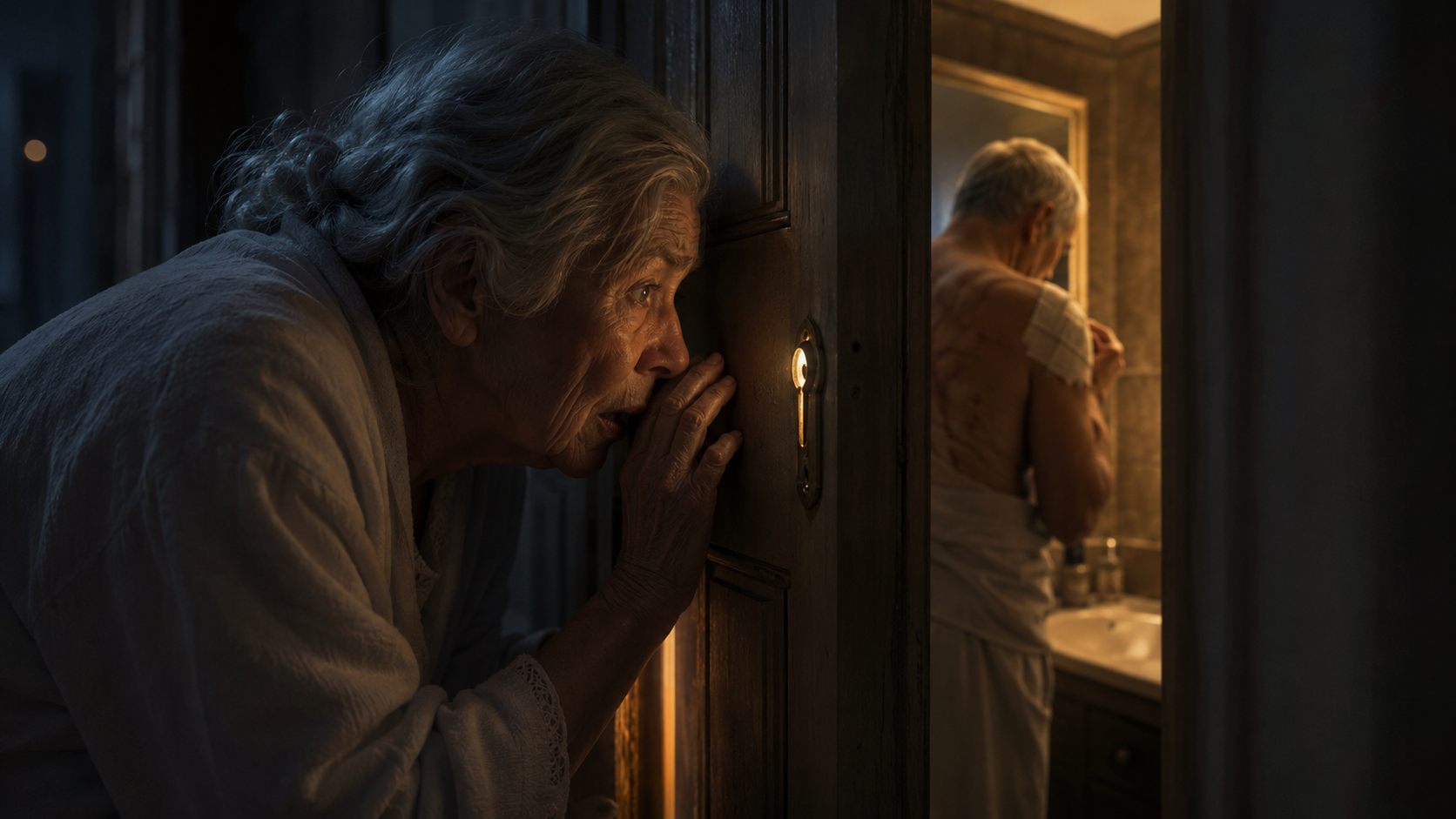
Evelyn went to him.
Slowly.
Carefully.
She placed one hand on his shoulder.
He trembled beneath her touch.
But he did not move away.
Mara arrived first, still wearing scrubs beneath her coat, hair pulled into a careless knot, face pale with alarm. Simon came twenty minutes later smelling of rain and engine oil, his jaw set the way Thomas’s used to be when he was pretending not to feel anything.
They found their father at the kitchen table wrapped in an old robe.
Mara looked from Evelyn to Thomas.
“What happened?”
Thomas opened his mouth.
No words came.
Evelyn answered gently. “Your father has been hurt for a very long time.”
Simon frowned. “What does that mean?”
Thomas’s hands shook as he untied the robe.
“Dad,” Mara said softly, already sensing the shape of the moment.
He opened the robe enough to show his chest, his shoulder, the burned numbers, the edges of the scars.
Mara went completely still.
Simon turned away, one hand over his mouth.
No one spoke.
The clock above the stove ticked with unbearable cheerfulness.
Finally Mara whispered, “Who did this to you?”
Thomas looked at his children and saw the little girl who used to bring him seashells, the little boy who fell asleep in his truck after fishing trips. He saw all the times he had stepped away when they wanted closeness, all the love he had rationed as if tenderness might expose them to danger.
“I don’t know how to tell it,” he said.
Mara knelt beside him.
“Then don’t tell it all at once.”
Simon leaned against the counter, eyes wet and angry.
“How long?”
Thomas knew what he meant.
“All my life.”
Simon laughed once, a harsh sound with no humor in it.
“You let us think you were just cold.”
Thomas closed his robe.
“I thought cold was safer than broken.”
Simon looked as if he wanted to shout.
Instead, he walked out to the porch.
Evelyn followed him.
Rain fell in thin silver lines beyond the awning. Simon stood with his hands on the railing, breathing hard.
“He hugged other people,” Simon said.
“What?”
“At church. Neighbors. People he barely knew. He’d shake hands, pat backs, fix things for everyone. But when I was a kid, I used to wait for him to put his arm around me. I thought I’d done something wrong.”
Evelyn’s throat tightened.
“I know.”
Simon wiped his face angrily.
“No, Mom. You don’t know what it’s like to want your father to touch your shoulder and feel him pull away like you burned him.”
Evelyn looked through the window at Thomas sitting under the kitchen light, Mara beside him, both of them crying quietly now.
“No,” she said. “I don’t know that exactly.”
Simon looked at her.
“But I know what it is to lie next to someone for thirty-five years and wonder why love has to happen in the dark.”
His anger softened.
Inside, Thomas lifted his head as if he could feel them talking about him.
Simon looked away.
“I’m mad,” he said.
“You’re allowed.”
“I’m mad at people who are probably dead.”
“You’re allowed.”
“I’m mad at him too.”
Evelyn took her son’s hand.
“Then be mad near him. Not away from him.”
That was the first lesson the family learned after the door opened: pain did not disappear when given a name. It simply stopped wandering the house disguised as something else.
Mara arranged a doctor’s visit that afternoon. Thomas tried to refuse twice. Evelyn ignored him twice. By three o’clock, he sat in a private examination room with paper beneath him and terror in his eyes.
The doctor was a woman named Dr. Raines, older, calm, with silver hair and steady hands. She did not gasp when she saw his scars. She did not ask for every detail. She explained what she was doing before she touched him, and when Thomas said, “Stop,” she stopped so quickly he looked confused.
“You can say that here,” Dr. Raines told him.
Thomas blinked.
“What?”
“You can say stop. You can say no. You can ask questions. You can leave. This is your body.”
Evelyn saw his face change.
Not dramatically.
Just a crack in an old wall.
Later, in the car, he sat silent for miles. Then he whispered, “No one ever told me that.”
Mara, driving, pulled over because she was crying too hard to see.
The months that followed were not easy.
Healing, Evelyn discovered, was not a sunrise. It was weather. It changed. It circled back. Some days Thomas spoke. Some days he locked himself in silence without locking any doors. Some mornings he still woke at four-seventeen, drenched in sweat, already halfway down the hallway before he remembered where he was.
But now the bathroom door stayed open.
Sometimes Evelyn found him standing in front of the mirror, looking at the scars as if seeing someone else’s body. Sometimes she helped him change dressings. Sometimes Mara came by before work. Sometimes Simon appeared with coffee and pretended he had stopped in only because he was nearby.