I didn’t think much about the trip at first—just another school event, another weekend activity. But everything changed when I got a phone call I couldn’t ignore. The next day, as I walked into the school, I had no idea just how much my son’s actions had set into motion.
My name is Sarah. I’m 45, and raising my son Leo on my own has taught me what real, quiet strength looks like.

Leo is 12 now. He’s the kind of boy people often overlook at first—gentle, thoughtful, and deeply sensitive. He feels everything intensely, though he rarely puts it into words. Not since we lost his father three years ago.
But last week, something shifted.
He came home… different.
There was a light in him—not loud or restless, but steady. Almost glowing.
He dropped his backpack near the door and said, with unusual urgency, “Sam wants to go too… but they said he can’t.”
I turned from the kitchen. “You mean the hiking trip?”
He nodded.
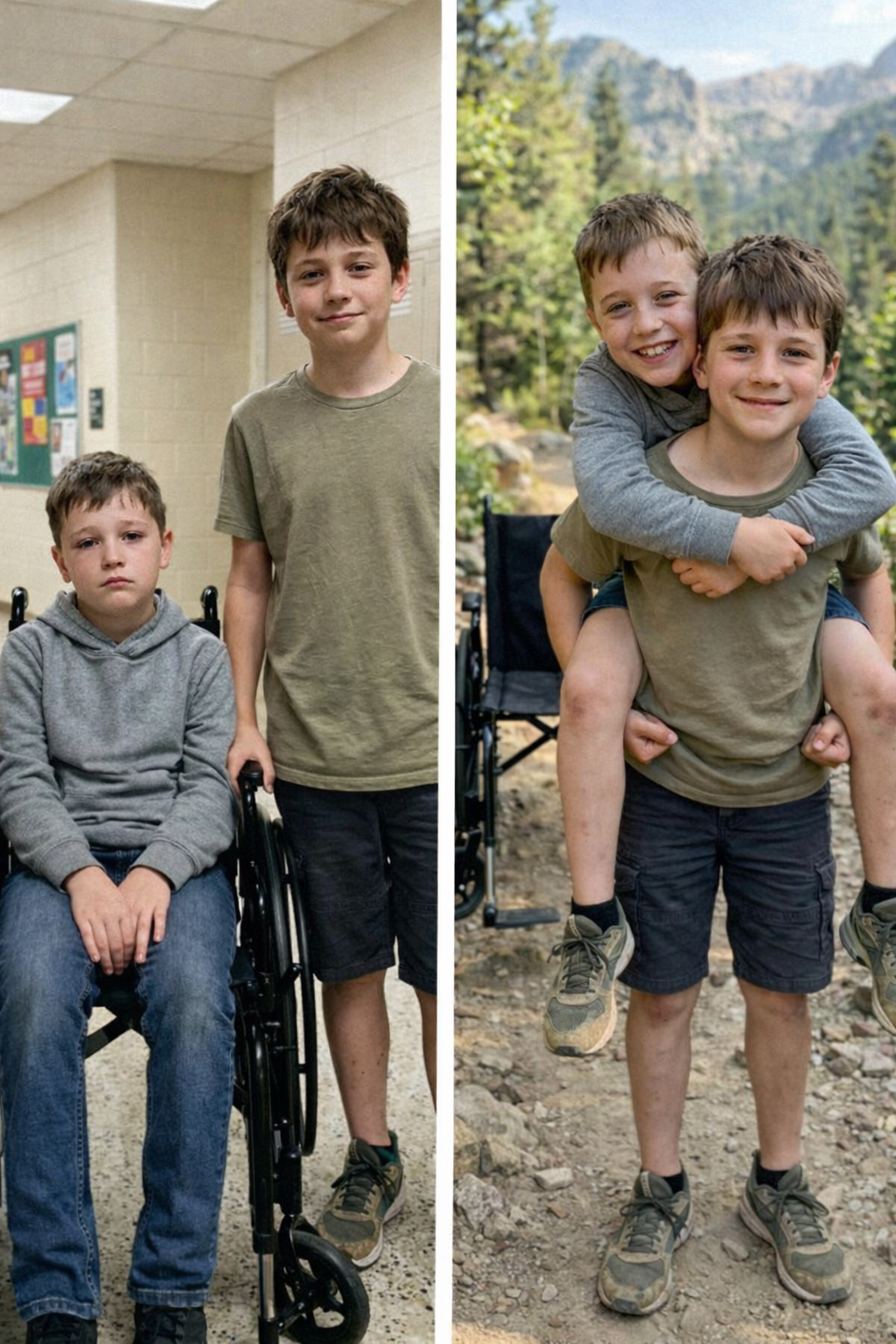
Sam has been Leo’s best friend since third grade. Bright, funny, quick-witted—but his life has mostly been spent watching from the sidelines. Sam has used a wheelchair since birth, and too often, that’s meant being left out.
“They said the trail’s too difficult for him,” Leo added quietly.
“And what did you say?” I asked.
He shrugged. “Nothing… but it’s not fair.”
I thought that was the end of the conversation.
It wasn’t.
Saturday afternoon, the buses pulled back into the school parking lot. Parents gathered, chatting as they waited.
I spotted Leo immediately as he stepped off.
He looked completely drained.
His clothes were covered in dirt. His shirt clung to him with sweat. His shoulders sagged like he’d been carrying something far too heavy for far too long. His breathing was still uneven.
I rushed over.
“Leo, what happened?” I asked, alarmed.
He looked at me—tired, but calm—and gave a small, quiet smile.
“We didn’t leave him.”
At first, I didn’t understand.
Then another parent, Jill, approached and explained everything.
The trail had been six miles long—steep, uneven, with narrow paths and difficult climbs.
And then she said it:
“Leo carried Sam on his back the whole way.”
I felt my stomach drop.
“Sam kept telling my daughter that Leo would say, ‘Hold on, I’ve got you,’” Jill continued. “He kept adjusting his grip and refused to stop.”
I looked back at my son.
His legs were still trembling.
Then his teacher, Mr. Dunn, approached us, clearly upset.
“Sarah, your son broke protocol. He took an alternate route—it was dangerous. We had clear rules. Students who couldn’t complete the hike were supposed to stay behind at the campsite.”
“I understand,” I said quickly, my hands beginning to shake. “I’m so sorry.”
And yet… beneath the fear, something else grew.
Pride.
Dunn wasn’t alone. The other teachers looked just as disapproving.
Still, no one had been hurt. So I assumed that was the end of it.
It wasn’t.
The next morning, my phone rang while I was home. I nearly ignored it.
Then I saw the school’s number.
My chest tightened.
“Hello?”
“Sarah?” Principal Harris’s voice came through. “You need to come to the school immediately.”
Something in her tone made my stomach drop.
“Is Leo okay?”
There was a pause.
“There are men here asking for him,” she said.
“What kind of men?”
“They won’t explain. Please—just come quickly.”
The line went dead.
I didn’t waste a second.
On the drive, my hands shook so badly I could barely hold the wheel. My mind raced through every possible scenario—and none of them were good.
When I arrived, my heart was pounding.
I walked toward the office… and stopped cold.
Five men stood outside.
All in military uniforms.
Still. Focused. Silent.
Principal Harris rushed toward me.
“They’ve been here for twenty minutes,” she whispered. “They said it has something to do with what Leo did yesterday.”

My throat went dry.
“Where is my son?”
Before she could answer, the tallest man stepped forward.
“Ma’am, I’m Lieutenant Carlson. Would you join us inside?”
I nodded, barely able to think.
Inside, the room felt tight and tense. Mr. Dunn stood in the corner, clearly irritated.
Carlson turned toward the door.
“Bring him in.”
The door opened.
Leo walked in.
The moment I saw his face, my heart dropped.
He looked terrified.
His eyes darted between the men… and me.
“Mom?” he said, his voice shaking.
I rushed to him. “Hey, it’s okay. I’m here.”
But he didn’t relax.
“I didn’t mean to cause trouble,” he blurted out. “I know I wasn’t supposed to do that. I won’t do it again, I promise.”
That broke me.
“You should’ve thought about that earlier,” Dunn muttered.
“That’s enough,” I snapped. “You’re scaring him!”
Leo’s panic escalated.
“I’m sorry! I won’t break the rules again! Please don’t let them take me! I just didn’t want my best friend to be left out!”