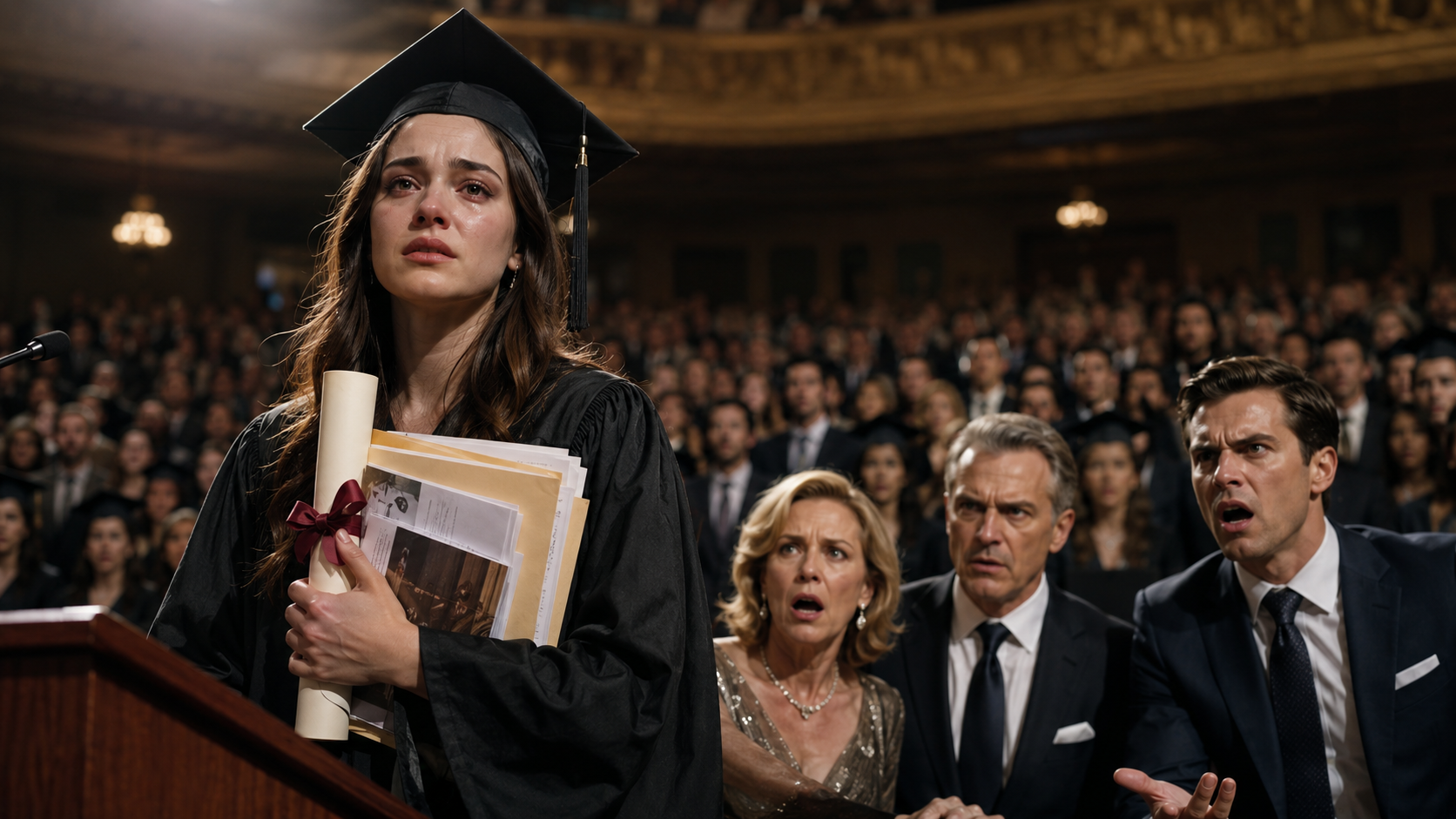
They Called Her Worthless—Until Her Graduation Speech Destroyed the Lie Their Golden Son Was Built On

The morning of graduation, Claire Whitmore’s father looked at her cap and gown hanging from the closet door and sighed like it was a parking ticket.

“Try not to make today about yourself,” he said.

Claire stood in the hallway with one earring in her hand.

For a second, she thought she had misheard him. Graduation day. Four years of working overnight shifts, eating vending machine dinners, tutoring freshmen for cash, sleeping in library chairs between labs — and the first thing her father said was not congratulations.

It was a warning.

Her mother, Denise, stepped out of the kitchen carrying a travel mug and wearing the cream dress she usually saved for charity galas.

“Your father means we have a lot going on today,” she said, not looking Claire in the eyes. “Preston’s announcement is important.”

Of course.

Preston.

Claire’s older brother had not been a student at Wexford University for three years, but somehow, her graduation had still become his event.

Preston Whitmore was the son people remembered. The charming one. The one with perfect teeth, expensive watches, and a voice that made adults lean in. He had been on local news twice, once for launching a youth leadership foundation and once for being named “one of the city’s brightest young innovators.”

Her parents kept both interviews framed in the living room.

Claire’s high school diploma was still in a cardboard tube somewhere in the garage.

“What announcement?” Claire asked.

Her mother’s lips tightened.

“Don’t start.”

“I’m not starting. I just asked a question.”

Her father folded the newspaper and looked at her over his glasses.

“Preston is being introduced today as the new director of the Whitmore Foundation’s education initiative. The university president will mention him during the ceremony.”

Claire stared at him.

“At my graduation?”

“At the university graduation,” he corrected. “Not everything belongs to you, Claire.”

There it was.

The sentence of her childhood, polished into different shapes.

Not everything belongs to you.

Don’t be jealous.

Don’t make trouble.

Preston earned this.

You should be happy for your brother.

Claire turned the earring between her fingers. It was a tiny pearl stud she had bought from a thrift shop three days earlier because her mother had forgotten to ask what she was wearing.

“Right,” she said quietly.

Her father softened his voice, which was always worse than when he yelled.

“Claire, this is a chance for the family to look united. Preston has worked hard to repair the foundation’s image after everything. Don’t sit there with that face.”

That face.

The same face she had apparently made at twelve when Preston blew out the candles on her birthday cake because he was “just being funny.”

The same face she made at sixteen when her parents gave Preston a car for getting into business school and told Claire she could borrow the old minivan if she paid for gas.

The same face she made at eighteen when her college savings mysteriously became “family investment money” and Preston’s failed startup suddenly had seed funding.

Claire put on the second earring.

“I’ll behave.”

Her mother smiled with relief, as if obedience was the same thing as peace.

“Good. And please don’t mention your little award thing unless someone asks. We don’t want people thinking you’re bragging.”

Claire almost laughed.

Her little award thing.

The university had sent three emails about it. The dean had called personally. A woman from the National Research Council had flown in for the ceremony.

But her parents had not opened the invitation.

They had been too busy helping Preston choose a tie.

Claire looked at herself in the hallway mirror.

Black gown. Straightened hair. Borrowed shoes. Calm face.

Behind her reflection, Preston came down the stairs wearing a navy suit and the kind of smile people trusted before they knew better.

“Big day,” he said.

Claire met his eyes in the mirror.

“For me or for you?”

He grinned.

“Depends who gives the better speech.”

Something cold moved through her chest.

“What speech?”

Preston adjusted his cuffs.

“Oh, come on. You didn’t know? They asked me to say a few words before the foundation announcement. Alumni success story, community impact, all that.”

Her father looked proud enough to glow.

Claire nodded slowly.

Of course they had told Preston.

Of course they had told everyone.

Everyone except her.

Preston stepped beside her and lowered his voice.

“Don’t look so wounded, Claire. You got your little degree. Let the adults handle the real opportunities.”

He walked away before she could answer.

Her mother called from the kitchen, “Everyone ready?”

Claire picked up her cap.

Inside the top, hidden beneath the black fabric, she had taped a folded piece of paper.

Not a quote.

Not a decoration.

A promise.

Today, I stop protecting people who never protected me.

She touched it once, then followed her family out the door.

The auditorium was already packed when they arrived.

Families carried flowers, balloons, cameras, signs. Mothers cried before the music even started. Fathers fixed their sons’ collars. Little sisters waved from the aisles. Everywhere Claire looked, there was proof that some people were celebrated without having to beg for it.

Her family moved through the crowd like a campaign team.

Her father shook hands. Her mother kissed cheeks. Preston accepted congratulations for an announcement that had nothing to do with the diploma Claire was about to receive.

Claire walked three steps behind them, holding her own gown so it would not drag across the floor.

A woman from her mother’s charity circle touched Denise’s arm.

“You must be so proud today.”

Denise smiled instantly.

“Oh, we are. Preston has such exciting news.”

The woman glanced at Claire.

“And your daughter too, of course.”

There was a half-second pause.

The kind that told the whole story.

“Yes,” Denise said. “Claire finished school.”

Finished school.

Not graduated with highest honors.

Not completed two degrees in four years.

Not became the youngest recipient of the Whitcomb Research Medal.

Just finished school.

Claire kept walking.

She found her row near the front with the other honor graduates. Her best friend, Jade, was already there, waving with both hands.

“You look like you survived a hostage situation,” Jade whispered as Claire sat down.

“I might still be in one.”

Jade’s smile faded.

“They still don’t know?”

Claire shook her head.

“About the medal?”

“No.”

“About the speech?”

“No.”

“About Boston?”

Claire looked down at her hands.

“No.”

Jade let out a slow breath.

“Claire.”

“I wanted one thing they couldn’t touch before it became real.”

Jade did not argue.

She knew too much.

She knew about the nights Claire came to the lab with swollen eyes after family dinners. She knew about the unpaid internships Claire had turned down because she needed rent money. She knew about the research proposal Claire wrote at nineteen — the one that disappeared from her laptop the same week Preston launched his education technology foundation with a suspiciously familiar mission statement.

Jade also knew about the folder.

The emails.

The timestamps.

The original drafts.

The faculty review notes.

The proof Claire had carried for years because she was too scared to use it.

The music began.

Graduates stood.

The auditorium filled with applause.

Claire walked with the others down the aisle, but she did not search for her family at first. She knew exactly what she would see.

Her father checking his phone.

Her mother watching Preston.

Preston smiling like the building belonged to him.

The ceremony moved slowly.

Speeches about perseverance.

Speeches about service.

Speeches about the future belonging to those brave enough to build it.

Claire listened with the stillness of someone standing at the edge of a cliff, waiting for the wind to decide.

Halfway through the ceremony, the university president stepped up to the podium.

“And now,” he said, “before we continue with our graduate honors, we are pleased to recognize an alumnus whose leadership has brought national attention to community education access.”

Claire felt Jade’s hand find hers.

“Please welcome Preston Whitmore.”

The applause was immediate.

Her parents stood.

Of course they stood.

Denise clapped with both hands pressed high against her chest, eyes shining. Claire’s father whistled. People around them turned, impressed.

Preston walked onto the stage like he had been born under lights.

He hugged the university president. He waved modestly. He placed both hands on the podium and smiled.

“Thank you, President Harlan. It’s always emotional to return to Wexford, the place where I learned that opportunity means nothing unless you use it to lift others.”

Claire’s stomach turned.

Preston continued.

“When I founded BrightPath, I was thinking of students who feel invisible. Students who are told they are not enough. Students who need someone to believe in them before they can believe in themselves.”

Jade whispered, “I’m going to be sick.”

Claire did not move.

On stage, Preston’s voice grew warmer.

“My family taught me that success is not about personal glory. It’s about service. It’s about sacrifice. It’s about remembering where you came from.”

Claire looked at her parents.

Her mother was crying.

Actually crying.

Not for Claire.

Not for the daughter who used to fall asleep at the kitchen table over scholarship applications.

Not for the daughter who had once asked for help buying textbooks and been told, “Maybe college isn’t for everyone.”

No.

Denise was crying because Preston had said the word sacrifice into a microphone.

Preston ended to loud applause.

Then came the announcement: the Whitmore Foundation, in partnership with the university, would fund a new mentorship center.

A center based on Preston’s “original model.”

Original.

Claire closed her eyes.

For four years, she had told herself silence was maturity.

For four years, she had believed exposing him would make her look bitter.

For four years, she had let her family turn stolen work into a golden staircase for their favorite child.

But then President Harlan returned to the podium.

“And now we come to one of the highest honors Wexford University can bestow.”

Claire opened her eyes.

Beside her, Jade squeezed her hand so hard it hurt.

“The Whitcomb Research Medal is awarded each year to a graduating student whose work demonstrates exceptional originality, discipline, and social impact. This year’s recipient has not only completed a groundbreaking thesis on educational access algorithms, but has also been accepted into the doctoral fellowship program at Northeastern Institute with full funding.”

Claire heard a sound behind her.

Her mother.

A soft, confused intake of breath.

President Harlan smiled.

“Please join me in congratulating Claire Elise Whitmore.”

For a moment, no one around her moved.

Then Jade screamed.

The honor graduates stood. Faculty rose. Applause rolled through the auditorium, growing louder, wider, impossible to ignore.

Claire stood slowly.

Her legs felt distant.

She walked toward the stage with every eye on her, but she only looked once at her family.

Her father’s face had gone pale.

Her mother’s mouth was open.

Preston was no longer smiling.

Claire climbed the steps.

President Harlan handed her the medal. Dr. Maren Bell, her research advisor, hugged her with one arm and whispered, “You earned this. All of it.”

Claire almost broke then.

Not because of the applause.

Because someone had said earned without making it sound like an accident.

She turned toward the audience with the medal in her hands.

The applause kept going.

And for the first time in her life, her family could not pretend they did not see her.

President Harlan waited for the room to quiet.

“As this year’s medal recipient,” he said, “Claire will now deliver the graduate response.”

Somewhere in the audience, her father stood halfway out of his seat.

“What?” he said, loud enough for the nearby rows to hear.

Claire looked at him.

Then she stepped to the microphone.

The paper she had prepared was folded inside her sleeve.

But when she saw Preston’s face — the anger, the warning, the silent command to stay small — she knew she did not need it.

She leaned toward the microphone.

“My name is Claire Whitmore,” she said. “And for most of my life, I believed I was the least impressive person in my family.”

The auditorium went quiet.

Not polite quiet.

Curious quiet.

“My brother was the gifted one. The confident one. The one teachers remembered, donors trusted, and my parents celebrated. I was the difficult one. The emotional one. The one who was told she asked for too much and achieved too little.”

Her mother’s hand flew to her throat.

Claire kept going.

“When I was eighteen, I almost didn’t come to college. Not because I wasn’t accepted. Not because I didn’t want it. But because the money set aside for my education had been used elsewhere.”

Her father’s face hardened.

Preston slowly sat back in his chair.

“I was told to be practical. I was told to stop dreaming. I was told that some people are leaders and some people are support.”

Claire looked down at the medal.

“For a long time, I believed them.”

She lifted her eyes again.

“But then I met professors who read my work before judging my name. I met friends who stayed up with me when I wanted to quit. I met students who reminded me that being overlooked is not the same as being empty.”

A few people applauded softly.

Claire waited.

“And I learned something else. Sometimes the person called worthless is not worthless at all. Sometimes they are simply surrounded by people who profit from them not knowing their value.”

The air changed.

She felt it move across the room.

A warning before a storm.

“My thesis,” Claire said, “began as a project when I was seventeen. It was a mentorship model for first-generation students, built around predictive support, peer pairing, and community accountability. I wrote it after watching classmates fall through cracks no one bothered to measure.”

Preston stared at her.

Now he knew.

“Years ago, an early version of that project was taken from me.”

Someone gasped.

Claire’s father stood fully.

“Claire,” he said sharply.

She did not look away from the audience.

“It was renamed. Repackaged. Presented as someone else’s vision. It became the foundation for a public success story I was expected to applaud from the shadows.”

The auditorium was so silent she could hear the lights humming.

“I stayed quiet because I was afraid. Afraid of being called jealous. Afraid of being told I was trying to ruin my brother. Afraid that no one would believe the daughter my own family had trained everyone to underestimate.”

Her voice shook once.

Only once.

“But research teaches you to keep records.”

Dr. Bell lowered her head, but Claire saw the pride in her eyes.

“Drafts have dates. Emails have timestamps. Faculty submissions have archives. Ideas leave fingerprints.”

Preston stood.

“That’s enough.”

His voice echoed across the auditorium.

Every camera turned toward him.

Claire finally looked at him.

“No,” she said. “It was enough when you took it. It was enough when you let them call you brilliant for work you knew was mine. It was enough when you accepted awards while I worked nights to pay for the education my own family said I didn’t deserve.”

Denise began to cry again, but this time there was no beauty in it.

Preston’s face flushed.

“You’re lying.”

Claire turned back to the microphone.

“The full documentation has already been submitted to the university ethics board and to the foundation’s trustees. I am not asking this room to take my word for it.”

A murmur spread through the crowd.

Her father moved into the aisle.

“You ungrateful girl.”

The microphone caught it.

Every person heard.

Claire’s eyes burned, but her voice stayed steady.

“That sentence is exactly why I waited until today.”

Her father froze.

“Because behind closed doors, families like mine can rewrite anything. They can turn neglect into discipline. Favoritism into standards. Theft into support. They can call one child golden and the other ungrateful until even the truth sounds rude.”

She looked at her mother.

“They can watch you drown and later say they taught you how to swim.”

Denise covered her mouth.

Claire took one breath.

Then another.

“I did not come here to humiliate my family. I came here to stop carrying their version of me into the next part of my life.”

Her hand tightened around the medal.

“To every student who sat at a table where your dreams were laughed at, to every daughter told her anger was the problem instead of the pain that caused it, to every son, every sibling, every quiet worker behind someone else’s spotlight — please remember this.”

She leaned closer.

“You do not become worthless because someone benefits from treating you that way.”

The applause began in the back.

One person.

Then five.

Then a whole row.

Then the faculty.

Then the graduates.

Jade was standing on her chair, crying openly.

Claire’s family remained seated like stones in a river they could not stop.

She finished softly.

“Today, I graduate without their permission. And for the first time, that is enough.”

The auditorium erupted.

Not the polite applause Preston had received.

This was different.

This was people rising because they had witnessed a cage open.

Claire stepped back from the microphone.

President Harlan approached her carefully, his expression unreadable at first. Then he offered his hand.

“Congratulations, Ms. Whitmore,” he said.

Not Claire.

Not sweetheart.

Not dramatic.

Ms. Whitmore.

A woman with a name that stood on its own.

When Claire returned to her seat, graduates reached for her hand as she passed. Some whispered thank you. Some were crying. Some simply nodded like they understood too well.

Jade wrapped both arms around her.

“I thought you were going to wait until after the ceremony,” she whispered.

“So did I.”

“Your dad looks like he swallowed a brick.”

Claire almost smiled.

The rest of the ceremony passed in a blur.

Diplomas were handed out.

Names were called.

Caps were thrown.

But the room had changed.

People no longer glanced at Preston with admiration. They glanced with questions.

By the time Claire walked into the lobby, her phone had hundreds of notifications.

Faculty emails.

Messages from students.

Unknown numbers.

A text from an investigative reporter.

Three missed calls from her father.

She ignored them all.

Near the marble staircase, her family waited.

Not gathered.

Waiting.

There is a difference.

Gathered families hold flowers.

Waiting families hold accusations.

Her father stepped forward first.

“You have five minutes to fix this.”

Claire looked at him calmly.

“I’m not fixing your lie.”

His jaw twitched.

“You think you’re clever? You think a little speech makes you powerful?”

“No,” Claire said. “The proof does.”

Her mother’s eyes were red.

“Claire, how could you do that to your brother?”

Claire stared at her.

And somehow, even after everything, that hurt more than her father’s anger.

“How could I do that to him?”

Denise shook her head as if Claire were breaking her heart on purpose.

“He will lose everything.”

Claire’s voice dropped.

“What did you think I lost?”

Her mother looked away.

There it was.

The silence that had raised her.

Preston stepped forward, all charm gone now.

“You always wanted to be me.”

Claire laughed once.

It came out tired.

“No, Preston. I wanted you to stop using me.”

“You have no idea what you’ve done.”

“I know exactly what I’ve done.”

He moved closer.

“You destroyed our family.”

Claire looked at her father, then her mother, then her brother.

“No. I exposed what was already broken.”

A photographer approached hesitantly.

“Ms. Whitmore? The university would like a photo with the medal recipient.”

Her father instantly changed his face.

It was almost impressive.

The rage disappeared. The public smile returned. Denise wiped her cheeks and reached for Claire’s arm. Preston straightened his jacket.

Claire stepped back.

“No family photos.”

Her mother flinched.

“Claire.”

“No.”

The photographer froze.

Claire turned to him.

“Just me, please.”

For one beautiful second, no one knew what to do with a Claire who did not ask permission.

Then the photographer nodded.

She stood alone beside the university banner, medal against her gown, diploma in her hand.

The flash went off.

Once.

Twice.

Three times.

For the first time in twenty-two years, there was a picture of Claire Whitmore where no one stood beside her pretending they had built what they had tried to bury.

Afterward, Dr. Bell found her near the side doors.

“You were brave,” she said.

Claire swallowed hard.

“I was terrified.”

“That counts.”

Claire looked through the glass doors at the courtyard, where families were laughing in the sunlight.

“What happens now?”

“With the investigation?”

“With everything.”

Dr. Bell smiled gently.

“Now people who lied have to answer questions. And you get to decide how much of your life they’re allowed to stand in.”

Claire looked back at her family.

Her father was on the phone now, pacing.

Her mother sat on a bench, stunned.

Preston was surrounded by two foundation board members who no longer looked friendly.

For years, Claire had imagined this moment would feel like revenge.

It did not.

It felt like setting down a suitcase she had carried so long her hands had shaped themselves around the handle.

Her phone buzzed.

A message from an unknown number appeared.

This is Mara Ellis from the Northeastern Fellowship Office. We watched your speech. We are proud to welcome you this fall. Housing details attached. Also — breathe. You are safe here.

Claire read the last sentence twice.

You are safe here.

Jade came running up with two coffees and mascara under both eyes.

“I stole these from the faculty table,” she said. “You’re a legend now. Legends need caffeine.”

Claire laughed.

Really laughed.

Not the small, careful laugh she used at family dinners.

A full laugh.

A free one.

Across the lobby, her mother looked up at the sound.

For a moment, Denise seemed confused, as if she had never heard her daughter laugh without asking whether it was too loud.

Claire took the coffee.

“Thank you.”

Jade bumped her shoulder.

“So what now?”

Claire looked at the doors again.

Outside, the sun had broken through the clouds.

Students were leaving in every direction, carrying flowers, boxes, diplomas, futures.

For once, Claire did not look back to see if her family was following.

“They can keep the golden son,” she said.

Jade smiled.

“And you?”

Claire touched the medal at her chest.

“I’m done being the shadow that made him shine.”

Then she walked out of the auditorium and into the bright afternoon, not as the daughter they called worthless, not as the sister they expected to stay silent, but as the woman who had finally told the truth loudly enough for the whole room to hear.

They Called Her Worthless—Until Her Graduation Speech Destroyed the Lie Their Golden Son Was Built On
Knowing it was their daughter’s last birthday, the parents threw a grand party for her!