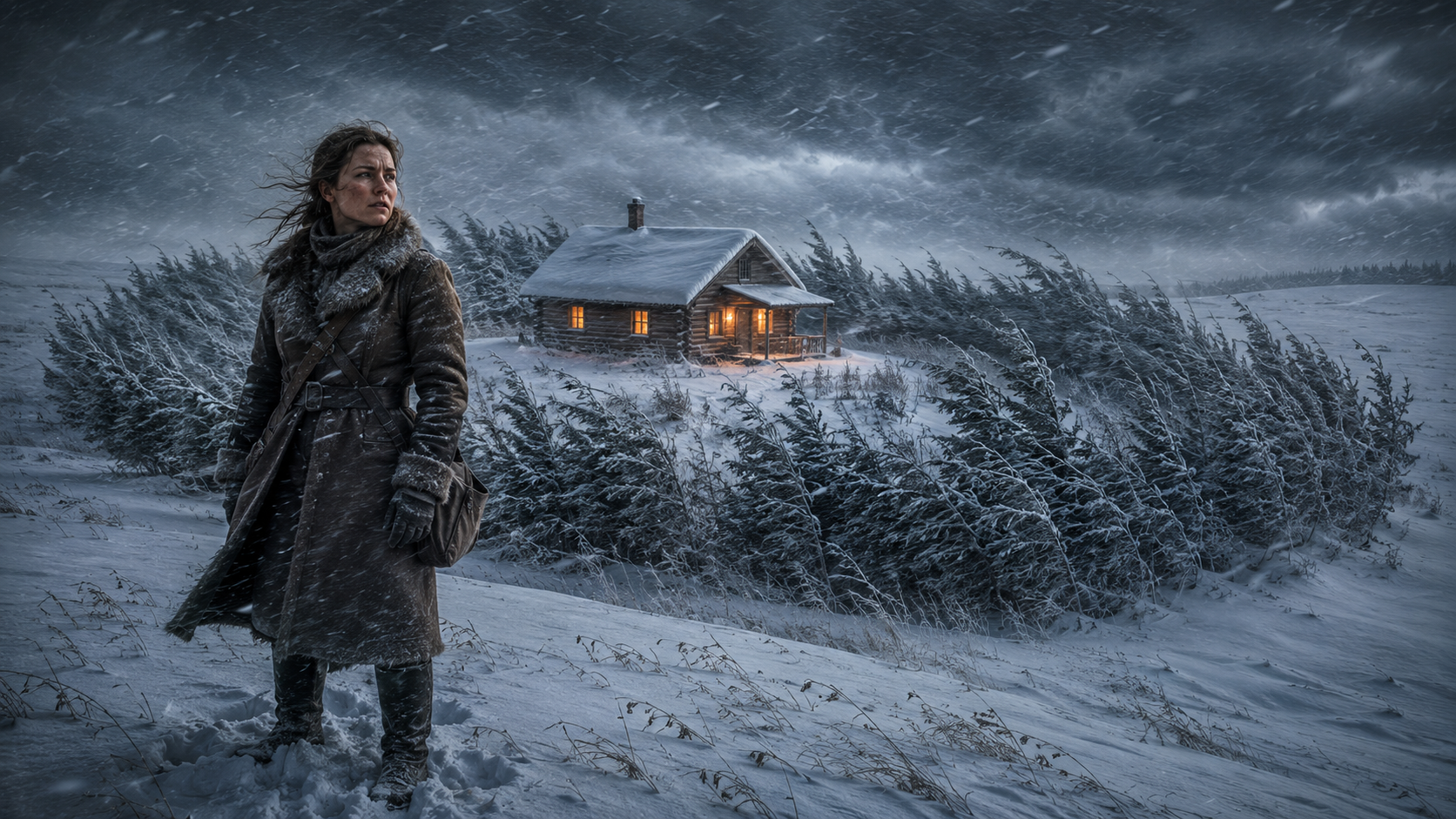
He stood at the edge of the porch, looking at the curved rows of young trees. Snow clung to their branches. Some had bent nearly to the ground. Two had snapped. Most stood.
“You saved my men,” he said.
“The trees helped.”
His jaw tightened at the correction.
Then, slowly, he nodded.
“The trees helped,” he repeated.
Clara waited.
Rourke took a breath that seemed to pain him. “I misjudged your work.”
“Yes.”
“And your judgment.”
“Yes.”
Elias, standing near the door, looked down to hide something like a smile.
Rourke heard it anyway.
The old cattleman turned toward him. “You knew.”
Elias did not deny it. “I suspected.”
“And said nothing?”
“I said enough. You did not like the answer.”
For once, Rourke had no ready reply.
Clara stepped down from the porch. Snow came nearly to her knees. She walked to the first row of spruce and brushed ice from a bent branch.
“These are young,” she said. “They will need replacing where the storm broke them. More brush in the low gaps. More willow near the drainage. If the valley wants to survive winters like this, it needs shelter rows again.”
Rourke looked over his ruined field.
For years, he had measured land by how much it could be forced to yield. Grass. Cattle. Money. Obedience. He had not measured what absence cost.
Now the cost lay white and enormous before him.
“And you would advise me?” he asked.
Clara turned. “No.”
His brows drew together.
“I would charge you.”
Elias laughed once before he could stop himself.
Judd coughed into his fist.
Rourke stared at Clara.
Then, for the first time since she had known him, Silas Rourke laughed without cruelty. It was not pleasant exactly. Too rusty. Too surprised. But it was human.
“What is your price, Mrs. Voss?”
Clara looked toward the valley.
“No more offers on my land. Ever.”
“Done.”
“The old service-road plan ends.”
His mouth tightened. “That is more complicated.”
“So is freezing.”
A pause.
“Done,” he said.
“And you will replant the north fields. Not for pretty. For survival. Willow along the drainage. Spruce staggered across the rise. Brush breaks where the snow runs.”
“You expect me to turn pasture into thicket?”
“I expect you to stop mistaking bareness for strength.”
Rourke studied her for a long moment.
Then he looked at Elias. “Can it be done?”
Elias looked at Clara, not Rourke. “Yes.”
Rourke heard the allegiance in that small choice.
So did Clara.
“So,” Rourke said. “The valley’s useless trees have become a public necessity.”
Clara brushed snow from her gloves. “They were never useless. You were simply laughing too loudly to hear what they were saying.”
News traveled faster than thaw.
By the end of the week, everyone in Ashford Hollow knew that Clara Voss’s cabin had stood while Rourke’s west barn fell. Everyone knew Judd and Mercer Kessler had survived the storm under her roof. Everyone knew Silas Rourke had walked away from the hill without the deed he wanted and with instructions for planting trees.
The same mouths that had mocked now found new words.
Practical.
Clever.
Providence.
Luck.
Clara let them have their vocabulary. It cost her nothing.
In March, when the thaw began, men came up the road with shovels.
Judd came first, red-faced and awkward, carrying a bundle of spruce seedlings.
“For the ones that broke,” he said.
Clara looked at the seedlings, then at him.
“Plant them where I tell you.”
“Yes, ma’am.”
Mercer came with wire. Mrs. Baird came with bread and stayed to mulch. Children who had once sung about wooden soldiers carried buckets from the pump. Elias came every morning and left only when Clara ordered him away to sleep.
By April, the hill looked less lonely.
By May, Rourke’s north field was marked with rows.
Not enough yet. But beginnings were allowed to be small.
One evening, Clara and Elias stood beside the tallest spruce in her shelterbelt. Its top had browned from winter burn, but new green showed along the lower branches.
“It will live,” Elias said.
“You sound certain.”
“I am practicing.”
“At what?”
“Trusting things that take time.”
Clara glanced at him.
The sunset laid copper over the thawing fields. Water ran in thin bright lines toward the creek. Somewhere below, a hammer rang where men repaired a barn wall. Beyond that, the ridge stood dark and patient.
Elias shifted his weight. “Rourke offered me the north restoration.”
“You should take it.”
“I did.”
“Good.”
“He also said I am free to keep helping here.”
Clara raised an eyebrow. “How generous of him to permit you to do what I have not requested.”
Elias smiled. “Have you not?”
“No.”
“Will you?”
She looked at the rows of young trees, at the repaired porch, at the land that had tried to kill her and then, with help, had become her ally.
“I might request useful objects from time to time,” she said.