“Objects only?”
“For now.”
His smile softened. “For now is more than I expected.”
The wind moved through the shelterbelt.
Not gone. Never gone. But changed.
It slipped through spruce needles, combed willow stems, bent dogwood twigs, and came to the cabin carrying less of itself than before.
Clara listened.
A year earlier, the wind had sounded like a threat.
Now it sounded like work.
And work, she understood, could become a kind of promise.
That winter, the valley planted trees.
Not everyone. Not at first. Pride has deeper roots than spruce. But enough.
A line of willow appeared behind the schoolhouse. Brush breaks rose near the lower road. Mrs. Holm planted dogwood near her chicken yard and pretended it had always been her idea. Judd Kessler put spruce along the west edge of his small place and threatened to punch any man who called them toothpicks.
When the first snow came, people watched differently.
They looked not only at the sky, but at the land.
Where wind ran free.
Where snow gathered.
Where shelter stood.
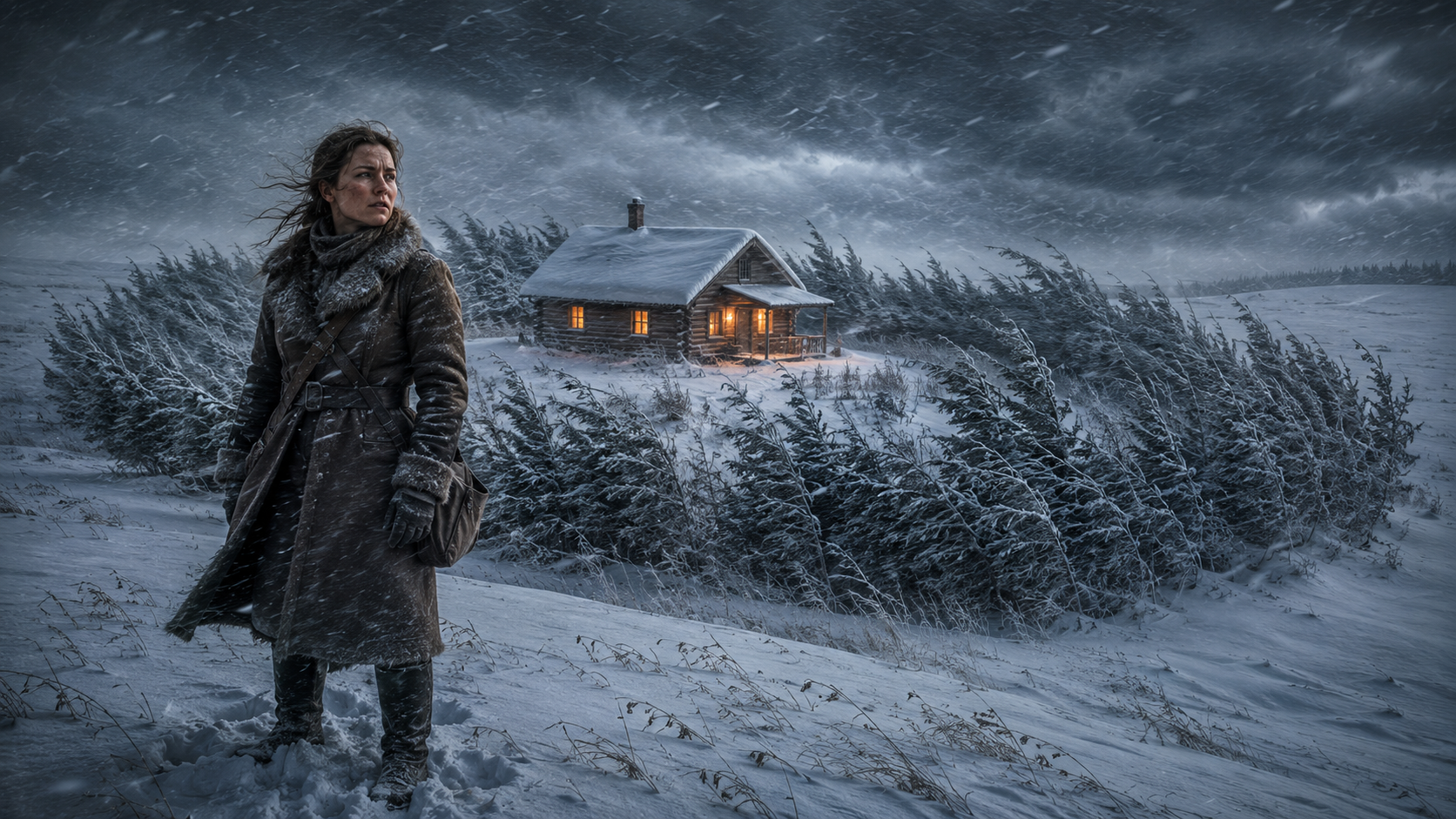
And high on the north rise, Clara Voss stood on her porch while the young trees darkened against the white world.
Elias came up the road just before dusk with a sack of flour over one shoulder and a crooked little pine under his other arm.
Clara opened the door.
“What is that?” she asked.
“A tree.”
“I have noticed.”
“It is for the south side.”
“The south side does not need a windbreak.”
“No,” he said. “But someday you may want shade.”
She looked at the little pine, then at Elias.
“Shade is not survival.”
“No,” he said. “It is something after.”
Clara took the tree from him.
For a long moment, neither spoke.
Then, from the road below, a boy’s voice called out, bright and teasing, “Mrs. Voss! My pa says your trees saved half the valley!”
Clara turned and saw Judd’s youngest son waving from a sled.
She lifted one hand.
The boy shouted, “He says we’re planting more come spring!”
Elias leaned beside the doorframe. “What will you tell him?”
Clara looked at the shelterbelt.
The trees were still young. Still imperfect. Still scarred from the storm. But they stood in their wide, stubborn curve, holding space against the north.
She smiled.
“Tell your father,” she called, “to dig deep holes.”
The boy laughed and vanished down the road.
Clara stepped back into the warmth of the cabin. Elias followed, closing the door behind him.
Outside, winter gathered its breath.
Inside, the stove burned steadily.
And around the little house on the rise, the so-called useless trees took the first blow, bent beneath it, and held.