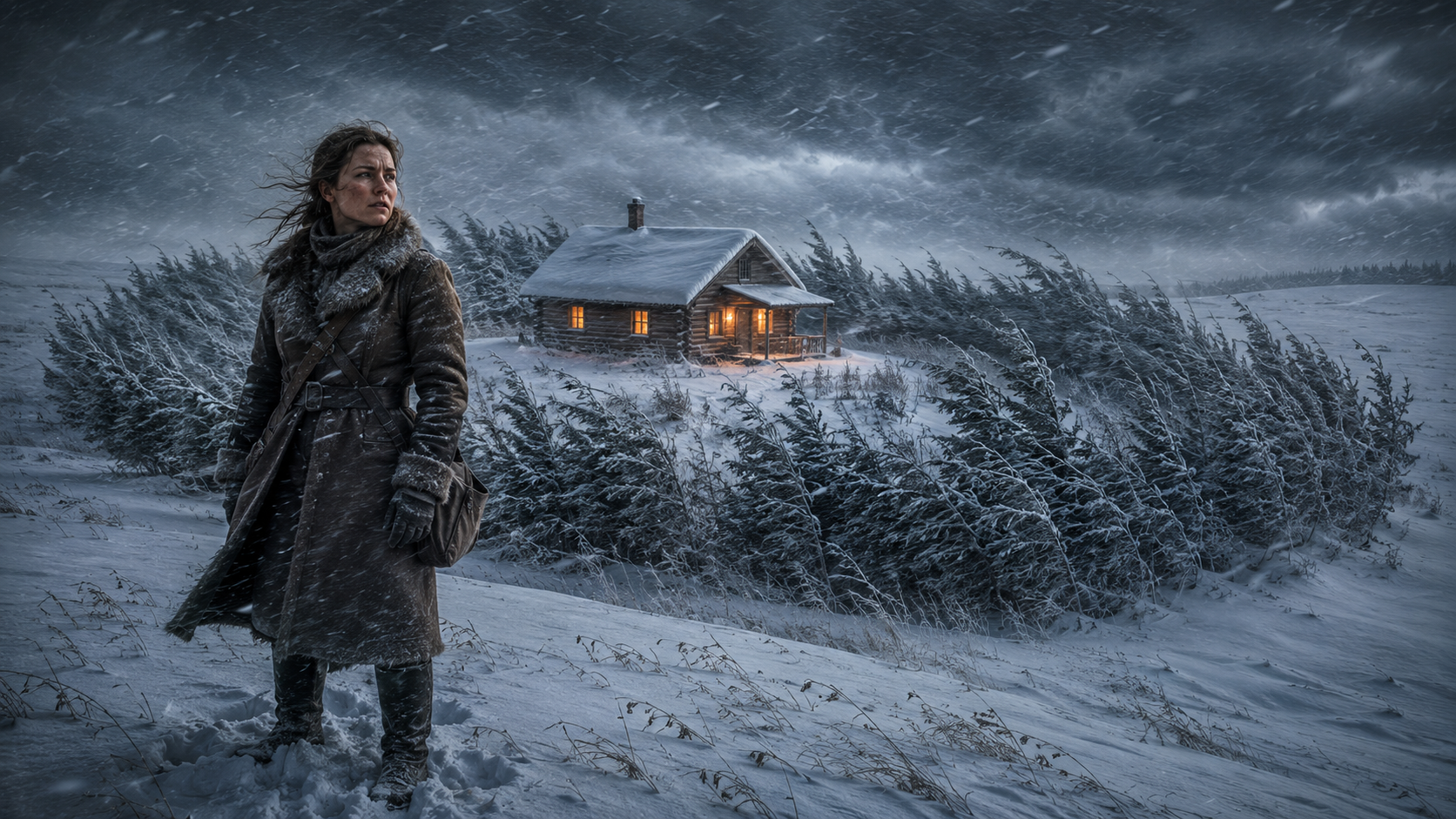
She knew which corner of the cabin groaned before midnight.
She knew the shape of danger now.
And knowledge, once earned, was property no man could buy.
Rourke took an envelope from his coat and placed it on the porch rail.
“Think on it,” he said.
“I won’t.”
“Winter will think for you.”
He returned to his carriage.
Clara watched him leave. Only when the road was empty did she pick up the envelope.
She did not open it.
She used it to start the stove.
By June, Ashford Hollow had made Clara’s trees into a public joke.
At church, Mrs. Holm asked whether Clara expected birds to pay rent in her forest.
At the general store, Judd Kessler told a cluster of men that the widow was “planting husbands by the dozen and hoping one grew useful.”
Children passing the rise sang little rhymes about “Clara’s wooden soldiers.”
Even kind people were unkind in the soft way, which sometimes stung worse.
“You must be lonely up there,” Mrs. Baird said one morning, patting Clara’s hand. “A garden would cheer you more than all those gloomy evergreens.”
“They are not for cheer.”
“Then what are they for?”
Clara looked out the store window toward the north ridge, where clouds gathered like bruises.
“They are for the day cheer is not enough.”
She bought twine, nails, and four sacks of meal. She paid in coins counted twice. When she stepped outside, Elias Ward was waiting by the hitching post with a bundle of willow cuttings tied across his saddle.
Clara stopped.
“I did not ask for those,” she said.
“I know.”
“I am still not taking charity.”
“Good. I am not offering any.”
“What are you offering?”
“Information.”
She stared at the cuttings. “Information has leaves now?”
“These root fast if you keep them wet. Put them in the low gaps. They’ll catch snow close to the ground.”
“Why?”
“Because you are right.”
The answer was so plain she did not know what to do with it.
Elias looked uncomfortable, as if truth were a tool he had not used in some time.
Clara crossed her arms. “Did it pain you to say that?”
“Yes.”
She nearly smiled.
He glanced toward the store windows. Several faces had turned away too late.
“You know they are watching,” he said.
“They are always watching.”
“Does it bother you?”
“Of course.”
“You do not show it.”
“That is not the same thing.”
Elias nodded slowly. “No. It isn’t.”
For a moment they stood in the muddy street while the village pretended not to listen.
Then Elias said, “Rourke is angry.”
“I guessed.”
“He has been asking who sells you supplies. Who lends tools. Who comes up your road.”
“Does he imagine windbreaks are contagious?”
“He imagines anything he did not order is rebellion.”
Clara took the bundle of willow cuttings from his saddle. “And you? Are you rebelling?”
“I have not decided yet.”
“That sounds dangerous.”
“It is.”
“For whom?”
He looked up toward the ridge.
“For the man who waits too long.”
After that, Elias came twice a week.
Never at the same hour. Never openly enough to call attention. He brought stakes, old rope, a cracked wheelbarrow, a sack of bone meal, a roll of wire, and once, without explanation, a tin of coffee that smelled too expensive for any honest errand.
Clara accepted the supplies after making him name a price for each one. Sometimes she paid with eggs. Sometimes with mended shirts. Sometimes with preserves from the last jars her mother had put up before dying.
At first they worked in stiff quiet.
Then the quiet changed.
It became the kind of silence that could hold two people without making either one small.
Elias showed her how to brace the tallest saplings without strangling them. Clara showed him the map she had drawn of winter drifts around the cabin. He studied it long enough that his face lost its guarded look.
“You measured all this?” he asked.
“With a broom handle marked in inches.”
“During storms?”
“After storms.”
“Alone?”
“Unless the wind counts.”
He traced one line with his finger. “The drift curls here because the shed corner turns it.”
“Yes.”
“And here, this low place fills first.”
“Yes.”
“If you build brush between these two rows, not solid, just woven loose, it will drop snow here before it reaches the porch.”
“That is what I thought.”
“It will make a wall.”
“That is what I need.”
Elias looked at her.
Clara waited for the warning. Men always had one ready. Too hard. Too much. Too late. Too strange.
Instead he said, “Then we should start tomorrow.”
The word we hung in the cabin like a lantern.
Clara turned away first.
“There is no we,” she said.
“No?”
“No. There is my land, my cabin, my trees, and your habit of arriving with useful objects.”
“Useful objects can be loyal.”
“Objects, perhaps.”
“Men?”
“Less often.”
He accepted that too.
By August, the shelterbelt had shape.