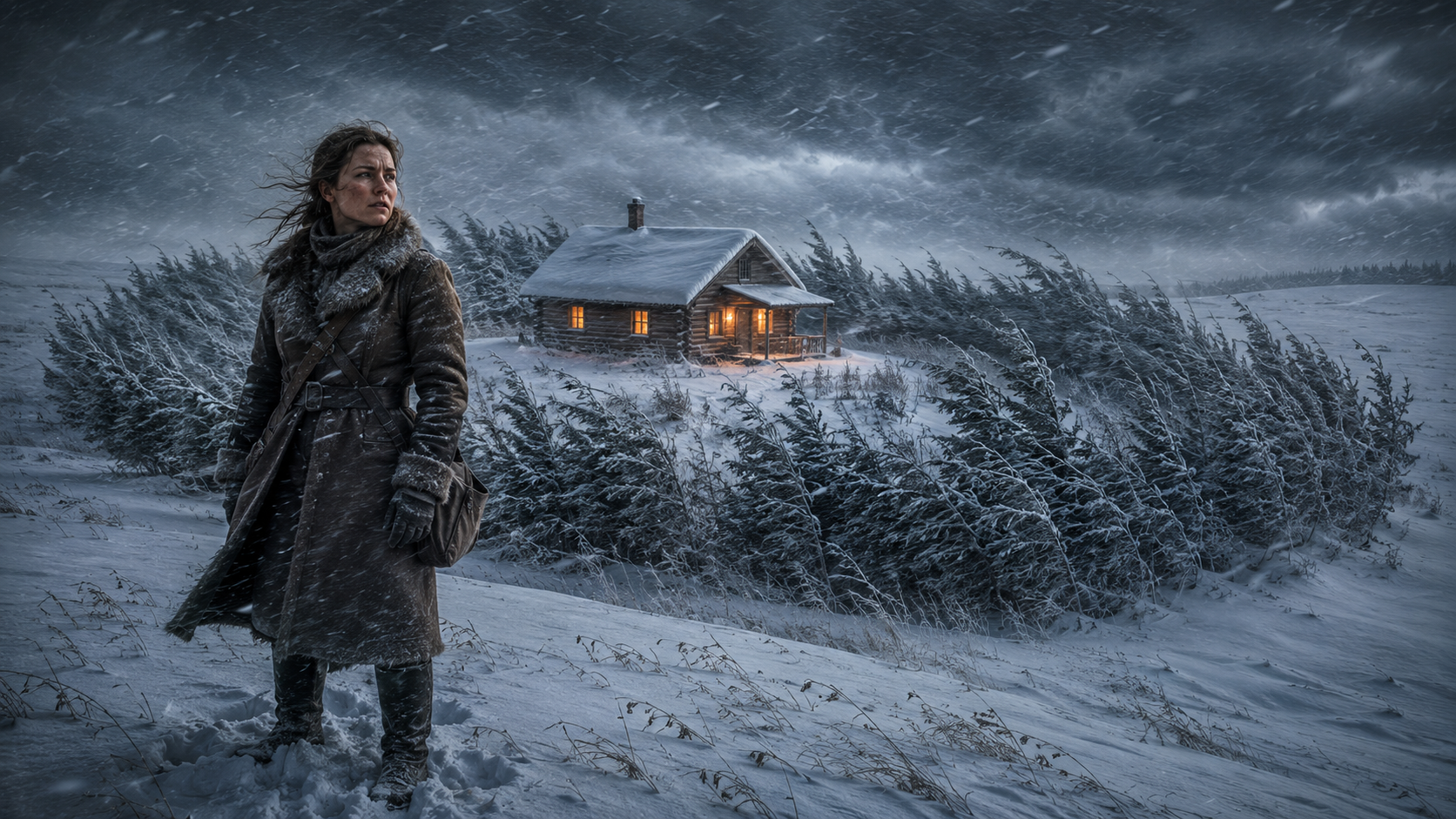
From the road, it still looked foolish to those determined to see foolishness: uneven rows of saplings, brush piles, stakes, water barrels, rough mulch, and strips of cloth tied to branches to startle deer away.
But from inside the curve, Clara could already feel the difference.
On windy afternoons, the grass near the cabin no longer lay flat. Dust dropped sooner. The pump handle did not rattle as fiercely. The porch lantern stayed lit longer before the gusts found it.
Small victories.
But winter was made of small defeats, and Clara knew better than to despise small victories.
Silas Rourke came again in September.
This time he rode on horseback, with Judd and Mercer Kessler behind him. Elias was not with them.
Clara was repairing the west fence when they approached. She kept working until Rourke dismounted.
“Mrs. Voss.”
“Mr. Rourke.”
His horse tossed its head. It did not like the brush rows. Animals often understood boundaries before people did.
“I hear Ward has been visiting.”
Clara wrapped wire around the post and twisted it tight. “Then your hearing is still in working order.”
Judd snorted.
Rourke ignored him. “He is my employee.”
“I am not.”
“No. You are a widow with a difficult winter ahead.”
“Many things are difficult.”
“Especially when faced alone.”
She looked up. “Are you threatening me?”
“I am advising you.”
“The difference being?”
“Whether you are wise enough to appreciate it.”
Clara stood.
The wind moved through the young trees behind her. Their leaves flickered silver and green. They were not tall enough yet. Not strong enough yet. But they were alive, and there were many of them.
“I have heard your advice,” she said. “You may go.”
Rourke’s eyes hardened.
“You think those saplings make a fortress?”
“No.”
“You think Ward makes you safe?”
“No.”
“You think stubbornness will hold a roof down?”
Clara stepped closer, close enough to see the fine lines at the corners of his pale eyes.
“I think you are afraid.”
Judd laughed once, then stopped when Rourke turned his head slightly.
“Careful,” Rourke said.
“No,” Clara answered. “You have confused caution with obedience for so long that you hear every honest word as danger.”
Rourke’s mouth tightened.
Clara pointed toward his fields. “You cleared the old breaks. You tore out the willows along the drainage. You grazed the north pasture down to dirt by October because every acre had to earn. Now the wind comes off your land harder than it ever did before, and my little trees are the only ones telling the truth about it.”
His face went still.
“You know nothing about running land.”
“I know what happens when a man strips it bare and calls the emptiness profit.”
Mercer muttered, “Mouthy woman.”
Clara turned her eyes on him. “Uninvited man.”
Judd’s hand twitched toward his reins.
Rourke smiled then, but there was no warmth in it.
“Winter will settle this.”
“Yes,” Clara said. “I expect it will.”
The first real storm came early.
On the second week of November, rain fell all morning, turned to sleet by afternoon, then froze hard after sunset. By midnight, the wind rose from the north with the sound of a train breaking loose from its tracks.
Clara woke to the cabin shaking.
She lit the lamp, pulled on wool stockings, skirt, coat, gloves. The stove still held a red heart under the ash. She fed it split wood and listened.
The wind struck.
The roof groaned.
Snow hissed against the walls.
But the old scream at the north window was different.
Lower.
Broken.
Not gone, but interrupted.
Clara took the lantern and went to the door. When she opened it, the storm shoved itself inside. She leaned her shoulder against the wood, forced her way onto the porch, and raised the lantern.
At first she saw nothing but white.
Then lightning flickered blue behind the clouds, and for one bright instant the world appeared.
The shelterbelt was working.
Snow had piled in the brush rows, caught and held before it reached the cabin. The young spruce bent but did not snap. The willow whips thrashed and sprang back. The woven brush at ground level had already gathered a low white wall that lifted the wind over the porch instead of letting it slam straight into the door.
Clara laughed.
It came out wild and breathless, torn away by the storm before it reached anyone’s ears.
She went back inside and barred the door.
By dawn, the road was gone.
By noon, the valley was blind.
The second night was worse.
Clara had just finished melting snow for water when something pounded on the door.
Not wind.
A fist.
She froze.
The pounding came again.
“Clara!”
Elias.
She lifted the bar and opened the door. He fell in with half the storm on his back. His face was raw from cold, lashes iced white, one sleeve torn, blood dark at his temple.
She slammed the door behind him.
“What happened?”