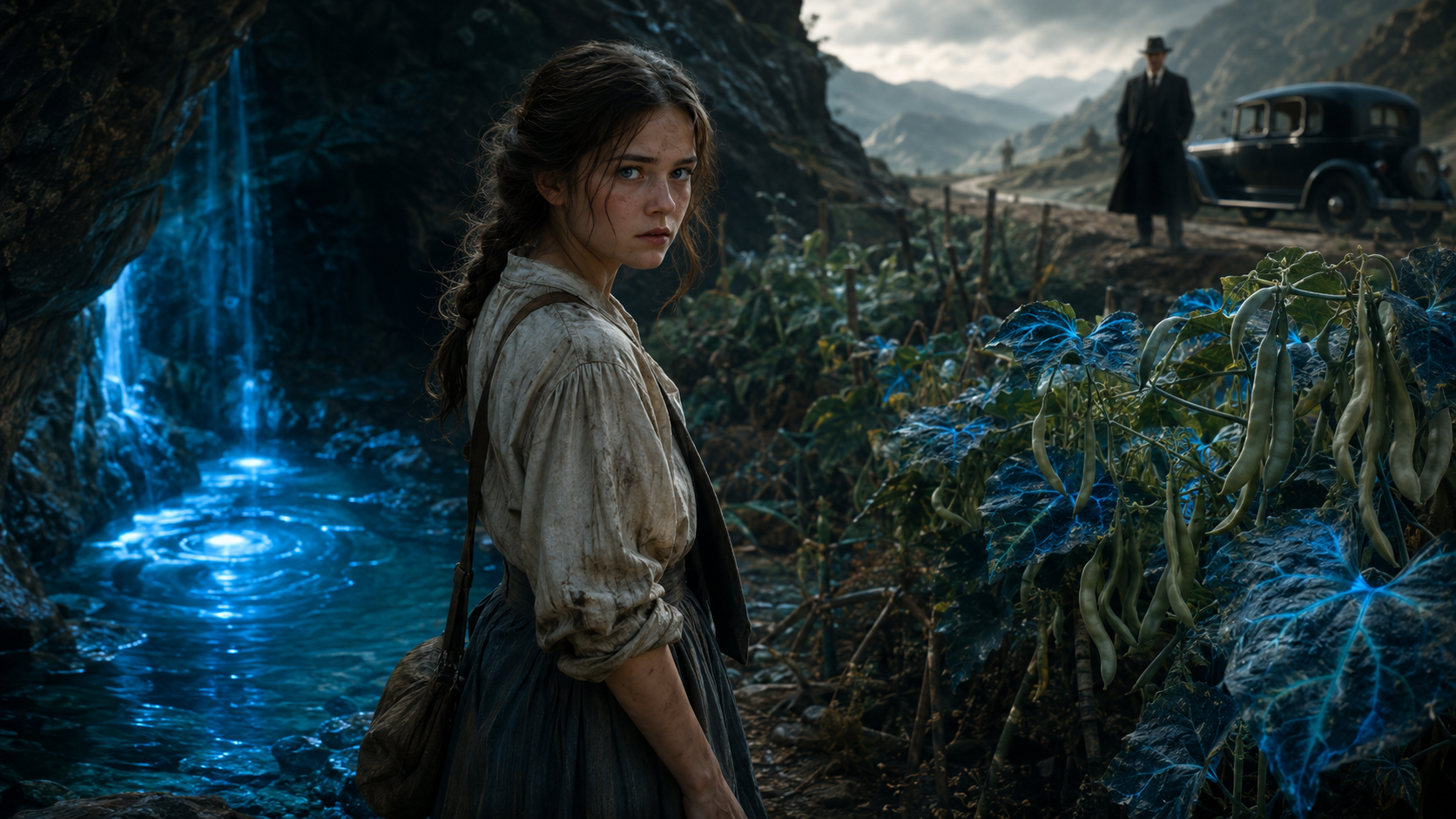
Not all at once. Fame is only gossip with better shoes. First came county agents. Then farmers from neighboring valleys. Then restaurant men from cities who spoke of flavor as if they had invented hunger. They wanted Leona’s beans, her mineral cucumbers, her blue-water squash, and the seeds she saved from every successful crop.
Stone Fertilizer wanted more.
Alaric Stone’s company released a product called Azure Growth Tonic in bright tins printed with a blue droplet. It promised “the power of mineral-fed harvests.” Some farmers said it worked. Others said it burned roots if mixed too strong. Dr. Marr tested it and came to Leona furious.
“They copied the idea badly,” she said, throwing papers onto the table. “And they are using your farm in private sales letters.”
Leona read the line twice.
Inspired by the famous blue fields of Harrow County.
Not illegal, maybe.
But ugly.
By then, Alaric Stone was older, and his son Caspian had begun running the company’s public affairs. Caspian Stone was smoother than his father. He wore softer suits, used softer words, and hid harder intentions behind them.
He invited Leona to his office.
She went because Dr. Marr said refusing would make them think she was afraid, and Odelia said she wanted someone to insult a Stone indoors where the echo would improve it.
Caspian’s office had more polished wood than some churches. He greeted Leona with both hands.
“Miss Voss, I’ve admired your work for years.”
“No, you haven’t.”
His smile paused, then recovered.
“I admire what Blue Hollow represents.”
“What does it represent to you?”
“Possibility.”
“To me, it represents water.”
He gestured to a chair. She remained standing.
“We can be enemies,” he said, “or we can be partners. Stone Agricultural Works has distribution. You have authenticity. Together we could help thousands of farmers.”
“You mean sell them canned imitation water.”
“A refined mineral formula.”
“A poor copy.”
His eyes hardened, but only briefly.
“My father handled matters badly.”
“That is a thin coat of paint over a large rot.”
“What would satisfy you?”
“Stop using my farm to sell your tonic.”
“That may be difficult.”
“No. Frost is difficult. Stone is difficult. Telling printers to stop lying is simple.”
Caspian studied her.
Then he opened a drawer and removed an old folder.
“There are things you don’t know about Blue Hollow.”
Leona felt the room change.
“What things?”
“My grandfather tried to buy that parcel before my father. Private tests were done as early as 1908. Stone Fertilizer began as a mineral concern. A naturally mineralized spring had obvious value.”
“Then why didn’t you buy it before I did?”
“Because the woman who owned it refused to sell.”
The old widow.
The one everyone had called mad.
The one whose collapsed shed Leona had slept in.
Caspian slid a yellowed letter across the desk. The signature belonged to Alaric Stone’s father.
Mrs. Irena Vale remains uncooperative. Local superstition regarding the blue water may be encouraged. Maintain public belief that the parcel is dangerous until tax abandonment becomes possible.
Leona’s hands went cold.
“They lied,” she said.
“Yes.”
“They let people call her mad.”
“Yes.”
“They made the land worthless so they could steal it later.”
Caspian looked away.
“My family used fear as a fence.”
Leona folded the letter carefully.
“I want copies of everything.”
“I cannot provide company records.”
“Then I will tell every newspaper from Richmond to New York that Stone built a fertilizer empire while hiding proof that living mineral water and healthy soil outperformed their products.”
“You would not win that fight.”
“No,” Leona said. “But I would make it expensive.”
Two weeks later, the copies arrived.
They showed decades of pressure, rumors, discouraged buyers, hidden tests, and one paid doctor who had described Irena Vale’s grief after her husband’s death as “blue-water instability.”
Irena had not been mad.
She had been inconvenient.
Leona went to the old cemetery above the ravine. Irena’s stone leaned beneath lichen and weeds.
IRENA VALE
BELOVED WIFE
1872–1919
Nothing about courage.
Nothing about refusal.
Nothing about how lonely it is to be right before anyone powerful admits it.
Leona cleared the weeds with her bare hands.
“I’m sorry,” she whispered. “They made me think I was the first.”
After that, Blue Hollow Farm became Vale & Voss Cooperative.
Odelia said it sounded like a law firm.
Leona said good, because they had legal matters to settle.
With Dr. Marr’s help, Rowan’s steady patience, Odelia’s terrifying talent for remembering every insult ever spoken in Harrow County, and farmers from five valleys, Leona formed a cooperative. The spring would never be sold. No company could drain it, bottle it by the trainload, or claim exclusive rights. Members could receive measured amounts for soil restoration. Profits funded seed education, farm ledgers, legal training, and housing for older girls leaving Saint Brigid’s with nowhere to go.