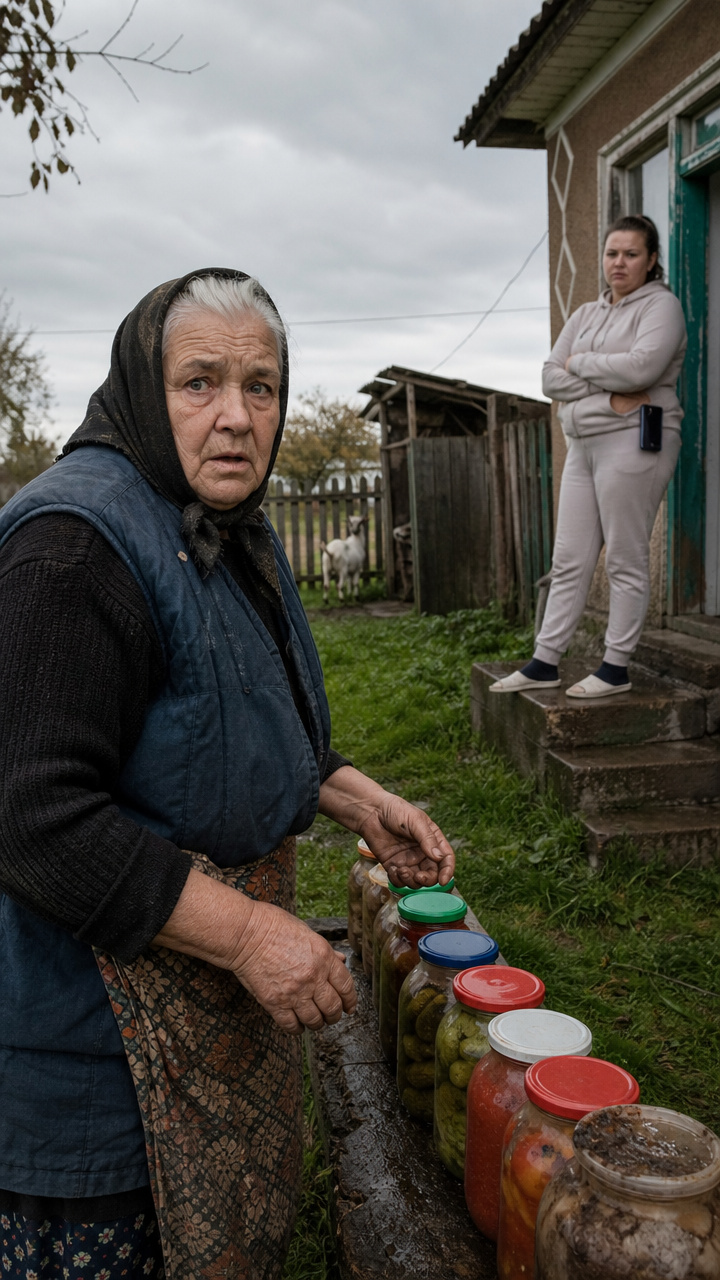
“You must be stuck in the last century, Margaret. The whole house reeks of those jars, so I carried them outside. At least they can air out.”
Margaret stood frozen in the doorway, staring silently at the ground beside the gate. Under the heavy gray September sky, her jars stood in a neat line on the wet grass.
Pickles. Tomatoes. Pepper relish. Plum jam. Cherry compote. And the fiery garlic sauce she began cooking before sunrise, before the kitchen became unbearably hot.
She had sealed every jar herself. She checked each lid carefully, turned every one upside down on a towel, wrapped them in an old blanket, and felt relieved whenever the lid sank neatly inward without the slightest bulge.
Now all of it sat beneath the open sky, like worthless junk no one wanted.
“Claire,” Margaret said quietly. “Why did you do that?”
Claire stood on the porch in a pale tracksuit, her phone in one hand and her perfectly styled hair untouched by the damp air. She looked as though she had spent the night in a country club, not a farmhouse.
“Because it’s impossible to breathe in there,” she said with a grimace. “First the goat screams, then there are jars everywhere, and the entire house smells of garlic. We’re not living in a museum of rural life.”
Margaret clenched her fingers until her nails pressed into her palms.
She could have stayed silent. She had done that for years. She had stayed quiet the first time Claire came to the village and announced that the place was “one enormous swamp full of mosquitoes the size of airplanes.”
She had said nothing when Claire pushed away a plate of homemade farmer’s cheese, then quietly asked her husband to pack the same cheese in a container “for the child, because it’s healthy.” She had swallowed her hurt when Claire refused to call her “Mom” or even “Margaret,” referring to her only as:
“She sent more of those jars again.”
Or:
“Tell her to use less dill next time.”
Margaret had buried the insult each time. For her son. For her grandson. For the sake of peace in the family.
The day before, they had not come merely for a visit. Her grandson Daniel had graduated from university in the city and had brought his diploma to show them. Margaret had been waiting for that moment almost as eagerly as if the diploma belonged to her.
From early morning she had stayed by the stove. She fried potato pastries, roasted chicken, cooked a pot of fruit compote, and made a salad from tomatoes grown in her own garden.
Daniel was the first through the door—a tall, smiling young man in a new shirt.
“Grandma, look,” he said, placing a red folder on the table. “You always said you wouldn’t believe it until you saw it yourself.”
Margaret touched the gold lettering with trembling fingers and suddenly began to cry.
“Oh, my darling boy… I lived to see it. Your father never finished his studies. Those were hard times. But you managed it.”
Claire let out a tired sigh.
“Mom, please don’t start. It’s only a diploma.”
Only a diploma.
To Margaret, those pages were far more than ink and paper. They represented the years when she sent Daniel’s father to the city with bags of potatoes, homemade cheese, preserves, and money saved from her pension. They represented her cracked, earth-stained hands, her early mornings, and the endless hours she spent working in the garden.
Then something happened that finally pushed Claire past the edge of her patience.
Daisy, the white goat—stubborn, inquisitive, and determined to investigate everything—slipped into the house while everyone was distracted. She spotted the red folder on the table, stretched out her neck, and managed to bite the corner of the cover.
“Daisy!” Margaret cried. “Good heavens, what are you doing, you silly creature?”
Claire sprang to her feet as if the house had caught fire.
“This is not normal! Your animal is walking around inside the house! Right beside the table! Next to important documents! Do you even understand that this is an official document?”
Daniel sat pale and silent, staring at his diploma. Margaret led the goat back outside, returned to the kitchen, and said only:
“You drink her milk. You take the cheese. You take the butter, too. But the goat herself disgusts you?”
Claire gave no answer. Her expression, however, turned cold as ice.
And the next morning, Margaret found the jars beside the gate.
Their neighbor Helen had gone out to fetch water and had heard everything. She looked first at Margaret, then at Claire, and finally at the jars. For a moment, it seemed she might say something. Instead, she adjusted her scarf and went back into her own yard.
For some reason, that hurt Margaret more than anything else.
Every year she gave Helen jam. When Helen’s husband had been recovering from a stroke, Margaret brought them milk, hot soup, and fresh bread. And now Helen had simply turned away.
Margaret bent down and began lifting the jars from the ground. One was covered in cold dew. Mud clung to another. A tiny wet fly sat on the lid of the third.