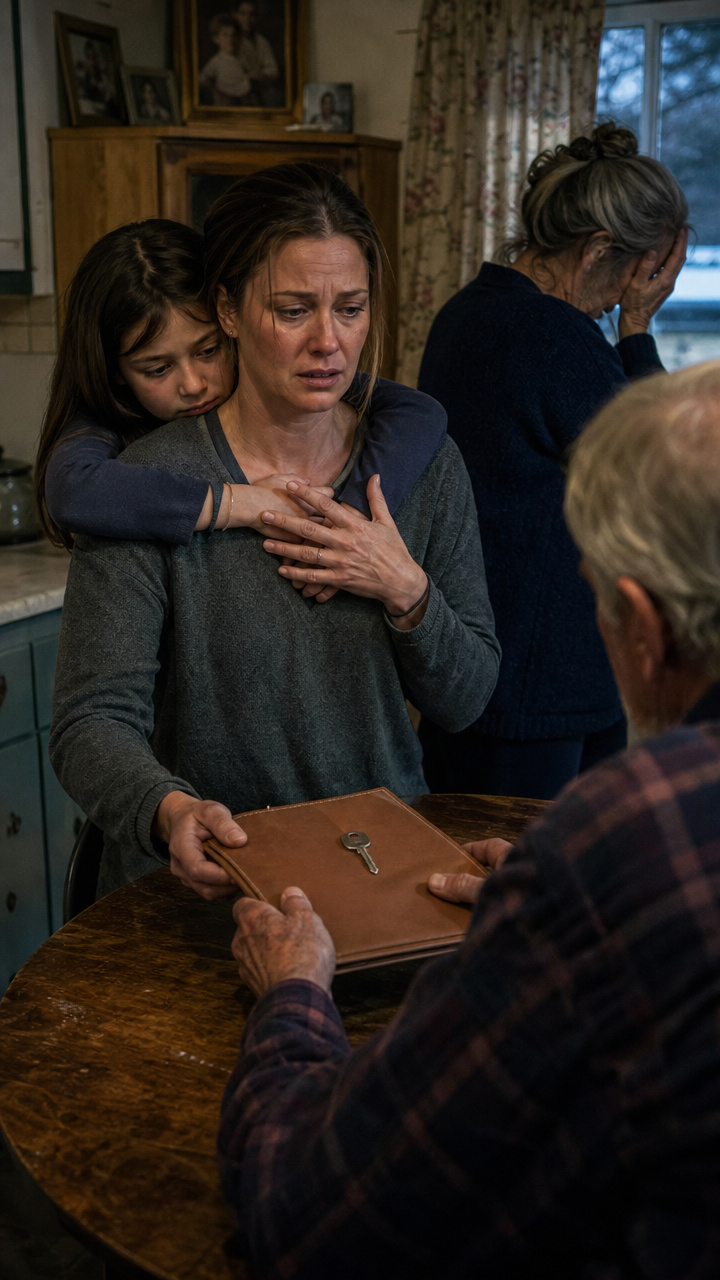
Kate arrived in the village on the very first bus, a little before half past seven in the morning. She carried two grocery bags and wore a backpack. Inside it were a jar of stuffed cabbage, medicine for her father, and a pair of new socks she had knitted over two evenings while Sophie sat beside her doing homework.
Margaret saw her daughter from the window and hurried onto the porch, still wearing her housecoat.
“Kate, sweetheart, why did you come so early? We told you we could manage.”
“Mom, Dad sounded terrible on the phone yesterday. He was breathing as if he had a sack of cement strapped to his back. What do you mean, you can manage? Where is he?”
“In the garden. Digging potatoes. They’re predicting rain, and he says we have to finish before it starts.”
Kate left the bags on the bench, changed into her father’s old rubber boots—the ones that always stood in the entryway—and walked around behind the house.
Thomas stood beside a row of potato plants, both hands resting on his shovel. He was staring toward the strip of trees beyond the fields. The moment he saw his daughter, he straightened, as though she had caught him doing something he was ashamed of.
“Well, look at that. The inspector has arrived.”
“She has. Give me the shovel, Dad, and don’t even think about arguing.”
He did not argue.
Instead, he lowered himself onto an overturned bucket and seemed, for the first time that morning, to take a full breath.
Margaret would remember that October morning for years.
Watching her thin, hardworking daughter turn over one potato plant after another, she finally admitted something she had spent her whole life refusing to see: she and Thomas had always lived as if they had two children, but only one of them was meant to be the family’s real hope.
Oliver had been born first, and somehow the best of everything had always found its way to him.
It was not because his parents had wanted to hurt their daughter.
That was simply how things had happened.
A son. An heir. The one who would carry on the family name. Their future.
Every autumn, Oliver received a new jacket. Kate wore the old coat passed down from a cousin, and by its second year the sleeves barely reached her wrists.
When Oliver was young, their parents brought him a brand-new bicycle from the city.
Kate was told that girls did not need bicycles. She would only scrape her knees.
After graduating from school, Oliver announced that he would study only in the capital, only economics, and only at the university whose name appeared constantly on television.
His scores were not high enough for a free place.
Thomas sat at the kitchen table for a long time, adding figures on the back of an old calendar with a pencil. At last he said, “We’ll pay for it. We’ll rent out the apartment in the city to students, sell the boar, and I’ll find extra work on weekends. Somehow, we’ll manage.”
And somehow, they did.
For five years, Margaret bought almost nothing for herself except the things they absolutely needed.
Three years after Oliver finished school, Kate graduated as well.
She had studied far better than her brother. Her mathematics teacher even came to their house and begged her parents not to waste the girl’s talent.
But there was no money left for a second tuition contract.
“Sweetheart, apply to community college,” Margaret said, unable to meet Kate’s eyes. “Train as a bookkeeper. You’ll always find work. Later, perhaps, you can continue your education part-time.”
Kate was silent for a while.
Then she nodded.
“All right, Mom. Oliver still has to finish his studies.”
She never mentioned it again.
Not once did she reproach them.
For years, Margaret waited for the day her daughter would finally bring up that injustice.
Once, she even tried to begin the conversation herself.
But Kate merely waved it away.
“Mom, stop worrying. I’m fine.”
“Fine” meant a small rented one-bedroom apartment on the edge of the city, where Kate had lived for eight years.
It meant a bookkeeping job at a modest company that sold building supplies.
It meant Sophie, her serious eleven-year-old daughter, with neat braids and a quiet, thoughtful manner.
Kate’s husband had left when the child was not yet three.
From then on, Kate carried everything by herself.
She visited her parents every week.
Not because they demanded it.
On Saturday mornings, she simply boarded the village bus with Sophie and came.
Sometimes she brought fish.
Sometimes medicine.
Sometimes new curtains for the kitchen, saying, “The old ones have faded completely.”
She had set up a smartphone for her mother and patiently explained, for the third time, how to answer a video call.
When the temperature climbed close to a hundred and four in August, she brought her parents a fan.
Afterward, she spent another full hour scolding her father for climbing onto the roof alone to replace a broken sheet.
Every so often, Margaret secretly slipped a few bills into her daughter’s coat pocket.