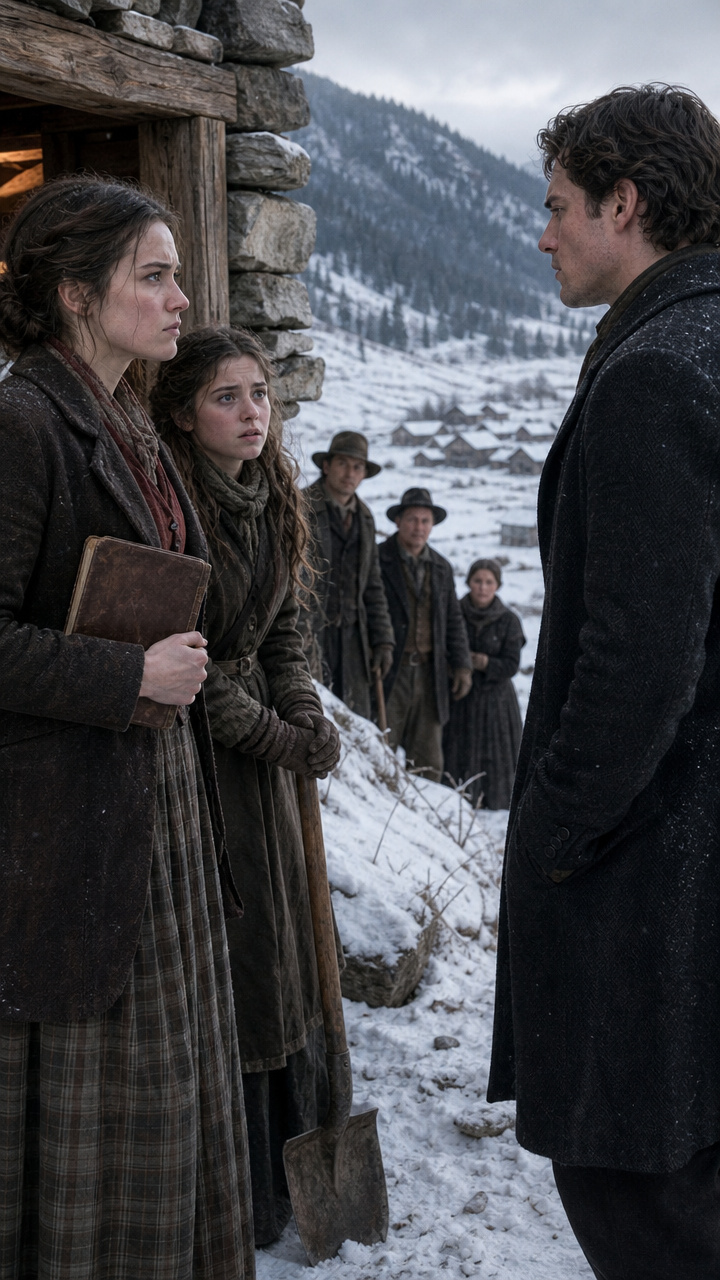
Not darkness.
Nothing.
Snow filled the world beyond the glass until the outside became a white wall.
By morning, the valley had disappeared.
The lower halves of both windows were buried beneath packed snow. Wind screamed against the overhang but could not strike the entrance directly. The fire drew hard and clean. Stone around the hearth warmed gradually and then held its heat. The edges of the floor remained cold but never cruel.
Inside, the thermometer read fifty-seven.
Outside, Briar Glen began to break.
The first knock came on the second night.
At first, Eleanor thought a branch had struck the wall. Then Finch raised his head and made a sound she had never heard from him—not warning, not anger, but urgent grief.
Thud.
Silence.
Thud.
Clara froze with a cup in her hand.
Thomas moved toward the door. “Someone is outside.”
Eleanor seized blankets. “Unbar it.”
The wind fought them as the door opened. Snow spilled into the room. For a moment there was only white.
Then a man collapsed across the threshold.
Daniel Boone.
His fine black coat was crusted with ice. His face had turned gray and raw. Behind him, half buried in a drift, lay a woman Eleanor recognized as his mother, Margaret Boone. A quilt stiff with frozen snow wrapped her body, and her head rolled against Daniel’s shoulder.
Daniel tried to speak.
Only one word emerged.
“Roof.”
Eleanor did not hesitate.
“Thomas, help him. Clara, warm water—not hot. Ruth, wrap stones from the hearth in cloth. Amos, clear the bench. Move.”
Daniel looked at her as if he had expected refusal even while falling through her doorway.
Eleanor caught Margaret beneath the arms.
“Inside,” she ordered.
They dragged both Boones into the cave house. Cold followed them like a living enemy. Thomas forced the door shut and dropped the bar. Clara knelt beside Margaret, trembling but steady. Ruth cut through the frozen outer quilt with a knife.
“Not too close to the fire,” Eleanor said. “Warm her slowly. If she starts shivering, that’s good. Daniel, sit down.”
He tried to remain standing.
Eleanor shoved him into a chair.
“I said sit.”
For once in his life, Daniel obeyed.
For nearly an hour, the cave became something more than a home. It became a battlefield.
Warm stones went beneath blankets. Wet clothes were removed. Water touched lips one careful spoonful at a time. Finch pressed himself against Margaret’s side and refused to move. Daniel gripped a mug with both hands, trembling so violently that water spilled over his fingers.
At last, Margaret began to shiver.
Clara covered her mouth and cried.
“She’s alive,” Eleanor said. “Let her shake. Her body is fighting.”
Daniel stared at the fire, then at the stone walls, and finally at the door that had opened for him.
His voice came out broken.
“I mocked this place.”
No one answered.
“I told everyone you were building a grave.”
Eleanor adjusted the blanket around his mother.
“And yet,” Daniel whispered, “when my house fell, this was the only door still standing.”
Eleanor looked at him.
“Your mother needs warmth more than I need an apology.”
His face twisted.
That hurt him more than anger could have.
By morning, more people came.
The Mercer family arrived tied together with rope, three children between two adults, all of them crying without sound because their mouths were too numb. Frank Miller stumbled in with his teenage brother on his back. Reverend James appeared with frost in his beard and one boot missing. Mrs. Harper was carried by two neighbors after her stove pipe tore loose and filled her kitchen with smoke.
By the third day, twenty-two people were inside the cave house.
It had been designed for four.
It held twenty-two because stone did not care who had laughed.
Some slept beyond the finished room, deeper in the raw cave where the air was cooler but still merciful compared with the killing darkness outside. Eleanor rationed the food. Ruth managed blankets like a commander. Clara comforted children. Thomas tended the fire and never allowed the coal bed to sink too low. Amos sat near the hearth, pale but watchful, correcting anyone who blocked the airflow with luggage.
On the fourth night, Frank Miller approached Eleanor with a folded banknote.
She was adding wood to the fire.
“What is that?”
“My wager,” he said.
She stared at him.
He looked at the floor. “I said this place would crush you before New Year’s.”
Behind him, his younger brother slept beneath Clara’s quilt, alive because the cave had held.
Eleanor turned back toward the fire.
“Keep it.”
“You should take it.”
“Buy your brother gloves.”
Frank’s mouth trembled.
“If you were like me, he would be dead.”
Eleanor placed another log on the coals.
“If the door had stayed closed, he would be dead,” she said. “That is the only thing that matters.”
The storm ended on the fifth morning.
The silence woke them.
Eleanor opened the door and found the world remade in white.
Snow rose in enormous drifts against the slope. Fences had vanished. Trees had snapped halfway up their trunks. Roofs sagged or had split across the valley. Smoke rose from some chimneys. From others, nothing rose at all.