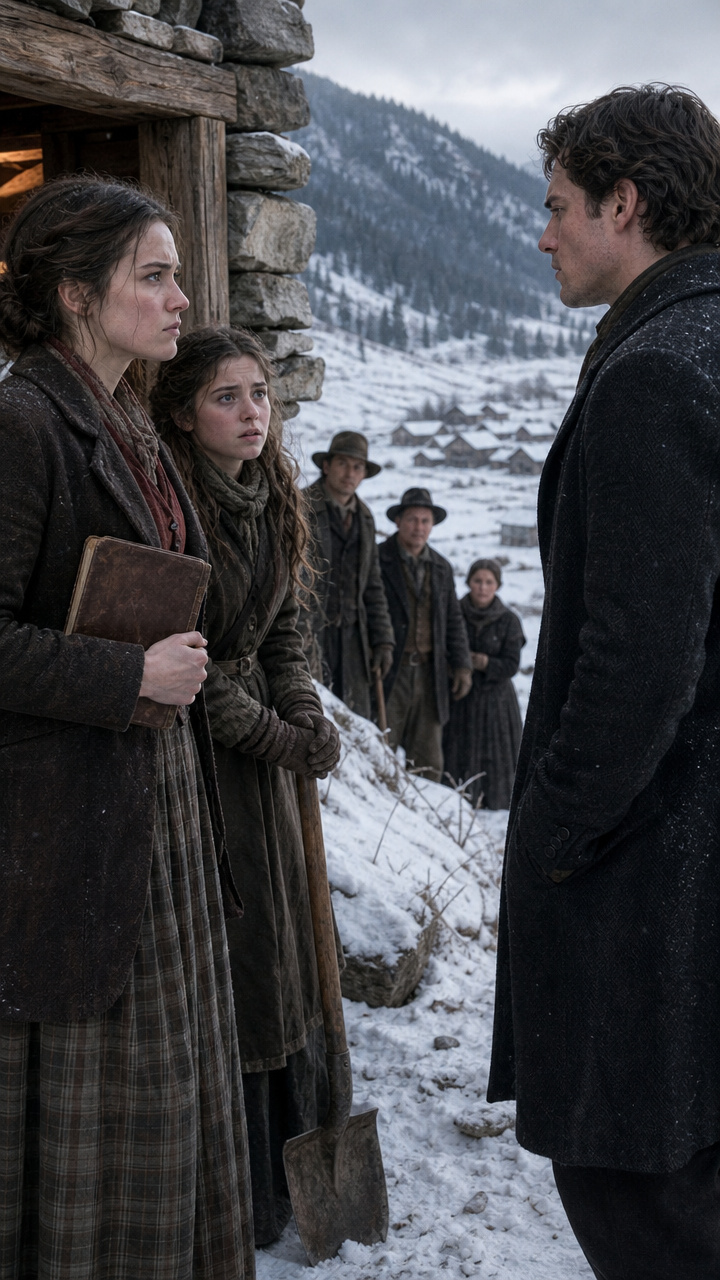
Briar Glen had survived.
But survival had come at a cost.
The Boone house had collapsed across the kitchen. The Mercer barn was gone. Mrs. Harper’s back wall had blown inward. A shepherd named Samuel Frost was found beside his woodpile, one hand still gripping a split log. Two children on the lower road lived only because their mother tied them together with apron strings and crawled beneath an overturned wagon until morning.
Three people died.
Not because they were foolish.
Not because they were weak.
They died because they had built as everyone built, and everyone had mistaken repetition for wisdom.
The funeral filled the church a week later.
People stood shoulder to shoulder in damp wool and bandages. Frostbitten hands rested in laps. Children leaned against their parents, who had not stopped touching them since the storm—as though warmth might vanish if they forgot to guard it.
Before Reverend James spoke, Daniel Boone stood.
A hush crossed the room.
He turned toward Eleanor and Clara.
“I owe these women words,” he said.
His voice shook, but he remained standing.
“I called Eleanor Hart proud. I called Clara foolish. I called their home a hole, a den, and a grave. I said those things in the street, in the store, and to their faces because I believed that what I knew was the same as truth.”
No one moved.
Daniel lowered his eyes once, then forced himself onward.
“On the second night of the storm, my roof came down. My mother was freezing in my arms. The only shelter left was the door I had mocked. Eleanor opened it before I apologized, before I deserved mercy. She opened it because she had built a real shelter, and real shelter does not ask whether pride is worth saving.”
His mother, seated in the front pew, began to cry silently.
Daniel faced the congregation.
“If Briar Glen has any sense remaining, we will stop laughing at what saved us and begin learning from it.”
For a long moment, the church was silent.
Then Amos Grant rose with the help of his cane.
“Learning is allowed,” he said. “Foolish building is not. A cave with a stove is not automatically a house. A hole is not a miracle. Measure. Drain. Vent. Build with humility, or build another coffin.”
This time, a few people laughed softly.
Not in mockery.
In relief.
By spring, seven families had asked Eleanor to inspect their land.
By summer, Thomas had become her best student.
By autumn, three new earth-sheltered homes were rising into the hills around Briar Glen. From the road they looked almost shy: timber fronts tucked beneath stone, small windows aimed toward the morning sun, chimneys following the mountain’s natural lines. Men who had once laughed now argued over drainage angles. Women who had once pitied the Hart sisters arrived with notebooks. Children carried stones in buckets and boasted that their homes would be warmer than everyone else’s.
One October evening, Thomas walked with Eleanor above South-Face Hollow.
The valley below glowed gold and brown in the last light. Smoke rose from the new homes. Clara’s laughter drifted from the cave entrance, where she and Ruth were arguing about whether dried apples improved bread. Finch slept in a patch of sunlight like an old king.
Thomas stopped beside Eleanor.
“I first came because my mother was cold,” he said.
“I remember.”
“I kept coming because of you.”
Eleanor looked over the valley. “That sounds dangerous.”
“It is.”
She turned to him.
His expression was open, frightened, and steady at once.
“I love you, Eleanor Hart,” he said. “Not because you proved everyone wrong. Not because you survived a storm. I love you because when the world tried to make you hard, you became useful instead. You built a door wide enough for even your enemies to enter.”
Eleanor could explain chimney draw, floor insulation, drainage, mortar, and thermal mass under pressure. Yet now she could find no sensible sentence.
Thomas smiled faintly.
“I didn’t know silence was possible from you.”
“Enjoy it,” she replied. “It won’t last.”
He took her hand.
“Will you marry me?”
Eleanor looked toward the cave that had begun in desperation and become a lesson the valley could no longer ignore.
“Yes,” she said. “But I will not live in a foolish house.”
Thomas laughed.
“I would never ask you to.”
They married the following spring in the meadow above the cave.
Clara wore green and cried before the vows began. Ruth stood beside Eleanor like a soldier guarding a bridge. Daniel Boone brought a cedar chest he had built himself, every joint clean and every edge smoothed by hand.
He did not call it an apology.
He did not need to.
Years passed.
The notebook grew thicker.
Eleanor added what her grandfather had never lived to write: how to redirect seepage before it reached the floor, how to size a fireplace for six people instead of two frightened sisters, how to brace a snow shed against crosswinds, how to test a vent with candle smoke, and how to teach proud people without wasting breath on their pride.