He looked directly at me.
“You must make no mistakes.”
He raised one finger.
“No arguments.”
A second.
“No emotional outbursts.”
A third.
“No early confrontation.”
Then he said, “You will not tell him what you know. He must never understand the extent of your evidence.”
“What does that give us?”
Arthur leaned back.
“Men like your husband are in love with their habit of underestimating other people.”
His voice grew even quieter.
“They write the trial in their minds before the court ever convenes.”
He put his glasses back on.
“Let him write it.”
He held my gaze.
“Let him dismiss you. Let him be rude. Let him believe you are frightened. Let his lawyer prepare a simplified version of the story.”
His hands came together.
“And if he lies under oath—which he probably will, because arrogance and dishonesty usually travel together—then we will teach him the real cost of false testimony.”
For the first time since I found the receipt, I felt something resembling relief.
It was not simply revenge.
It was the relief of having another person see the structure I had uncovered.
Arthur did not need me to translate the facts into emotional language before taking them seriously.
He did not see only my pain.
He saw leverage.
Over the following month, we planned every step.
The divorce petition was filed in the most ordinary manner possible. The goal was to avoid alarming Daniel.
Everything happened as Arthur predicted.
Daniel immediately became more confident.
He hired Victor Langley, an attorney who looked like a luxury showroom in human form. His cuff links probably cost more than professional ethics required.
Daniel sent me a settlement proposal so insulting it would have been funny without the official letterhead.
He offered a small payment and a limited share of the “remaining liquid assets” in exchange for my agreement never to question his personal spending.
The meaning was obvious.
He intended to keep everything he had hidden.
Arthur called me after reading the offer.
“Your husband believes you no longer have the strength to fight.”
“He’s wrong,” I said.
“I know.”
Then he added, “That is precisely why the end will hurt.”
When discovery began, the first major cracks appeared.
Victor filed lengthy objections. Daniel delayed his financial disclosures. Arthur did not force the process forward too aggressively.
He waited.
Every delay created another indication that Daniel was intentionally obstructing the truth.
Every incomplete document gave us another comparison point.
We hired a digital investigator to examine the login records connected to the false electronic authorization for the mortgage.
We hired a handwriting expert.
Her report was devastating because it was so restrained.
No outrage.
No theatrical language.
Only conclusions.
We formally requested Daniel’s employer’s records concerning his expense reimbursements. The stated reason was the accurate assessment of marital property.
The company’s legal department resisted at first.
Then the documents arrived faster than expected.
Someone inside the company had begun to understand that something was wrong.
Daniel, meanwhile, acted as though judgment had already been entered.
In his mind, he was dividing money no one had awarded him.
Sophie appeared beside him more frequently. She posted a photograph of the two of them in a rooftop bar.
“The next chapter requires brave decisions,” she wrote.
A mutual acquaintance sent me a screenshot.
I thanked her and filed it with the other evidence.
The more certain Daniel became of his future, the more careless he grew.
People who recognize danger become cautious.
They reduce spending. They make plans. They measure every action.
Those who believe they have already won relax.
That is when they make their greatest mistakes.
A week before the hearing, Daniel called me directly for the first time in months.
I nearly let it ring.
Then habit made me answer.
“Emily, this doesn’t have to drag on.”
I said nothing.
“You’ve never liked conflict. Accept the offer. You can buy a smaller place, keep doing your little job, and move on.”
He let the silence linger.
Then came the sentence he had clearly rehearsed.
“We both know you weren’t made for fighting.”
I was standing in the kitchen, looking at the basil plant beside the window.
“From now on,” I said, “anything you want to tell me can go through our lawyers.”
He laughed softly.
“Still so administrative.”
Then he sighed.
“That’s your problem. Life isn’t an Excel sheet.”
I tilted my head.
“No,” I said. “But divorces are settled inside them.”
I ended the call.
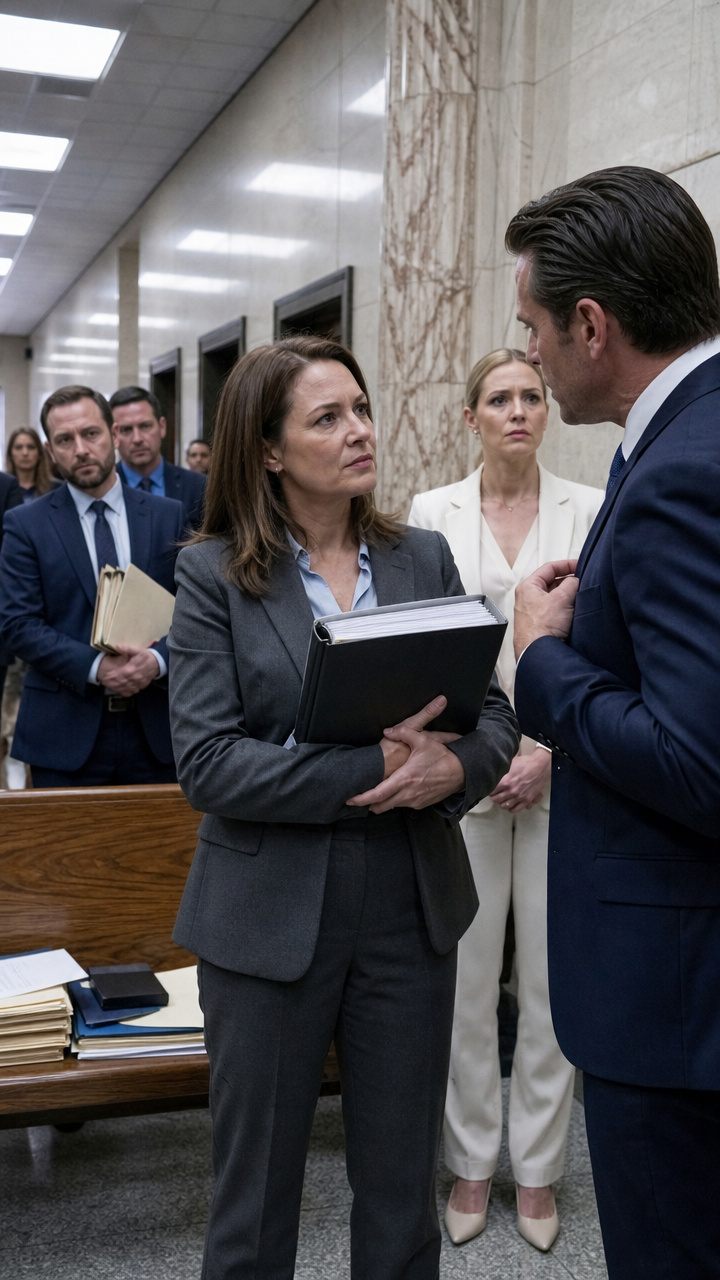
On the morning of the hearing, I chose a graphite-gray suit.
Not black. I did not want to look as though I were in mourning.
It was not dramatic or fashionable.
It was simply well made.
I wore no jewelry except my watch and tied my hair at the back of my neck.
I looked exactly as I needed to look.
Daniel wore a midnight-blue designer suit with a dark wine-colored tie.
Sophie walked several paces behind him, like a seasonal fashion trend that had mistaken itself for destiny.